

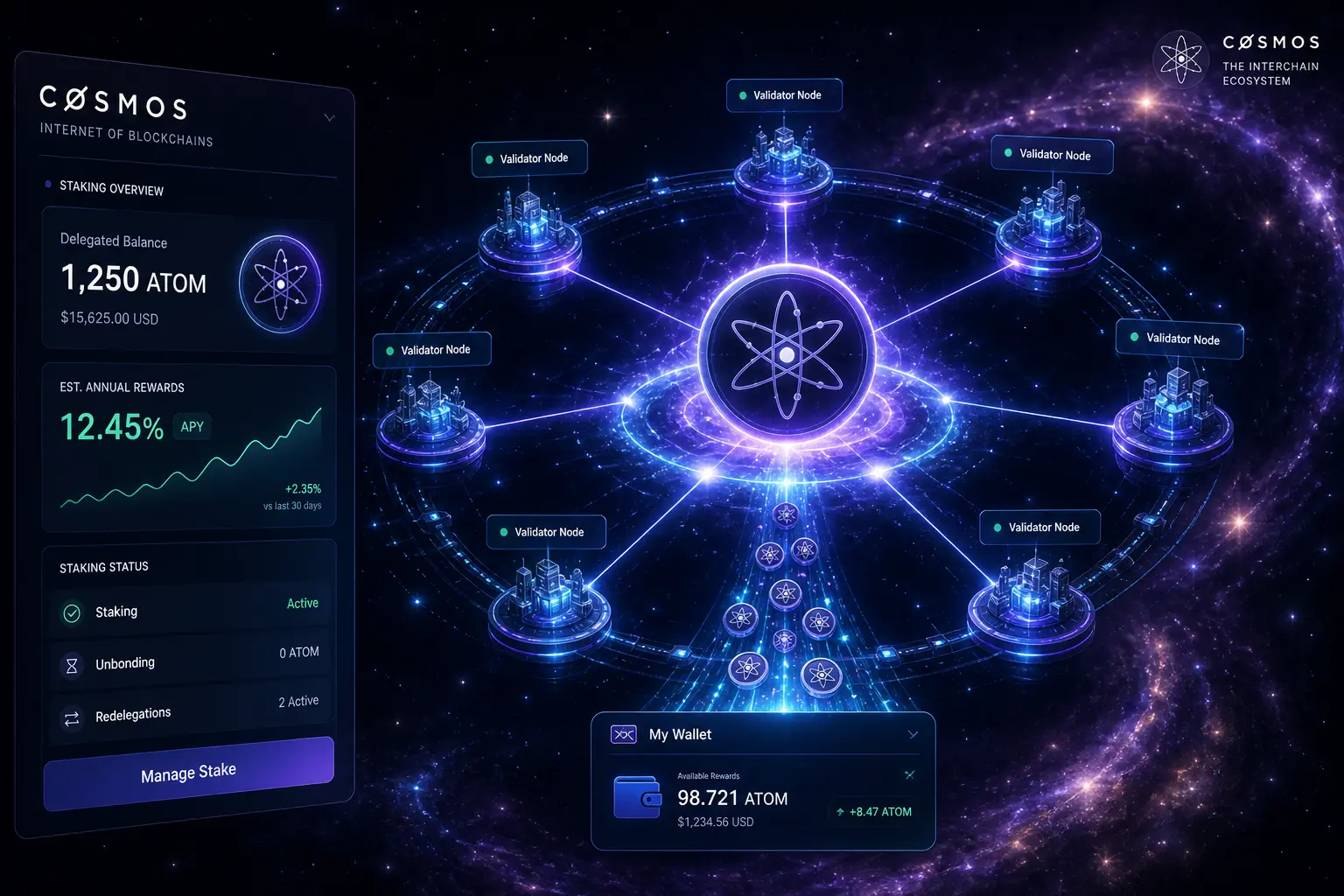
Staking in the Cosmos Ecosystem is one of the simplest ways to earn passive income in crypto.
Instead of trading or farming complex DeFi strategies, you can delegate your tokens and earn rewards over time.
But to do it properly, you need to understand:
- How staking actually works
- How you earn rewards
- Where risks come from
- How to optimize your strategy
This guide outlines a clear path from beginner basics to intermediate skills.
What Is Cosmos Staking? (Quick Answer)
Cosmos staking means locking up ATOM and assigning it to validators who help run and secure the network in exchange for rewards. Instead of mining, users lock tokens and receive a share of transaction fees and inflation-based rewards.
How Cosmos Staking Works (Simple Steps)
- Create a wallet (like Keplr Wallet)
- Transfer ATOM tokens
- Choose a validator
- Delegate your tokens
- Earn staking rewards
What Is Cosmos Staking?
Cosmos uses a Proof-of-Stake (PoS) model.
Instead of miners:
- Validators secure the network
- Users delegate tokens to validators
- Participants split the rewards.
In simple terms:
You “lock” your tokens to support the network and earn rewards in return.
| Component | Role | Why It Matters |
|---|---|---|
| ATOM | Staking token | Used to earn rewards and secure the network |
| Validators | Network operators | Generate rewards and maintain blockchain security |
| Delegators | Token holders | Earn passive income by staking tokens |
| Wallet | Access tool | Used to manage staking and rewards |
Core components
1. Cosmos (ATOM)
The main token used for both staking and voting on network decisions.
2. Validators
Nodes that:
- Validate transactions
- Produce blocks
- Earn rewards
3. Delegators
You (the user):
- Delegate ATOM to validators
- Earn a share of rewards.
Basic flow
- Choose a wallet
- Select a validator
- Delegate tokens
- Earn rewards
Staking Rewards Explained
Staking rewards come from:
- Network inflation
- Transaction fees
What affects your rewards:
- Validator uptime
- Commission rates
- Total network staking ratio
APR vs Real Returns
High APR can be misleading.
Real return depends on:
- Token price movement
- Inflation rate
- Validator performance
Auto-Compounding
Rewards can be:
- Claimed manually
- Reinvested automatically
To maximize long-term yield through reinvestment strategies, see how auto-compounding can turn staking rewards into a continuous passive income stream in How to Earn Passive Income with Cosmos Staking and Auto-Compounding.
Choosing Validators (Critical Step)
Not all validators are equal.
Key metrics:
- Uptime (reliability)
- Commission (fees)
- Reputation
- Slashing history
| Type | Risk Level | Reward Potential | Best For |
|---|---|---|---|
| Safe Validators | Low | Moderate | Long-term stability |
| Balanced Validators | Medium | Good | Most users |
| High-Yield Validators | High | High | Advanced users |
Safe vs High-Yield Validators
Some validators:
- Offer stable returns
- Others offer higher but riskier rewards.
Best Cosmos Coins for Staking
ATOM is the main asset, but the Cosmos ecosystem includes many other tokens.
While ATOM is the core staking asset in the ecosystem, many users diversify across multiple tokens to improve yield opportunities. Explore the full breakdown of the best Cosmos coins for staking, safety, rewards, and ecosystem strength.
Categories:
- Stable core assets
- Higher-yield ecosystem tokens
Wallets for Cosmos Staking
You need a wallet to:
- Store tokens
- Delegate to validators
- Manage rewards
Top options:
- Keplr Wallet
- Leap Wallet
- Cosmostation Interchain Wallet
| Wallet Type | Security Level | Ease of Use | Best Use Case |
|---|---|---|---|
| Software Wallet (Keplr, Leap) | High | Easy | Daily staking and DeFi access |
| Hardware Wallet (Ledger) | Very High | Moderate | Long-term storage |
| Mobile Wallet | High | Very Easy | Beginner-friendly staking |
Risks of Cosmos Staking
Staking is relatively safe—but not risk-free.
1. Slashing Risk
Validators can be penalized for:
- Downtime
- Misbehavior
2. Inflation Risk
High rewards may lose value due to inflation.
3. Price Volatility
Token value may fall despite earning rewards.
4. Opportunity Cost
Locked tokens remain unavailable for other uses.
5. DeFi Risks (Context)
If you move into liquidity pools, risks include impermanent loss in crypto.
Full risk breakdown:
Crypto Passive Income Risks (Full Breakdown)
How to Maximize Staking Returns
1. Diversify Validators
- Avoid single-validator exposure
2. Balance Risk vs Yield
- Combine safe + higher-yield validators
3. Use Auto-Compounding
- Increase long-term returns
4. Monitor Performance
- Reallocate if needed
5. Think Long-Term
- Compounding beats short-term APR chasing
| Strategy | Risk Level | Return Potential | Description |
|---|---|---|---|
| Single Validator | Medium | Moderate | Simple but less diversified |
| Multi-Validator | Low | Stable | Diversifies risk |
| Auto-Compounding | Low | High (long-term) | Reinvest rewards for growth |
Beginner Setup Checklist
- Choose a wallet
- Fund with ATOM
- Select a validator
- Delegate tokens
- Track rewards
- Reinvest periodically
Frequently Asked Questions (FAQs)
Is Cosmos staking safe?
Relatively safe compared to DeFi, but not risk-free.
How much can you earn staking ATOM?
Returns vary based on network conditions and validator performance.
Can I unstake anytime?
Yes, but there is an unbonding period.
What is the best wallet for Cosmos staking?
Keplr is the most widely used option.
Should beginners start with ATOM?
Yes, this is the most stable and simplest starting point.