

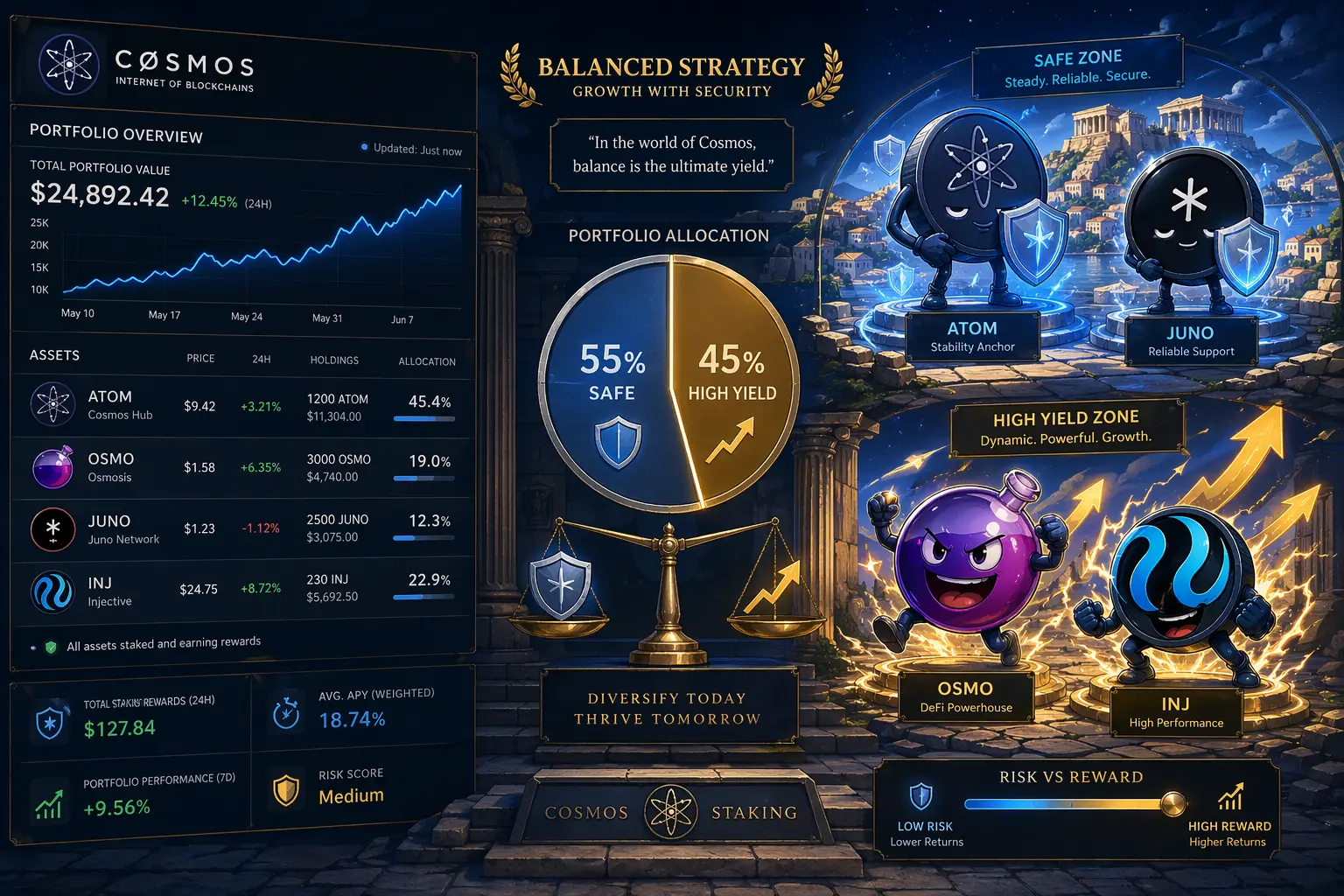
Not all staking opportunities in Cosmos are equal.
Some tokens offer stable, predictable rewards. Others promise higher yields—but with greater volatility.
Understanding the difference is critical.
This guide ranks Cosmos staking coins into safe vs high-yield categories, helping you build a strategy based on risk-adjusted returns—not just APR.
Use this dashboard to compare Cosmos staking opportunities by Risk, yield, and validator quality. For detailed strategies, follow the linked guides.
| Coin | Category | Estimated APR | Risk Level | Validator Quality | Best For | Guide |
|---|---|---|---|---|---|---|
| ATOM | Safe | Moderate | Low | High | Long-term stability | Staking Guide |
| OSMO | Balanced | Moderate–High | Medium | Strong | Yield + utility | Staking Guide |
| JUNO | High Yield | High | Medium–High | Variable | Aggressive allocation | Staking Guide |
| INJ | High Growth | Moderate–High | Medium | Strong | Growth + staking | Staking Guide |
Important: APR ranges and risk levels are estimates and may change based on network conditions and market dynamics.
What Defines a “Good” Staking Coin?
Inside the Cosmos Ecosystem, a strong staking asset is not just about yield.
Key factors include:
- Network security
- Validator quality
- Token inflation model
- Real ecosystem usage
Before optimizing yields with auto-compounding, it helps to understand the foundation in the Cosmos staking guide for beginners, which breaks down staking from setup to rewards.
Safe vs High-Yield Cosmos Coins (Quick Comparison)
| Category | Safe Coins | High-Yield Coins |
|---|---|---|
| Yield Stability | High | Variable |
| Inflation Risk | Moderate | High |
| Adoption | Established | Growing / early |
| Price Volatility | Lower | Higher |
| Best For | Long-term holding | Yield optimization |
Validator quality also affects your returns. Refer to this ranking of the best Cosmos validators (safe vs. high-yield) to evaluate reliability and reward trade-offs.
Safe Cosmos Coins (Stability First)
These are core staking assets with stronger fundamentals and wider adoption.
1. Cosmos (ATOM)
- Backbone of the ecosystem
- Strong validator set
- Balanced reward structure
→ Best for: long-term staking stability
2. Osmosis (OSMO)
- Leading DEX in Cosmos
- Active ecosystem usage
- Moderate yield + utility
→ Best for: balanced yield and utility exposure
3. Secret (SCRT)
- Focus on privacy
- Consistent validator network
- Established use case
→ Best for: niche but stable staking
High-Yield Cosmos Coins (Higher Risk, Higher Potential)
These tokens typically offer:
- Higher APR
- Faster growth narratives
- Greater volatility
1. Juno (JUNO)
- Smart contract platform
- Historically high staking rewards
- Governance-driven ecosystem
→ Risk: volatility + evolving ecosystem
2. Injective (INJ)
- Advanced DeFi infrastructure
- Strong growth potential
- Competitive yields
→ Risk: market-driven volatility
3. Emerging Cosmos Tokens
- New chains or smaller networks
- Incentive-heavy rewards
→ Risk:
- High inflation
- Unproven security
The Balanced Staking Strategy (Recommended)
Portfolio structure
- 60–70% → Safe coins (ATOM, OSMO)
- 30–40% → Higher-yield coins (JUNO, INJ, emerging)
Why it works
- Protects downside risk
- Captures upside opportunities
- Improves long-term compounding
The Role of Auto-Compounding
Using tools like Restake.app:
- Rewards are auto-compounded.
- Growth becomes exponential
- Efficiency improves significantly
For a full breakdown, see the Cosmos staking and auto-compounding section.
Validator Choice Still Matters
Even the best coin can underperform if paired with a poor validator.
To minimize Risk, follow a structured approach:
→ See how to choose safe validators in Cosmos staking.
→ Learn more about What Is APR vs APY in Crypto Staking?
Hidden Risks Most Investors Ignore
Inflation-driven yield
A high APR may not equal a real return.Token price volatility
Falling prices can cancel out your yield.Overconcentration
Holding only one token increases Risk.Structural DeFi risks
Unlike staking, liquidity pools involve risks like impermanent loss in crypto.
How to Choose the Right Crypto Coin for Your Strategy
Choose safe coins if:
- You want stability
- You’re building long-term positions
- You prefer predictable rewards.
Choose high-yield coins if:
- You accept volatility
- You want higher potential returns
- You diversify properly
Frequently Asked Questions (FAQs)
What is the safest Cosmos coin to stake?
ATOM is generally considered the most stable due to its role in the ecosystem.
Which Cosmos coin has the highest staking rewards?
Smaller or newer tokens often offer higher APR, but with higher Risk.
Can you stake multiple Cosmos coins?
Yes—and diversification is recommended.
Is a higher APR always better?
No. It often comes with inflation and volatility.
Should beginners stick to ATOM?
Yes, it’s the most straightforward and stable entry point.