

Privacy remains one of the most misunderstood aspects of cryptocurrency.
Most blockchains are open and visible, but some projects focus on keeping financial data private. Two of the most prominent are:
Both aim to solve the same problem—transaction privacy—but they approach it in very different ways.
This guide delivers a structured comparison—explaining how each functions, where they diverge, and which aligns best with your intended use.
If your goal is earning passive income instead of privacy, you can follow this how-to stake ATOM using Keplr Wallet (step-by-step beginner guide) to start generating rewards.
Monero vs Zcash (Quick Answer)
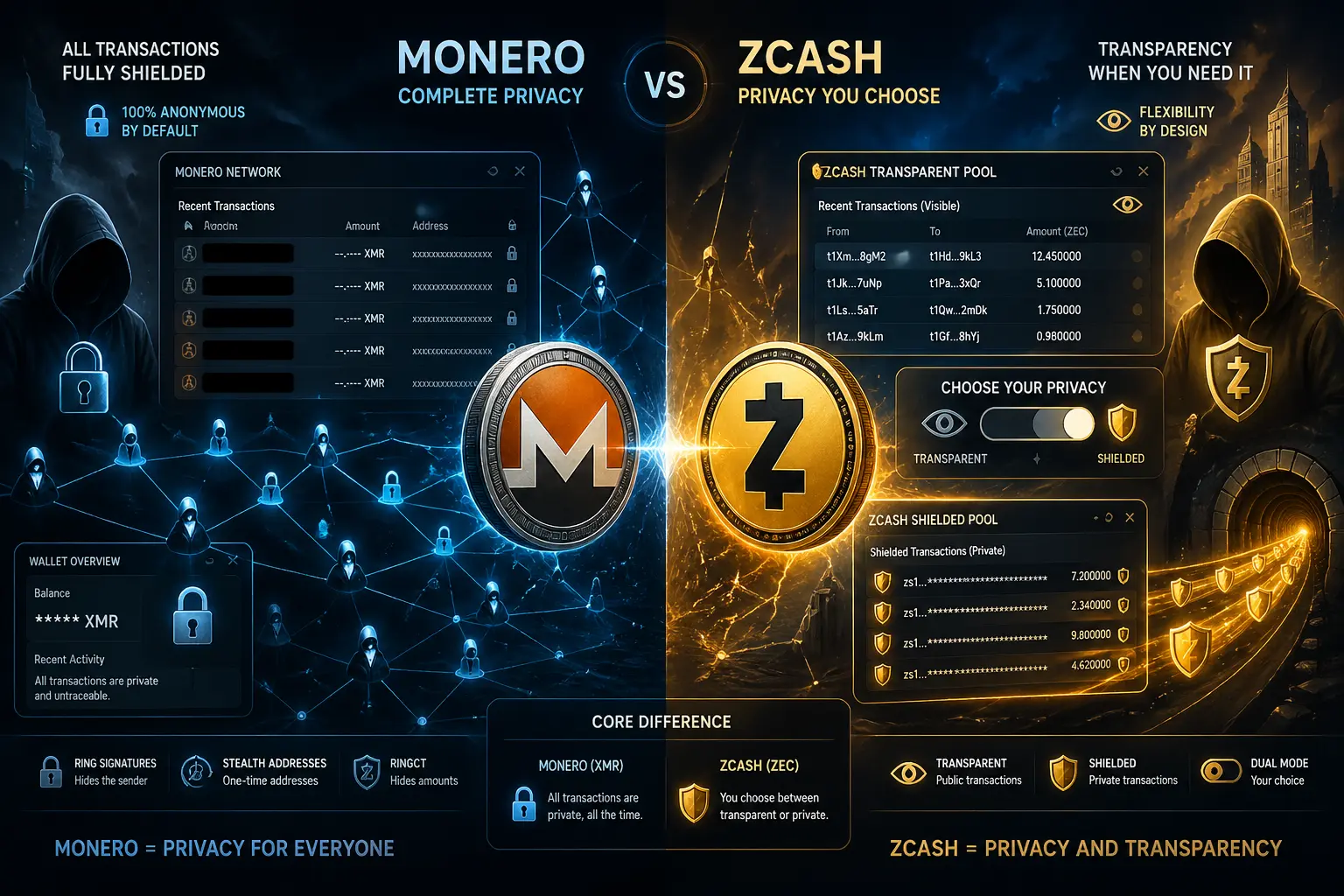
Monero provides default, always-on privacy, making all transactions anonymous. Zcash provides optional privacy, allowing users to choose between transparent and private transactions. Monero focuses on full privacy, while Zcash focuses on flexibility and wider use.
Curious how Zcash compares in the crypto world and whether it could grow into something like Bitcoin? Read on:
Is Zcash (ZEC) the Next Bitcoin?
What Is Monero?
Monero (XMR) keeps every transaction private by default.
Key features:
- Hidden sender and receiver
- Hidden transaction amounts
- No transparent option
- Strong anonymity guarantees
In simple terms:
All activity is private—no exceptions.
What Is Zcash?
Zcash (ZEC) allows users to choose between privacy and transparency.
Key features:
- Optional private transactions
- Transparent transactions available
- Uses zero-knowledge proofs
- More flexible compliance
Core Difference: Privacy Model
Monero
- Privacy is mandatory
- No public transaction data
- Strong anonymity
Zcash
- Privacy is optional
- Public + private modes
- Hybrid system
| Feature | Monero (XMR) | Zcash (ZEC) |
|---|---|---|
| Privacy | Default (always private) | Optional |
| Transaction Visibility | Fully hidden | Public or hidden |
| Technology | Ring signatures | zk-SNARKs |
| Ease of Use | Simple (automatic privacy) | More complex (manual choice) |
| Regulatory Pressure | Very High | High |
Technology Comparison
Monero Technology
- Ring signatures
- Stealth addresses
- Confidential transactions
Designed for maximum anonymity
Zcash Technology
- Zero-Knowledge Proofs
- Shielded addresses
- Selective transparency
Designed for privacy + flexibility
| Category | Monero | Zcash |
|---|---|---|
| Ease of Use | High (automatic privacy) | Moderate (manual setup) |
| Exchange Support | Limited in some regions | Better support |
| Adoption | Strong niche community | More experimental usage |
Risks of Privacy Coins
Both projects face similar challenges:
Regulatory Pressure
Governments monitor privacy coins closely.Exchange Delistings
Some platforms remove them for compliance reasons.Limited Mainstream Adoption
Privacy coins remain a niche segment.
Which One Is Better?
Choose Monero if:
- You want maximum privacy
- You prefer automatic protection
- You value anonymity above flexibility
Monero and Zcash are two of the most well-known privacy-focused cryptocurrencies in the market.
To understand Monero in more detail:
What Is Monero (XMR)? The Most Untraceable Cryptocurrency in the World
Choose Zcash if:
- You want optional privacy
- You need exchange compatibility
- You prefer flexibility
To understand Zcash’s full strengths and risks, read:
Is Zcash (ZEC) the Most Underrated Crypto? A Complete Guide to Private Cryptocurrency
Frequently Asked Questions (FAQs)
Is Monero more private than Zcash?
Yes, Monero is private by default, while Zcash requires enabling privacy.
Is Zcash still a privacy coin?
Yes, but privacy is optional.
Which is safer?
Both are secure, but Monero offers stronger default privacy.
Can these coins be tracked?
Monero is extremely difficult to trace. Zcash privacy depends on feature usage.
Can I switch between privacy and transparency in Zcash?
Yes. Zcash (ZEC) allows users to choose between transparent and shielded transactions, giving flexibility depending on the situation or requirement.
Why do some exchanges delist privacy coins like Monero and Zcash?
Exchanges may remove privacy coins due to regulatory pressure. Because transactions are harder to trace, regulators often require stricter compliance, which can lead platforms to limit or delist these assets.