

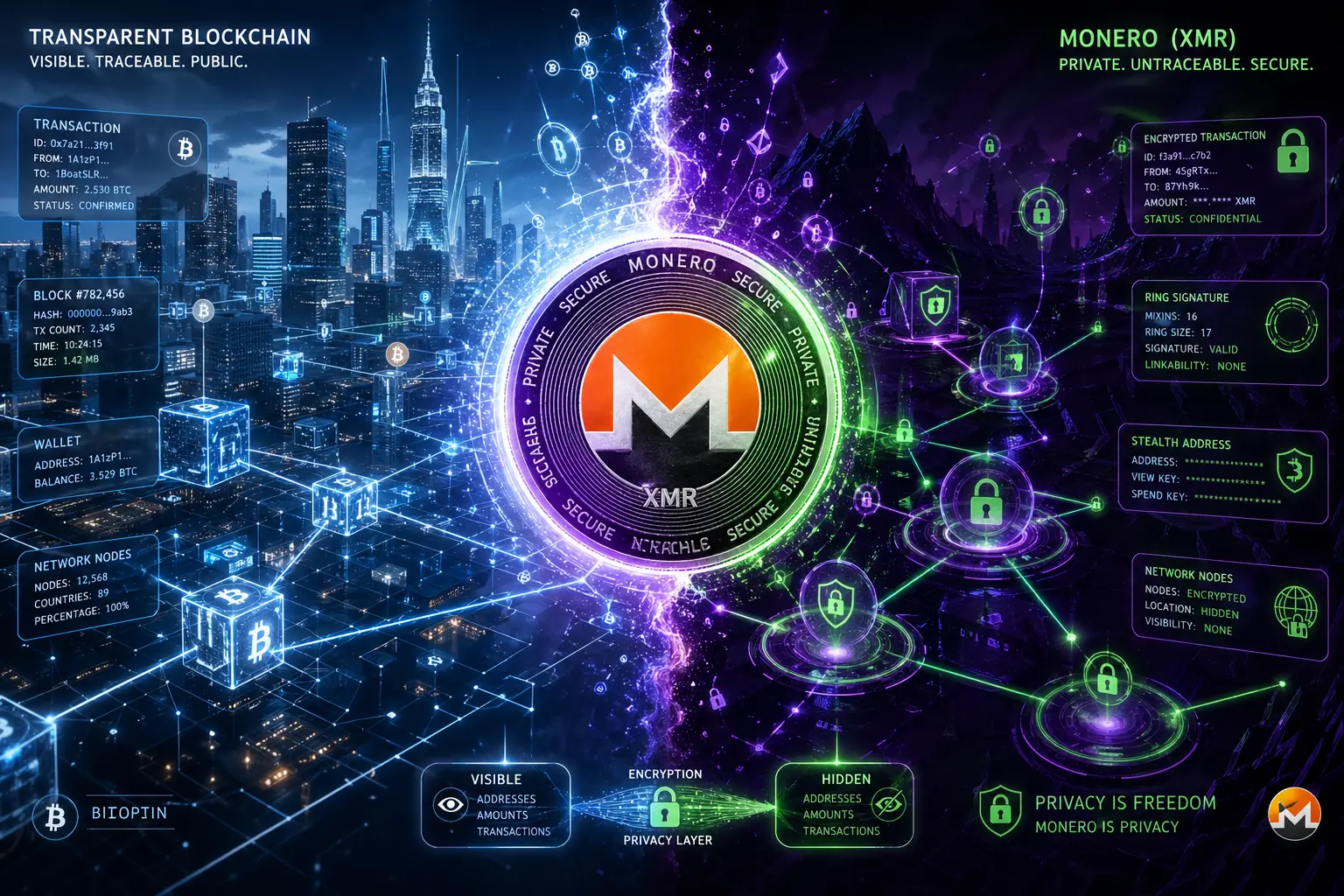
Monero (XMR) is a privacy-focused, decentralized cryptocurrency that allows users to send and receive funds without exposing sensitive transaction data.
Unlike transparent blockchains, Monero works in a way that keeps your data hidden, so that:
- No one can see who sent the funds
- No one can see who received them
- No one can see the amount sent.
It makes Monero one of the most privacy-focused digital currencies in the crypto space.
Monero offers strong privacy, but proper security is just as important.
Learn how to protect your XMR here:
How to Store Monero (XMR) Safely: Best Wallets and Security Guide
How Monero Works (Simple Explanation)
Monero uses advanced cryptographic tools to protect privacy:
Ring Signatures
Your transaction is mixed with others, making it impossible to identify the real sender.Stealth Addresses
A unique, one-time address is created for each transaction, hiding the receiver’s identity.Ring Confidential Transactions (RingCT)
The amount sent is not visible to the public.
Together, these technologies make Monero transactions extremely difficult to trace.
Why Monero Is Called “Untraceable”
Monero is often called untraceable because:
- No one can link transactions to a person.
- Blockchain analysis tools are ineffective against it
- Each transaction is structured to minimize visible linking patterns.
Why Monero Is Different From Bitcoin
| Feature | Bitcoin | Monero (XMR) |
|---|---|---|
| Transparency | Fully public | Private by default |
| Sender visibility | Visible | Hidden |
| Receiver visibility | Visible | Hidden |
| Amount visibility | Visible | Hidden |
| Privacy level | Low | Very high |
Why People Use Monero
People who care about financial privacy often use Monero, such as:
- Individuals protecting personal financial data
- Users in high-surveillance environments
- People are avoiding blockchain tracking
- Privacy-focused crypto users
It lets you use digital cash with privacy already protected.
Is Monero Truly Untraceable?
Monero is very difficult to trace with current blockchain analysis.
However:
- No system is 100% perfect
- “Untraceable” refers to practical real-world difficulty, not theoretical impossibility.
Monero remains widely recognized as the most robust privacy-focused cryptocurrency today.
Is Monero Legal?
Monero is legal in many countries, but regulations differ by region.
Some exchanges restrict it due to its privacy features, while others still support trading and usage.
Always check local regulations before using privacy coins.
Pros and Cons of Monero
Pros
- Strong privacy by default
- Untraceable transactions (practically)
- Decentralized network
- Fungible currency (all coins are equal)
Cons
- Limited exchange availability in some regions
- Regulatory scrutiny in certain countries
- Less mainstream adoption than Bitcoin
Monero vs Other Privacy Coins
Monero is often compared with coins like Zcash.
- Learn how Monero compares with Zcash in Monero vs Zcash: Which Coin Truly Protects Your Privacy?
- If you want to explore Zcash in more depth, is Zcash (ZEC) the Most Underrated Crypto? A Complete Guide to Private Cryptocurrency
The difference:
- Monero: Privacy is always enabled
- Zcash: Privacy is optional
It makes Monero more consistently private in real-world usage.
Frequently Asked Questions (FAQs)
Why is Monero untraceable?
Because it hides the sender, receiver, and transaction amount using advanced cryptography.
Can Monero transactions be tracked?
They are extremely difficult to trace compared to most cryptocurrencies.
Is Monero safer than Bitcoin?
Monero is safer for privacy, while Bitcoin is safer for transparency and tracking.
Why is Monero controversial?
Because its strong privacy features make transactions difficult to monitor.