
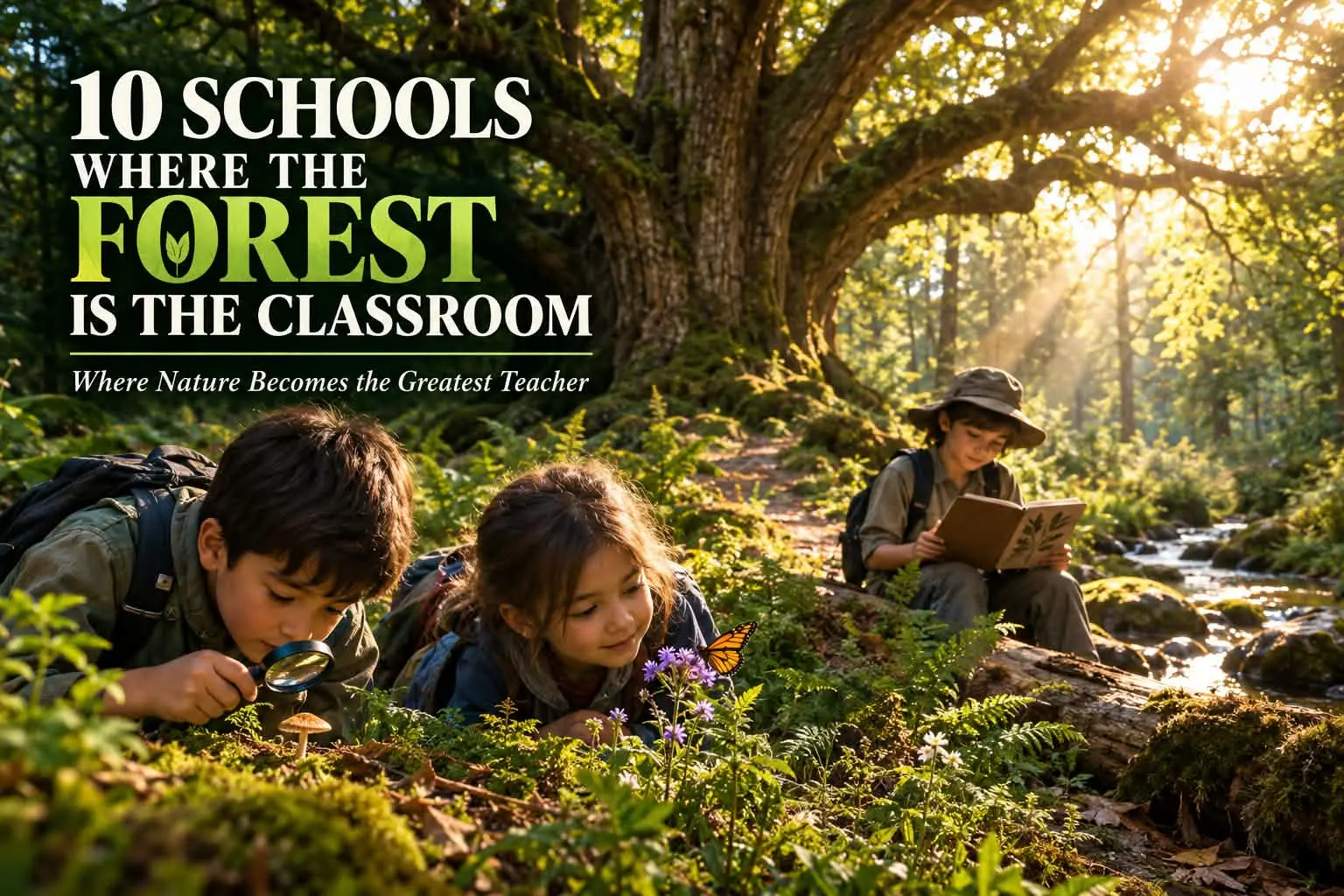
Picture a learning environment that challenges the conventional image of a classroom, replacing rows of desks, a front-facing whiteboard, and enclosed walls with a different kind of setting. Instead, the day begins beneath a canopy of trees. Children explore woodland paths, examine insects, collect leaves, build shelters, and discover how the natural world changes with the seasons.
For some schools, this is not an occasional field trip. It helps shape how children learn and develop.
Forest-based education takes lessons beyond conventional classrooms and places students in environments where they can observe, experiment, move, and explore. A walk through the woods can introduce biology. Building a shelter can encourage teamwork and practical thinking. Watching plants grow can help children understand ecosystems and the passage of time.
These approaches are not identical. Some schools organize regular forest-learning sessions alongside conventional lessons, while others use outdoor environments as the foundation of their educational model. Many also retain indoor facilities for particular activities, extreme weather, and other practical needs.
The following 10 schools and educational settings demonstrate different ways nature can become part of children’s everyday learning.
1. Bukkenspranget Nature Kindergarten — Tromsø, Norway
In northern Norway, Bukkenspranget Nature Kindergarten demonstrates how outdoor learning can become a regular part of early childhood education.
Education Scotland has documented the kindergarten’s approach through a series of learning resources featuring its owner and manager, Turid Boholm. The materials explore how children learn through outdoor experiences and how teachers use the surrounding environment to support their development.
One particularly interesting example involves introducing biological systems through firsthand experiences outdoors. Rather than relying entirely on pictures or explanations, children can encounter natural processes in their surroundings and begin developing questions about what they observe.
The approach also considers practical aspects of childhood, including independence, healthy routines, appropriate risk-taking, and the importance of helping families understand outdoor education.
In a place like Tromsø, where weather conditions can vary considerably, outdoor learning also depends on proper preparation and appropriate clothing.
What makes it different: Children experience nature as a regular learning environment, allowing everyday outdoor encounters to support curiosity, observation, and early scientific understanding.
Source: Education Scotland — Get the Bairns Oot! An Outdoor Kindergarten in Norway
2. Krudthus Forest Kindergarten — Denmark
Denmark has a long-standing tradition of nature-based early childhood education, and Krudthus Forest Kindergarten illustrates how children can spend much of their time learning outdoors.
Featured in a UNESCO Courier article, the kindergarten is located approximately 30 kilometers north of Copenhagen. Children explore the woodland environment, discover insects beneath fallen branches, observe seasonal changes, and investigate how natural materials break down.
These experiences introduce scientific ideas through direct observation.
For example, watching earthworms interact with decomposing leaves can help children begin to understand how organic matter returns to the environment. Observing trees throughout the year can introduce seasonal cycles and changes in living organisms.
The learning environment also encourages movement and exploration. Rather than spending long periods in one spot, children can discover the forest through exploration, play, and direct contact with nature.
This approach is rooted in a broader Scandinavian tradition of outdoor education, where nature is woven into childhood learning and development rather than reserved for occasional visits.
What makes it different: The forest becomes a setting for everyday discovery, helping children develop an understanding of nature through repeated observation and exploration.
Source: UNESCO Courier — Learning Among the Trees in Denmark
3. Washington Waldorf School — Maryland, United States
At Washington Waldorf School, outdoor education begins during the early years through its Forest Kindergarten program.
According to the school’s official description, children aged four to six begin their mornings with a walk into nearby woodland alongside their teachers. They then spend several hours playing and learning outdoors.
The program is not limited to lessons about plants and animals. The surroundings also influence how children play, communicate, and explore their interests.
A fallen branch might become part of an imaginative game. A collection of leaves could inspire questions about different trees. Moving across uneven ground and around natural obstacles helps children practise coordination and become more aware of their environment.
The school also emphasizes outdoor experiences throughout different weather conditions. Children can continue learning outdoors in different weather conditions, including rain, cold temperatures, and snow.
This creates a different relationship with nature. Rather than experiencing the outdoors only when conditions are comfortable, children gradually become familiar with seasonal changes and learn how to prepare for them.
What makes it different: Its Forest Kindergarten gives young children several hours of daily outdoor experience, combining imaginative play, exploration, and nature-based learning.
Source: Washington Waldorf School — Forest Kindergarten
4. The High School of Glasgow — Scotland, United Kingdom
Forest-based learning is not limited to independent outdoor kindergartens. The High School of Glasgow incorporates woodland experiences into its kindergarten curriculum.
The school’s Kindergarten @ The Forest program gives young children access to a natural outdoor environment where they can explore, play, and experience different aspects of the early years curriculum.
Children use natural materials, investigate their surroundings, and encounter the changing seasons firsthand. The school also emphasizes opportunities for independent play, social interaction, and creative activities.
Outdoor learning supports the curriculum rather than serving only as recreation.
The school’s approach allows children to explore familiar educational themes in a different setting. Rather than learning about nature only through books or other classroom resources, children can examine plants firsthand and observe how the environment changes with the seasons.
The kindergarten also maintains an indoor space for particularly difficult weather conditions and practical needs.
What makes it different: It integrates Forest Kindergarten principles into an established school environment, showing how outdoor education can complement a broader curriculum.
Source: The High School of Glasgow — Outdoor Education and Kindergarten @ The Forest
5. Ravenshall School — Dewsbury, England
Outdoor learning can also create meaningful opportunities for students with additional educational needs.
Ravenshall School is a special day school serving children and young people with complex learning difficulties and other special educational needs. Its forest school and vegetable garden provide practical environments for students to engage with nature.
One documented project involved planting a 142-meter edible hedgerow and fruit trees around the school’s forest school area.
As students care for the plants, they can follow their development across the seasons, understand how food is produced, and connect their efforts with the eventual harvest.
These activities can support several areas of learning at once. These practical experiences connect students with natural processes, from plant development and seasonal cycles to food production and environmental stewardship.
Gardening and woodland exploration offer additional ways to engage with education, especially for learners who benefit from sensory, hands-on experiences.
The project shows that outdoor learning does not require trips to distant or remote forests. A carefully developed school garden or wooded area can provide valuable learning opportunities close to the classroom.
What makes it different: Its forest school and edible hedgerow connect outdoor learning with practical, sensory experiences for students with complex learning needs.
Source: The Northern Forest — Ravenshall School: Edible Hedgerows for Outdoor Learning
6. Cairnshill Integrated Primary School — Belfast, Northern Ireland
Cairnshill Integrated Primary School uses its grounds and surrounding natural areas to extend learning beyond the traditional classroom.
The school describes itself as an official Forest School and incorporates outdoor experiences into everyday teaching.
The programme offers age-appropriate experiences, ranging from imaginative play and nature crafts for younger children to practical outdoor tasks for older pupils, including shelter construction, fire-lighting, and collaborative challenges.
Through these activities, children can build confidence, become more resilient, and learn to cooperate with others.
Forest school activities also connect outdoor learning with classroom lessons. Instead of treating nature as something separate from academic learning, teachers can use the environment to help children explore ideas in practical ways.
For example, constructing a shelter involves considering materials, structure, and stability. Exploring a wooded area encourages observation and questions about the environment. Team challenges require communication and cooperation.
The school’s approach shows how outdoor learning can become part of a mainstream primary school’s educational experience.
What makes it different: It combines ordinary primary education with age-appropriate forest activities, including nature crafts, shelter building, and outdoor team challenges.
Source: Cairnshill Integrated Primary School — Forest Schools
7. Hazeldene Family Centre — East Renfrewshire, Scotland
Hazeldene Family Centre regularly takes children into a nearby woodland for a full day of Forest Kindergarten activities.
Each child has a designated woodland day, making outdoor exploration a regular part of their learning experience rather than an occasional activity.
The centre’s woodland environment includes a base camp where children can have meals and refreshments. Beyond this area, they explore the surrounding woods and participate in activities that encourage imagination, cooperation, and independence.
Children also contribute ideas about improving their outdoor environment. The centre describes projects involving tyre swings, stick dens, ladders, and quiet spaces created through collaboration between children and adults.
One notable aspect of the approach is how it helps children become familiar with their surroundings. Children create their own names for woodland locations, turning familiar areas into imaginative places such as Bunny Land, Dragon’s Leg, and Mount Everest.
These personal landmarks help turn an unfamiliar natural environment into a place they recognize and feel connected to.
What makes it different: Its full-day woodland sessions give children time to develop relationships with a natural environment, contribute to its development, and explore at their own pace.
Source: Hazeldene Family Centre — Forest Kindergarten
8. Portland Forest School — Oregon, United States
Portland Forest School incorporates nature-based learning into its educational programme for students from kindergarten through eighth grade.
The school describes its approach as nature-first and centered on outdoor experiences. Students regularly take their learning outdoors, exploring and interacting with the natural environment as part of their everyday education.
Its model connects academic learning with practical outdoor skills and relationships with the natural environment.
This broader age range is particularly interesting. Forest-based education is often associated with preschool and early childhood development, but Portland Forest School demonstrates how nature-centered learning can extend into later elementary and middle school years.
Older students can continue developing their understanding of the environment while participating in activities that encourage independence, responsibility, and practical problem-solving.
The school’s approach also emphasizes relationships between students, teachers, families, and the natural world.
What makes it different: It extends a nature-first educational approach from kindergarten through eighth grade, demonstrating that outdoor learning can continue beyond early childhood.
Source: Portland Forest School
9. The Wild School — Houston, Texas, United States
The Wild School takes a particularly comprehensive approach to nature-based education. It describes itself as a fully outdoor school offering programs from infancy through adolescence.
Rather than using nature primarily for occasional lessons, the school organizes its educational activities around outdoor environments, including woods, prairies, parks, and other natural spaces.
Its approach emphasizes direct experience. Students explore, build, observe, use practical tools, and interact with their surroundings.
This creates opportunities to learn through activities that require movement, curiosity, and active participation.
For example, children might investigate how natural materials behave, observe changes in their environment, or work together on practical tasks. These activities bridge the gap between scientific theory and practical observation, helping students understand how natural processes work.
The school’s model also challenges the assumption that outdoor education is only suitable for very young children. By offering programs across multiple age groups, it presents nature-based learning as an approach that can continue through different stages of development.
What makes it different: Its fully outdoor, year-round model places natural environments at the center of education from infancy through adolescence.
Source: The Wild School
10. Samar’s Nature and Climate School — Eastern Samar, Philippines
One of the most interesting recent examples of nature-based education comes from the Philippines.
Opened in March 2026 under the Ulot Watershed Model Forest Project, the school makes the forest an important learning environment where children can explore and understand the natural world firsthand.
The program was officially launched in Barangay Tenani, Paranas, with support from the Department of Environment and Natural Resources in Eastern Visayas, the local government, and other partner institutions.
According to the Philippine Information Agency, children participating in the program explore the Ulot Watershed through forest trails, observe trees and wildlife, and experience the natural environment that supports their communities.
This approach connects environmental education with the places children actually depend on.
A watershed, for example, is not simply a diagram in a textbook. It is a living system involving forests, water, wildlife, and human communities. Seeing these connections firsthand can help children understand why protecting natural environments matters.
The program also introduces an important perspective: environmental education is not only about learning the names of plants and animals. The goal is to help students understand how ecosystems function and why protecting them matters.
Although this is a newly launched initiative rather than a long-established school, it offers a relevant example of how nature-based learning is developing in the Philippines.
What makes it different: It uses the Ulot Watershed as a learning environment to connect children with local ecosystems, watershed protection, and environmental responsibility.
What Do Children Learn in a Forest Classroom?
Forest-based education involves much more than spending time outside. Learning outdoors helps students develop academic, physical, social, and practical skills through hands-on activities.
| Learning area | Examples of outdoor learning |
|---|---|
| Science | Studying insects, recognizing plants, and exploring seasonal changes in nature. |
| Mathematics | Measuring natural objects, comparing sizes, counting materials, and estimating distances. |
| Language | Telling stories, sharing discoveries, and developing descriptive language. |
| Physical development | Climbing, balancing, walking on uneven ground, and developing coordination. |
| Social skills | Sharing resources, cooperating on activities, and resolving disagreements. |
| Environmental awareness | Understanding habitats, protecting wildlife, and observing how natural systems function. |
| Independence | Preparing for outdoor conditions, making decisions, and assessing manageable risks. |
What children do outdoors depends on their age, the environment in which they learn, and the educational goals the school aims to achieve. At its core, however, the approach uses nature as a setting where students can discover and understand concepts through observation and experience.
Does Learning in the Forest Mean Children Stop Using Classrooms?
No. Forest-based education does not mean schools must give up indoor classrooms, textbooks, or traditional teaching methods.
Many programs combine outdoor experiences with indoor learning. Teachers may introduce a topic inside, explore it outdoors, and return to the classroom to discuss observations or complete related activities.
For example, students studying plant growth might first learn about the basic requirements of plants. They could then observe different species in a woodland or garden, record their findings, and discuss how environmental conditions influence growth.
This combination can make learning more concrete without removing the structure that students need.
There are also practical considerations. Extreme weather, safety concerns, accessibility, and the availability of suitable outdoor spaces can influence how much time students spend outside.
The most effective approach is not necessarily to move every lesson outdoors. The aim is to identify where the natural environment can meaningfully enhance the learning experience.
Could More Schools Make Nature Part of the Curriculum?
Yes. Schools do not need access to a large forest to introduce meaningful outdoor learning.
A garden, tree-lined playground, nearby park, or small green space can give students opportunities to observe nature and explore their surroundings.
Teachers might organize activities such as:
- School garden projects: Students grow plants and observe how sunlight, water, and soil affect their development.
- Nature observation: Children record birds, insects, leaves, or seasonal changes in a nearby outdoor space.
- Outdoor mathematics: Students measure distances, compare natural objects, and practice estimating quantities.
- Environmental investigations: Classes examine waste, water use, or biodiversity around the school.
- Creative activities: Students use natural materials for drawing, storytelling, construction, and collaborative projects.
The important distinction is consistency. Spending consistent time in nature allows children to feel more confident outdoors while building a lasting appreciation for the natural world.
This idea also connects with other educational approaches. In 10 Schools Where Students Have More Freedom Than You Might Expect, we explored how some schools give children greater independence over their learning. Meanwhile, 10 Schools That Teach Children How to Solve Real-World Problems showed how practical projects can connect academic knowledge with everyday challenges.
Both approaches demonstrate that meaningful education can take different forms, and outdoor learning offers another way to make the experience more engaging and connected to the world beyond school.
Conclusion
A forest can offer children something that conventional classrooms cannot always provide: direct contact with the world they are learning about.
Instead of only reading about insects, students can observe them beneath fallen leaves. Rather than learning about plant growth only through illustrations, children can watch seedlings grow and respond to seasonal changes. Everyday outdoor experiences can become opportunities to ask questions, test ideas, and understand how natural systems work.
The schools and educational settings in this article demonstrate that nature-based learning can take many forms. Some make woodland exploration central to early childhood education, while others integrate outdoor experiences into established school curricula or extend nature-centered learning to older students.
The goal is not to suggest that classrooms are unnecessary or that every lesson belongs outdoors. It is to recognize that children can learn from the environments around them, and that meaningful education does not always need four walls.
Sometimes, the best learning opportunities lie just beyond the school gates.
Frequently Asked Questions (FAQs)
A forest school uses outdoor settings, particularly woodlands, as an integral part of the educational experience. It typically involves repeated outdoor sessions, hands-on exploration, child-centered activities, and opportunities to develop confidence, independence, and environmental awareness.
Yes. Forest-based learning can support subjects such as science, mathematics, language, and environmental studies. Teachers can connect outdoor experiences with academic concepts through observation, measurement, discussion, research, and practical activities.
Yes. Although forest schools are often associated with early childhood education, outdoor learning can also support older students. Activities can include environmental research, practical construction, biodiversity studies, outdoor problem-solving, and conservation projects.
Rather than limiting outdoor learning to favourable weather, many forest-based programmes continue in different conditions when safety allows. Children are generally expected to come prepared with suitable clothing and footwear. However, schools may use indoor facilities during severe weather or when outdoor conditions become unsafe.
Yes. Schools can begin with gardens, playgrounds, nearby parks, and other accessible green spaces. Regular outdoor lessons can help students explore natural processes without requiring a complete change to the school’s educational model.
Outdoor learning can provide opportunities for physical activity, direct observation, social interaction, independence, and environmental awareness. Successful implementation requires effective teaching, age-appropriate activities, and meaningful connections between outdoor learning and the wider curriculum.