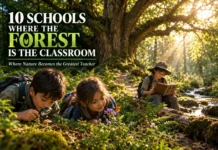


In many schools, students follow a fixed timetable. They attend lessons, do assigned work, take tests, and receive grades. Teachers decide which topics students study and when they are introduced.
But not every school follows that model.
Some schools allow students to choose whether to attend lessons. Others let children and adults vote on school rules. In certain learning communities, students have no fixed curriculum and can spend substantial time pursuing their own interests.
These approaches are often associated with democratic education and self-directed wisdom. They do not mean that children can do absolutely anything they want. Instead, they offer different ways to balance personal liberty, shared responsibility, and the practical demands of education.
These schools are part of a wider movement challenging conventional education, as explored in Schools Around the World That Break the Rules of Traditional Education.
Here are 10 real schools that challenge conventional assumptions about what school should look like.
1. Summerhill School — England
What makes it different: Students can choose whether to attend lessons.
Founded in 1921, Summerhill School in Leiston, Suffolk, is one of the best-known examples of democratic education.
Students have considerable liberty to organise their time at school. With lessons offered on an optional basis, they can explore academic subjects when they feel ready or motivated to learn. They can also participate in school meetings where community members discuss rules and decisions affecting daily life.
This does not mean lessons are unavailable. Summerhill offers structured classes and a curriculum for students who choose to attend them.
The distinction is that compulsory attendance is not the foundation of its educational philosophy.
Summerhill’s approach raises an interesting question: Can children develop a stronger interest in learning when they have more control over their decisions?
The school’s philosophy emphasizes personal development and responsibility alongside academic education. However, its model differs substantially from conventional schooling, and families must consider whether it suits a particular child’s needs.
Source: Summerhill School’s history and philosophy.
2. Sudbury Valley School — Massachusetts, United States
What makes it different: Students shape their own days without a prescribed curriculum.
Founded in 1968 in Framingham, Massachusetts, Sudbury Valley School uses a self-directed learning model that gives students considerable control over their daily activities.
The school has no compulsory classes, conventional grading system, or fixed curriculum. Students choose what to explore and how to spend their time, whether through conversations, creative activities, games, projects, or independent study.
The school is also run democratically. Students and staff help decide how it operates and what rules the community should follow.
Importantly, this is not simply a place where children are left alone. The school has shared expectations, community responsibilities, and procedures for addressing conflicts.
The model assumes that education can emerge through curiosity, experience, and sustained engagement with meaningful interests—not only through scheduled lessons.
It also challenges a familiar assumption: that every student must learn the same subject at the same age and at the same pace.
Sudbury Valley is one example of how schools can challenge conventional expectations, much like the institutions featured in The World’s Most Unusual Schools—and What They Teach Us About Learning.
Source: Sudbury Valley School’s educational model.
3. Alpine Valley School — Colorado, United States
What makes it different: Students have determination over both learning and school governance.
Alpine Valley School in Wheat Ridge, Colorado, follows the Sudbury model of self-directed democratic education.
Students choose what to learn, when to learn it, and how to pursue their interests. The school takes a different approach to education, without the usual requirements of scheduled classes, traditional grades, tests, or homework.
Its approach also extends beyond individual learning choices. Students and staff meet to discuss school rules and resolve disagreements.
This gives students opportunities to practise decision-making, negotiation, and understanding the consequences of shared rules.
For example, a student interested in music might spend time developing that interest, while another might focus on games, science, writing, or social activities. The school does not require everyone to follow an identical daily schedule.
Alpine Valley’s model places significant responsibility on students to use their time and engage with their community.
This level of freedom may appeal to students who value autonomy, but families should consider whether the approach offers enough structure and support for their children.
Source: Alpine Valley School.
4. The Circle School — Pennsylvania, United States
What makes it different: Even young students can have a voice in school decisions.
Located in Harrisburg, Pennsylvania, The Circle School is a self-directed democratic school for children from early childhood through high school.
Students and staff share responsibility for governing the school. At School Meetings, members have voting rights, and the community uses formal procedures to make decisions and address alleged rule violations.
Students also choose their activities rather than following a mandatory curriculum imposed on everyone.
The model gives children opportunities to experience how communities function: people have freedoms, but they also have obligations to others.
For instance, choosing an activity independently does not mean ignoring a shared rule or disrupting another person’s work. The community’s democratic processes help establish boundaries.
This is one of the most distinctive features of democratic education. Rather than learning about civic responsibility only from textbooks, students practise it by participating in everyday school decisions.
Source: The Circle School.
5. Philadelphia Free School — Pennsylvania, United States
What makes it different: Students help govern the school alongside adults.
Philadelphia Free School is built around the principles of freedom, trust, responsibility, and community participation.
Its governance system gives students and staff a voice in decisions about the school’s daily operations. A School Meeting addresses matters such as rules and spending, while a broader assembly handles wider policy questions.
Students also direct their own education, choosing how and when to pursue their interests.
The model differs from a conventional student council. Rather than electing a few representatives to speak for everyone, the school gives community members a direct role in its decision-making processes.
This creates opportunities to practise communication, disagreement, negotiation, and collective responsibility.
It also illustrates an important point about student freedom: having a voice in a school is not the same as having unlimited individual control. Decisions must also consider the needs of the wider school community.
Source: Philadelphia Free School: How It Works.
6. Sands School — Devon, England
What makes it different: Students help shape the school and can choose when to study.
Sands School in Ashburton, Devon, is an independent democratic school where students and staff share responsibility for school life.
The community holds regular School Meetings to discuss issues and make decisions. Students can influence decisions that adults typically control in conventional schools.
Sands also gives students flexibility in how they approach their learning. Rather than following a fixed study schedule, students can explore their interests, learn at their own pace, and choose when to sit examinations.
The school has also explored practical education through activities such as a student-run pop-up restaurant, connecting education with teamwork, enterprise, and real responsibilities.
Its approach shows that student freedom does not necessarily require abandoning academic subjects or examinations altogether. Instead, it can change how students participate in the decisions surrounding their education.
Source: Ashoka’s profile of Sands School.
7. Tokyo Sudbury School — Japan
What makes it different: It brings the Sudbury approach to a Japanese setting.
Tokyo Sudbury School follows an approach inspired by the Sudbury model, as noted in the Alliance for Self-Directed Education’s listing.
That model emphasizes student choice, mixed-age interaction, and responsibility for one’s own learning. Rather than organizing every student’s day around a common curriculum, Sudbury-style schools give learners substantial freedom to explore their interests.
The broader educational philosophy also includes democratic participation in school governance.
Tokyo’s example is particularly interesting because it shows that self-directed education is not limited to the United States or the United Kingdom. Alternative approaches to schooling can be explored in different cultural settings.
However, the existence of a school using this model does not mean it suits every student or produces the same outcomes as other Sudbury schools.
Families interested in this example should verify the school’s current operating status, program, and admissions information directly before publication.
Source: Alliance for Self-Directed Education.
8. The Open School — Orange County, California, United States
What makes it different: Learning is organized around real life and student interests.
The Alliance for Self-Directed Education lists The Open School among the communities that support self-directed learning.
In this approach, students can learn through play, conversation, exploration, and activities that reflect their interests. Instead of organizing the entire day around a fixed academic schedule, the school emphasizes freedom alongside responsibility within the community.
That can change what learning looks like.
A conversation might lead to an extended investigation. A game might inspire students to explore strategy or mathematics. An interest in a practical activity might develop into a longer project.
These examples illustrate the possibilities of self-directed wisdom, not a guarantee that every student will pursue the same activities or develop the same skills.
Families interested in this model should confirm the school’s current program, age range, and admissions status before relying on older descriptions.
Source: Alliance for Self-Directed Education’s school directory.
9. The Clearwater School — Washington, United States
What makes it different: It belongs to the democratic free-school tradition.
The Clearwater School, serving the greater Seattle area, is another school identified in the Alliance for Self-Directed Education’s directory.
Democratic free schools generally aim to give students meaningful control over their activities while allowing them to participate in a shared school community. Depending on the school, this can include freedom to explore interests, mixed-age interaction, and participation in governance.
The broader philosophy questions whether a single curriculum, divided into fixed lessons and age-based classes, must be the starting point for every child’s education.
For readers, the important distinction is between freedom to direct wisdom and the absence of all structure. A self-directed school still needs ways to maintain safety, manage shared spaces, support its community, and resolve disagreements.
Families should consult the school’s current official materials to understand its specific policies and educational arrangements before making decisions based on its model.
Source: Alliance for Self-Directed Education’s school directory.
10. Village Free School — Portland, Oregon, United States
What makes it different: Students participate in shaping their community as well as their intelligence.
The Alliance for Self-Directed Education lists Village Free School as an independent democratic school.
The school values both personal freedom and community involvement. Students may follow their interests, work with people of different ages, and help make decisions about school life.
Education involves more than learning academic subjects. Students also learn to work independently, cooperate with others, resolve conflicts, and take responsibility within a community.
The model’s central challenge is ensuring that students have access to useful resources and supportive adults while retaining meaningful control over their choices.
As with any alternative school, the details matter. Families should verify the school’s current status and practices directly before treating a directory description as a complete account of its program.
Source: Alliance for Self-Directed Education’s school directory.
What Do These Schools Have in Common?
Although the 10 schools are not identical, they challenge several assumptions about conventional education.
| Common assumption | What these schools demonstrate |
|---|---|
| Students must attend every scheduled lesson. | Some schools allow students to choose whether to attend lessons. |
| Every student must follow the same curriculum. | Some self-directed schools allow learners to choose their own activities and learning paths. |
| Adults should make all school rules. | Democratic schools may give students and staff shared decision-making power. |
| Knowledge must always be organized by age. | Some schools encourage students of different ages to interact and learn together. |
| Strength means having no rules. | These schools often use community rules and procedures to balance individual choice with responsibility. |
These differences are not merely cosmetic. They reflect different ideas about motivation, independence, the role of adults, and how children learn to participate in society.
Do Students Really Learn Without Strict Rules and Required Classes?
This is one of the most important questions raised by self-directed education.
Supporters argue that children can learn through curiosity, play, social interaction, independent exploration, and sustained engagement with interests. They also argue that students need opportunities to make decisions and take responsibility for the consequences.
But a school’s philosophy should not be confused with proof that its approach works equally well for everyone.
Students differ in their needs, interests, learning difficulties, and readiness for independent study. Some may thrive when given considerable autonomy. Others may benefit from more explicit instruction, predictable routines, structured practice, and regular feedback.
The practical details also matter. Students need access to books, materials, knowledgeable adults, safe learning environments, and appropriate support when they encounter difficulties.
The real question is not whether freedom is always better than structure. It is how much freedom, guidance, and structure different learners need—and how schools can provide them responsibly.
Could These Ideas Work in Ordinary Public Schools?
A public school does not have to adopt a fully self-directed model to give students more meaningful choices.
Allowing students more freedom can also encourage them to take an active part in addressing practical challenges. Through hands-on projects and real-world activities, they can connect classroom learning with situations outside school. The article 10 Schools That Teach Children How to Solve Real-World Problems offers further examples of schools that connect classroom learning with practical challenges.
Other approaches, including Montessori, project-based learning, and inquiry-based teaching, offer additional ways to give students a more active role in education. Learn how these methods work in Inside the Schools That Teach Children Differently.
Teachers can incorporate elements of student autonomy into conventional classrooms while working within curriculum requirements and school policies.
For example, they might:
- Allow students to choose between several project topics.
- Give learners some control over how they demonstrate understanding.
- Let students help establish classroom expectations.
- Offer independent investigation alongside teacher-led lessons.
- Create opportunities for students to reflect on their goals and progress.
- Give students a voice in solving classroom problems.
These practices are not the same as removing compulsory lessons, grades, or curriculum requirements. These are modest changes that can give students a more active role in their learning.
The most useful lesson from these schools may therefore be a question for every educator: Where can students take more responsibility without losing the guidance and support they need?
Frequently Asked Questions (FAQs)
A democratic school gives students a meaningful role in decisions about school life. Depending on the model, students and staff may share responsibility for making rules, resolving disputes, and managing aspects of the school community.
Not always. Some self-directed schools make lessons optional and allow students to choose how to spend their time. Other alternative schools offer student choice while retaining scheduled lessons and academic requirements.
Some schools operate without conventional grades or a predetermined curriculum. They organize learning around student choice, independent exploration, and self-directed activities. However, families should investigate how each school supports academic development and handles transitions to further education.
What works for one child may not work for another. Educational approaches differ in their goals, structure, resources, and expectations. Families should consider a child’s needs, the school’s actual practices, and the available evidence before deciding which environment is appropriate.
Freedom gives students opportunities to make choices within a community. Having no rules would mean there were no agreed boundaries to protect people or manage shared responsibilities. Democratic and self-directed schools commonly use rules, procedures, and adult support to balance individual freedom with others’ needs.