
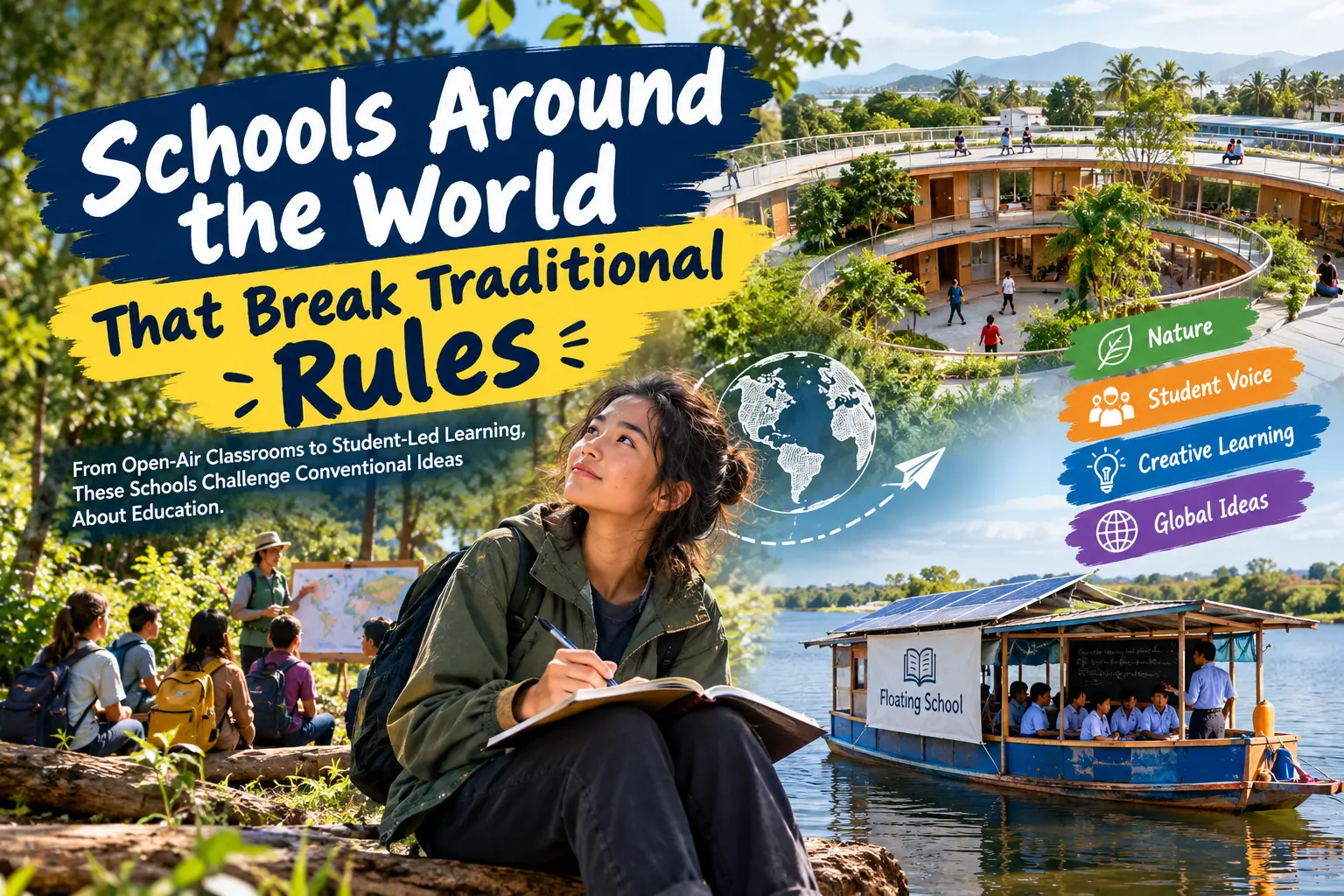
Imagine a different kind of school—one where learning happens beyond classroom walls, projects connect lessons to real life, and students help shape the rules of their learning community.
In another part of the world, a kindergarten uses its rooftop as a playground. Elsewhere, classrooms travel by boat to reach children whose communities are cut off by seasonal floods.
These are not imaginary ideas. They reflect real schools and education models that approach learning differently.
Traditional education often relies on fixed classrooms, scheduled lessons, textbooks, examinations, and teacher-led instruction. These methods can provide structure and help schools educate large numbers of students. However, they are not the only ways to organize learning.
Around the world, educators have developed alternatives that emphasize practical experience, creativity, independence, environmental awareness, and student participation.
Some of these approaches challenge how children learn. Others change the physical environment or find ways to deliver education under difficult conditions.
Their value is not that they automatically outperform traditional schools. Rather, they raise an important question: What could schools improve if they were more willing to rethink how education works?
1. Green School Bali: Learning Without Traditional Classroom Walls
Location: Bali, Indonesia
Many schools are designed around enclosed classrooms, rows of desks, and whiteboards. Green School Bali offers a different vision of education, where the natural environment becomes an integral part of the learning experience.
Opened in 2008, the school is known for its bamboo buildings, open-air classrooms, and strong focus on sustainability. Students learn not only academic subjects but also how to care for the environment, work with their community, and apply their knowledge through practical projects.
Green School Bali offers an educational program that extends from pre-kindergarten through Grade 12, according to its official information. It combines academic subjects with a broader emphasis on sustainability and student-led learning.
Source: Green School Bali—Official Website
What makes it different?
Instead of treating the environment as something students study only in textbooks, the school makes its surroundings part of the learning experience.
Sustainability becomes part of everyday learning as students work on projects, take part in campus activities, and interact with the natural environment.
For example, environmental education can become more meaningful when students investigate waste management, food production, renewable energy, or the effects of human activity on local ecosystems.
The physical setting also challenges the assumption that effective learning must always take place inside a conventional classroom.
However, open-air learning has limitations. Weather, noise, insects, heat, and other distractions can make some lessons more difficult. Building and maintaining a specialized campus can also be expensive.
Although Green School Bali offers valuable lessons, its educational model may not be practical for every public school to implement in full. Its more transferable lesson is that sustainability and practical learning can become part of ordinary school life without requiring an entirely different campus.
2. Fuji Kindergarten: A School Designed for Movement
Location: Tokyo, Japan
What if a school’s architecture encouraged children to move rather than constantly reminding them to sit still?
Fuji Kindergarten offers an unusual example. Its oval-shaped building surrounds a central courtyard, while its rooftop serves as an additional play space. Trees form part of the design, while the layout encourages young children to discover and engage with their surroundings.
The school combines its distinctive architecture with a Montessori-based educational approach.
Source: UNESCO—Fuji Kindergarten
Why is the design unusual?
In many traditional classrooms, the physical environment is organized primarily around desks, teaching boards, and designated activity areas.
Fuji Kindergarten takes a different view: School architecture can affect how students navigate their surroundings, engage with peers, and encounter new learning opportunities.
Its rooftop and open layout create opportunities for movement and play. Rather than separating every activity into a small, fixed space, the architecture gives children more room to explore.
This raises an important question about school design. Should the classroom be treated simply as a place where lessons happen, or can the entire learning environment help children develop?
The design does not mean children can move around without supervision. Safety, age-appropriate boundaries, and adult guidance remain essential.
Nor does one distinctive building prove that every school needs a rooftop playground. Many schools cannot afford such a design, and their sites may not allow it.
The broader lesson is more practical: even ordinary classrooms can be arranged to support movement, collaboration, natural light, and different ways of learning.
3. Summerhill School: Students Have a Voice in School Rules
Location: Suffolk, England
Most students are expected to attend scheduled classes and follow rules established by school administrators. At Summerhill School, the educational philosophy gives students a much stronger role in decisions about school life.
Founded by A. S. Neill in 1921, Summerhill is widely known for its democratic approach to education.
Its approach gives students considerable freedom to decide whether to attend lessons. School meetings also give students and staff opportunities to participate in decisions about shared rules and community matters.
Source: Summerhill Democratics—Frequently Asked Questions
What makes this model different?
Summerhill challenges the idea that students should have little say in the decisions that affect their daily lives.
In a conventional school, students may be expected to follow rules without having much influence over how those rules are created. A democratic model instead gives them opportunities to participate in decision-making and experience the responsibilities that come with freedom.
These experiences turn everyday interactions into learning opportunities, helping students explore fairness, resolve conflicts, respect different viewpoints, and understand shared decision-making.
However, student autonomy is not the same as having no boundaries. Schools still need to protect children, maintain a safe environment, and provide access to education.
The approach also raises difficult questions. How can schools balance freedom with academic preparation? What happens when a student avoids lessons but later needs particular qualifications? How much independence is appropriate at different ages?
These questions matter because a model that works for one community may not work equally well for every student.
Traditional schools can learn from Summerhill without adopting its entire educational approach. They could give students more meaningful opportunities to contribute to classroom agreements, school policies, and discussions about their learning.
4. Reggio Emilia: Children Learn Through Questions and Projects
Location: Reggio Emilia, Italy
The Reggio Emilia approach is defined less by a particular building or prescribed curriculum than by the educational principles that guide how children learn. The Reggio Emilia approach began in municipal early-childhood centers in the Italian city of Reggio Emilia and has since influenced educators worldwide.
It sees children as capable and curious learners who take an active role in their education. Teachers observe their interests, encourage investigation, and help them develop ideas through different forms of expression.
Source: Reggio Children—The Reggio Emilia Approach
How does learning work?
Imagine that a group of young children becomes interested in shadows.
Instead of answering every question immediately, a teacher might encourage the children to watch shadows at different times of day, draw what they see, compare their observations, and discuss why the shapes change.
The children might express their ideas through drawings, construction, conversation, or other creative activities.
The teacher remains actively involved. The difference is that learning develops through observation, questioning, investigation, and reflection rather than relying entirely on direct explanation.
The approach treats the learning environment as an important part of education and recognizes families as partners in children’s learning.
This does not mean children are expected to teach themselves without guidance. Teachers plan experiences, introduce useful materials, ask questions, and help children develop more sophisticated understanding.
The approach treats the learning environment as an important part of education and recognizes families as partners in children’s learning.
Its wider lesson is that curiosity can be a starting point for structured learning. Children can investigate meaningful questions while developing language, reasoning, creativity, and collaborative skills.
5. Floating Schools in Bangladesh: Education That Travels to Students
Location: Flood-prone regions of Bangladesh
Occasionally, the greatest challenge to education has little to do with the classroom or the teacher. It lies in the conditions surrounding the school and its students.
Seasonal flooding affects more than the roads. It can interrupt children’s education, disrupt daily routines, and cut families off from essential public services.
In parts of northwestern Bangladesh, the nonprofit organization Shidhulai Swanirvar Sangstha operates schoolboats to help reach communities affected by flooding.
Source: Shidhulai Swanirvar Sangstha—About Us
Why put a school on a boat?
In a conventional education system, students generally travel to a school building. But when rising water makes that journey difficult or impossible, a different arrangement may be needed.
A floating classroom brings educational activities closer to communities that might otherwise lose access to lessons during periods of flooding.
This is a practical response to a local problem. Rather than relying on permanent school facilities, the model adjusts how education is delivered to meet local needs and circumstances.
The approach also illustrates how education, disaster preparedness, and community needs can overlap.
A boat-based school is not suitable for every community. It requires suitable waterways, trained staff, resources, and safe operating conditions. It cannot eliminate every barrier to education, including poverty, shortages of learning materials, or the long-term effects of displacement.
Nevertheless, it offers a powerful lesson: sometimes schools must change where and how they operate before students can benefit from what teachers have to offer.
Other communities may need alternatives, such as temporary learning spaces, mobile classrooms, remote learning options, or stronger disaster planning.
6. Forest Schools: Learning Beyond the Classroom
Location: Various countries, including the United Kingdom and Nordic countries
In forest-school programs, children take part in supervised learning activities in natural outdoor environments.
Students might study wildlife, build structures from natural materials, practice outdoor skills, track changing weather, or take on projects that challenge them to plan and solve problems together.
Forest schooling does not follow one standard model across all countries. Each program has its own educational objectives, schedule, activities, and approach to connecting with the formal curriculum.
What can children learn outdoors?
A classroom can explain how plants grow. A simple outdoor activity can turn plant growth into a practical lesson, allowing children to examine soil, observe changing leaves, and investigate what plants need to thrive.
Outdoor activities can also create opportunities for communication, cooperation, physical movement, and learning to manage manageable risks under adult supervision.
However, outdoor education is not automatically better for every subject or every student. Some lessons require quiet concentration, specialized equipment, direct instruction, or access to books and technology.
Weather, accessibility, safety, and staffing can also limit outdoor activities.
The useful lesson is not that classrooms should disappear. The world outside the classroom can become another place for students to learn, observe, and ask questions.
A small school garden, an outdoor lesson, or a closer look at local wildlife can extend learning beyond the classroom and connect lessons with real-world experience.
7. Project-Based Learning: Students Learn by Working on Real Problems
Location: Used in different forms around the world
Some schools organize learning around projects that require students to investigate questions, apply knowledge, create something, or present a solution.
This is often called project-based learning. It is best understood as a flexible teaching approach rather than a school model tied to one country or education system.
For example, students studying environmental science could measure how much waste their school produces. By measuring waste, speaking with the people who manage it, and analyzing their findings, students could recommend realistic ways to reduce waste at school.
The project can bring together science, mathematics, writing, research, and communication.
These activities can also help students develop practical abilities that extend beyond academic subjects, including communication, planning, decision-making, and problem-solving. These are among the important life skills schools still fail to teach.
Why is this different from traditional lessons?
In a conventional lesson, students may learn each subject separately and then complete an examination to demonstrate what they remember.
Students may learn one subject at a time and take exams to prove what they remember. But can they use that knowledge to solve problems and handle situations outside the classroom? For a closer look at this issue, read Is Algebra Really Necessary in School?.
Project-based learning asks students to use knowledge across different stages of a task. They may need to research, plan, test an idea, interpret results, respond to feedback, and explain their conclusions.
That can make connections between subjects more visible.
However, a project is not automatically an effective lesson simply because students are busy. Without clear goals, good instruction, suitable resources, and individual assessment, students may complete an attractive presentation without understanding the underlying material.
Teachers still need to explain difficult concepts, correct misconceptions, and make sure every student contributes meaningfully.
The most useful approach combines direct teaching with opportunities to apply knowledge.
How These Schools Compare With Traditional Education
The examples above challenge different aspects of conventional schooling. Some change the learning environment, some give students greater autonomy, and others adapt education to local conditions.
| School or approach | What makes it different | Main lesson for other schools |
|---|---|---|
| Green School Bali | Nature-focused campus and sustainability education | Connect academic learning with environmental responsibility |
| Fuji Kindergarten | Architecture designed around movement and play | Make school spaces support children’s development |
| Summerhill School | Student freedom and democratic participation | Give students meaningful opportunities to influence school life |
| Reggio Emilia approach | Inquiry, creative expression, and collaborative learning | Take children’s questions seriously and guide their investigations |
| Floating schools in Bangladesh | Learning spaces adapted to flood-prone communities | Adapt education delivery to local barriers |
| Forest schools | Supervised learning in natural environments | Use outdoor spaces as additional learning resources |
| Project-based learning | Students apply knowledge to substantial tasks | Help students connect different subjects and use what they learn |
These approaches should not be ranked as if they were competing versions of the same school. They address different educational goals and operate in different circumstances.
A kindergarten designed for movement has different priorities from a secondary school preparing students for university examinations. A floating classroom addresses a different challenge from a democratic school.
The comparison is useful because it shows how many aspects of education can be reconsidered without assuming that one model is right for everyone.
Are These Schools Better Than Traditional Schools?
Not necessarily.
A school can have unusual architecture, flexible lessons, or a progressive educational philosophy and still face challenges. Its students may have different needs, its resources may be limited, and its methods may not suit every learning objective.
Likewise, a conventional school can provide excellent education when it has effective teachers, supportive leadership, appropriate resources, and a curriculum that helps students develop genuine understanding.
The important distinction is between an approach that looks different and one that produces meaningful educational benefits.
Evaluating a school means looking beyond its teaching style or physical environment. The quality of instruction and whether students genuinely understand what they learn matter just as much. This raises a fundamental question about Philippine public education: are schools helping students learn effectively?
To judge a school model fairly, we need to look beyond photographs and inspiring descriptions. Here are some useful questions to ask:
- Do students develop strong foundational knowledge and skills?
- Can they explain what they learn and apply it to new problems?
- Are students supported when they struggle?
- Does the school provide a safe and inclusive environment?
- Can the approach work for students from different backgrounds?
- What evidence is available about learning outcomes, and how reliable is it?
These questions prevent us from treating alternative education as automatically superior.
They also remind us that traditional schools do not need to abandon structure, examinations, or academic standards to improve.
What Can Ordinary Schools Learn From These Models?
Most public schools cannot build bamboo campuses, redesign entire buildings, or introduce a radically different school governance system overnight.
That does not mean the ideas are irrelevant.
Many improvements can begin with small changes that use existing facilities and resources.
1. Give students more chances to put what they learn into practice.
Students can investigate local problems, conduct simple experiments, interpret data, and explain their findings.
These activities can complement textbooks and direct instruction rather than replace them.
The goal should be to improve learning, not simply give students more work to complete. This connects with the wider problem of why Philippine schools give students more work when they need better teaching.
2. Make the learning environment more useful
Schools can consider whether classroom layouts support concentration, accessibility, collaboration, and movement.
Outdoor areas, libraries, gardens, and community spaces can also provide additional learning opportunities when they are safe and available.
3. Listen to students without abandoning teacher responsibility
Students can contribute ideas about classroom routines, learning activities, and ways to improve their school experience.
Teachers and school leaders must still maintain appropriate boundaries, protect students, and meet educational requirements.
4. Connect lessons with local needs
Environmental projects, community research, financial literacy, and practical problem-solving can help students understand how academic subjects relate to their surroundings.
The strongest examples align with the curriculum while remaining relevant to students’ everyday realities.
5. Evaluate what works before expanding it
A school should not adopt a fashionable teaching method simply because it looks innovative.
Educators should establish clear goals, monitor student progress, listen to feedback, and adjust their approach when results fall short.
This is particularly important in schools with limited budgets. School funding should focus on improvements that strengthen learning rather than impressive facilities that impose high maintenance expenses.
Why Education Does Not Need to Look the Same Everywhere
Schools share important responsibilities. They must help children develop knowledge, learn to communicate, build essential skills, and prepare for further education and adult life.
However, schools can meet these responsibilities in different ways.
A community affected by flooding may need mobile classrooms. A school with a suitable outdoor area may be able to provide more nature-based learning. A preschool may benefit from spaces that encourage movement and creative exploration. Another school may focus on helping students apply academic knowledge to local challenges.
These differences do not mean that academic standards should disappear. Nor do they suggest that one country can copy another school’s methods without considering its circumstances.
They show that educational design involves choices.
The most effective approaches address practical challenges, improve student learning, and adapt to local conditions.
Frequently Asked Questions (FAQs)
A school may differ in how it organizes lessons, uses its physical environment, involves students in decision-making, or connects learning with practical experiences. Some models emphasize outdoor education, project-based learning, sustainability, or student autonomy.
A school can be unusual because of where it is located, how students learn, or how it challenges traditional education. Around the world, communities have adapted education to reflect their values, local conditions, available resources, and specific needs.
Some learning can take place outdoors, in workshops, in community settings, or in other environments beyond the classroom. However, the appropriate setting depends on students’ ages, learning goals, accessibility, safety, and the subject being taught. A traditional classroom remains useful for many activities.
Not automatically. Educational approaches vary, and neither distinctive teaching methods nor innovative school designs necessarily produce better academic outcomes. Fair comparisons require reliable evidence and consideration of differences in students, resources, and school settings.
Project-based learning is an instructional approach in which students investigate a meaningful question or problem and develop a product, explanation, or solution. Effective projects combine clear learning objectives with teacher guidance, subject knowledge, and assessment.
Yes. Public schools can introduce practical projects, outdoor lessons, student participation, and more flexible classroom arrangements where appropriate. Any improvements should reflect the curriculum, available resources, school facilities, and the needs of the students they serve.
Sources
- Green School Bali—Official Website—School curriculum, sustainability, and campus.
- UNESCO—Fuji Kindergarten—School design and children’s interaction with the environment.
- Summerhill Democratics—Frequently Asked Questions—Student autonomy and democratic school life.
- Reggio Children—The Reggio Emilia Approach—The educational philosophy and its principles.
- Shidhulai Swanirvar Sangstha—About Us—Schoolboats and educational access in flood-prone Bangladesh.
- UNESCO—Issues and Trends in Education for Sustainable Development—Background on sustainability-focused education, including Green School Bali.