
Southeast Asia is among the fastest-growing economic regions in the world.
Education plays a decisive role in determining which countries translate growth into long-term competitiveness.
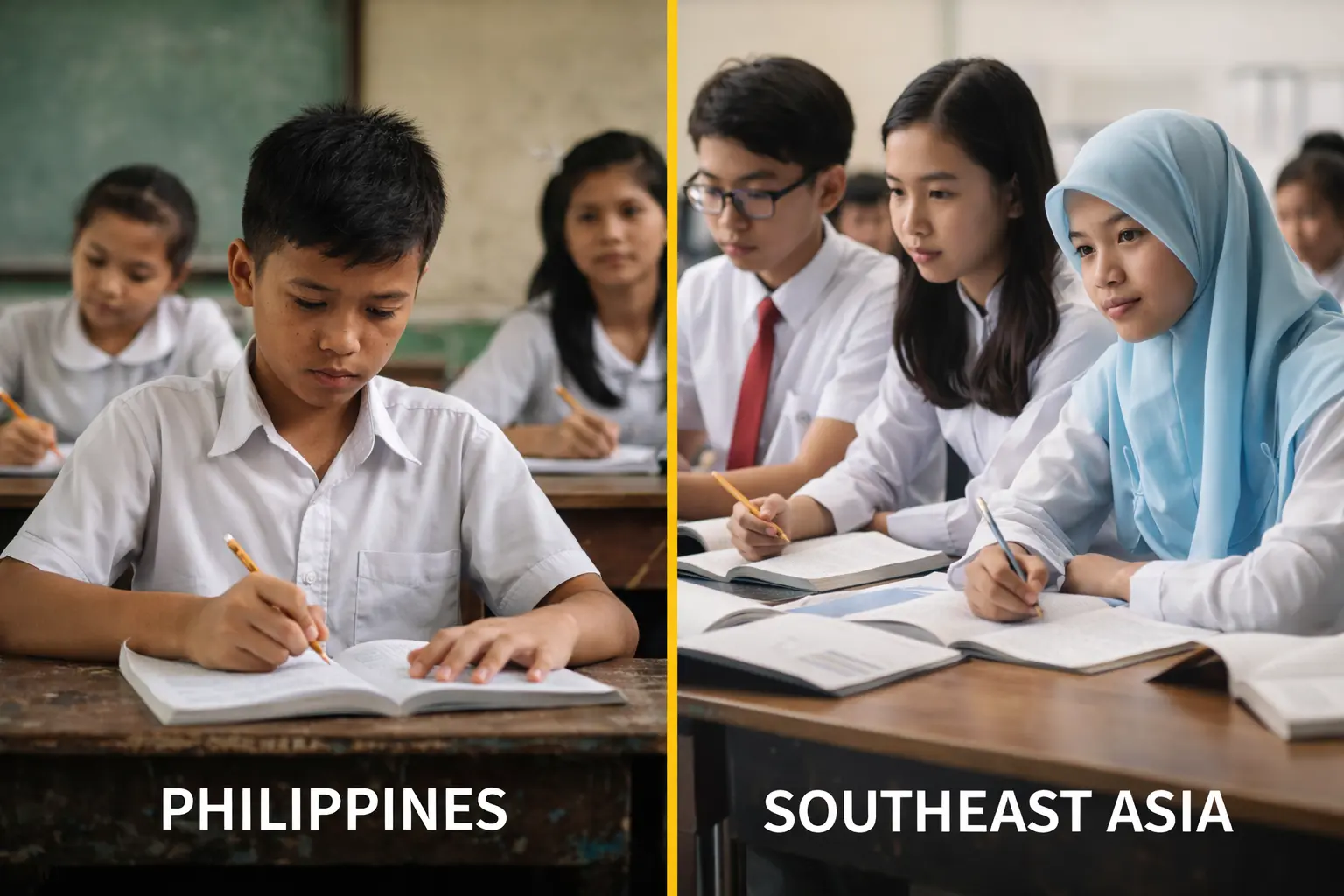
Analysts frequently compare the Philippines with regional peers, including Singapore, Vietnam, Malaysia, Thailand, and Indonesia.
A neutral, data-based comparison reveals meaningful differences — and important context.
Why Regional Comparison Matters
Education systems do not operate in isolation.
They reflect demographic pressures, funding priorities, governance models, and national development strategies.
Evaluating the Philippines alongside neighboring economies provides insight into its structural strengths and weaknesses, rather than temporary fluctuations.
1. Learning Outcomes Across Southeast Asia
International assessments offer one of the clearest comparison tools.
The Programme for International Student Assessment (PISA), coordinated by the OECD, measures 15-year-old students’ proficiency in reading, mathematics, and science.
Recent results show clear regional variation.
Singapore consistently ranks among the top performers globally.
Vietnam has demonstrated strong outcomes relative to income level.
Malaysia and Thailand perform near global averages.
The Philippines has ranked lower in reading, mathematics, and science compared to most of its ASEAN peers.
These differences highlight variations in curriculum depth, teacher preparation, and early literacy development.
Education Performance Comparison in Southeast Asia
| Country | Recent PISA Standing | Education Spending (% GDP) | Student–Teacher Ratio (Primary) | Key Strength |
|---|---|---|---|---|
| Singapore | Top global performer | ~2.8–3% | Low | Rigorous standards, teacher quality |
| Vietnam | Above OECD average | ~4% | Moderate | Strong foundational literacy |
| Malaysia | Near global average | ~4% | Moderate | Structured reform efforts |
| Thailand | Below OECD average | ~3–4% | Moderate | Curriculum modernization efforts |
| Philippines | Below regional peers | ~3–4% | Higher in public schools | Large English-speaking workforce pipeline |
2. Education Spending and Efficiency
Spending levels across Southeast Asia fall within a similar range as a percentage of GDP.
However, outcomes vary significantly.
It suggests that efficiency, allocation, teacher training quality, and governance structures play as important a role as funding levels.
In the Philippines, rapid population growth increases per-student funding pressures — a factor explored further in the 10 Biggest Problems in Philippine Education.
3. Class Size and Teacher Capacity
Student–teacher ratios directly influence classroom attention and learning outcomes.
Urban public schools in the Philippines often have larger class sizes than their regional peers.
Singapore and Vietnam emphasize teacher training rigor and structured professional development systems.
Teacher capacity, not just headcount, remains a decisive factor.
4. Infrastructure and Digital Access
Digital readiness is increasingly distinguishing high-performing systems from those that lag.
Singapore has achieved near-universal digital integration in its classrooms.
Vietnam and Malaysia have expanded broadband access in public schools.
The Philippines is working to close infrastructure gaps, especially in remote areas.
These disparities reflect broader development and logistical challenges.
5. Curriculum and Reform Models
Singapore operates a centralized, highly structured education model.
Vietnam prioritizes early literacy and the development of core competencies.
Malaysia and Thailand have pursued phased curriculum reforms.
The Philippines adopted K–12 reforms to align with global standards, but inconsistent implementation and shallow reform depth continue to pose challenges.
6. Unique Structural Challenges in the Philippines
Several structural factors distinguish the Philippine system:
- Archipelagic geography complicates resource distribution.
- Rapid population growth increases classroom demand.
- Budget constraints relative to student volume
- Regional income disparities
These factors shape outcomes independently of curriculum intent.
7. Regional Trends Shaping the Future
Across ASEAN, education systems are moving toward:
- Skills-based learning
- Technical-vocational expansion
- Digital literacy integration
- Public–private collaboration
The Philippines is part of these shifts, but implementation remains uneven.
Sustained reform, teacher development, and infrastructure investment drive long-term improvement.
Frequently Asked Questions (FAQs)
How does Philippine education rank in Southeast Asia?
Recent international assessments show the Philippines ranking below several ASEAN peers in reading, mathematics, and science performance.
Why does Vietnam outperform some higher-income countries?
Vietnam emphasizes foundational literacy, teacher training, and curriculum consistency, which contribute to strong student outcomes.
Does higher education spending guarantee better performance?
No. Results reflect how effectively systems allocate funds, develop teachers, govern institutions, and design curricula.
What challenges are unique to the Philippines?
Geography, rapid population growth, and crowded classrooms pose structural challenges not experienced equally across the region.
Which Southeast Asian country has the strongest education system?
Singapore consistently ranks as the region’s top performer based on international assessments.
Authority References
Data referenced from:
- Programme for International Student Assessment (PISA)
- World Bank education indicators
- UNESCO Institute for Statistics
- How Aging Populations Are Changing the Global Economy
- Barrio Luz National High School: Why Parents Are Concerned
- Why Evaluating Teachers Is Essential for Quality Education Today