

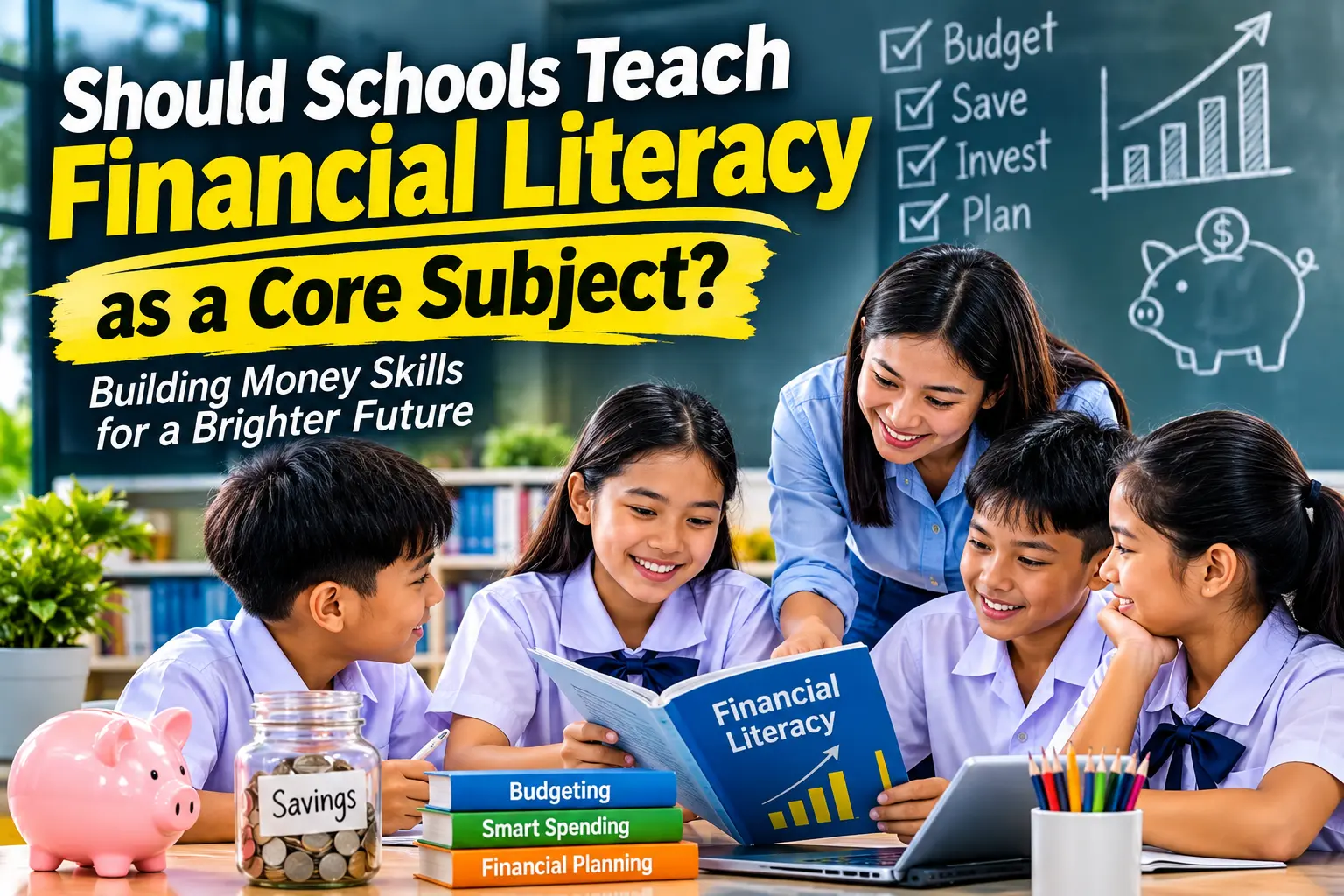
A student can graduate with strong grades, understand complex mathematical formulas, and explain major historical events. Yet that same student may struggle to manage a monthly allowance, compare loan offers, understand credit card interest, or plan for future expenses.
This raises an important question: Are schools giving students the financial knowledge they need to navigate adult life?
Money influences nearly every stage of adulthood. People must decide how to spend their income, save for emergencies, manage debt, pay bills, and prepare for long-term needs. Today, they must also navigate digital payments, online shopping, financial scams, and increasingly complex financial products.
Not every child has the same opportunity to learn these skills at home, as some families face limits in time, financial resources, or practical knowledge.
Schools can help reduce these differences by giving students access to practical learning opportunities. But should financial literacy become a core subject, or should teachers integrate it into existing lessons?
Financial literacy is one part of a broader question about whether schools prepare students for responsibilities beyond the classroom. Read Is the Philippines Preparing Its Children for Life—or Just for Exams? to examine this wider challenge.
1. Financial Decisions Begin Before Adulthood
Children start making financial decisions long before they receive their first salary.
They may receive allowances, buy snacks, save for toys, compare prices, or make purchases through online platforms. These everyday experiences introduce basic concepts such as spending, saving, value, and choice.
However, making purchases does not automatically teach someone how to manage money responsibly.
A student may understand that saving is important but struggle to decide how much to set aside. Another may know how to pay through an app but struggle to manage spending or recognize online scams.
As young people grow older, their financial responsibilities become more complicated. They may need to manage transportation costs, school expenses, part-time income, bank accounts, subscriptions, and eventually rent or loan payments.
Without basic financial knowledge, these decisions can become difficult and costly.
Schools can help students develop sound financial habits before they face more demanding responsibilities.
2. Many Students Lack Practical Financial Knowledge
Financial literacy involves more than recognizing money or understanding basic arithmetic.
Students need to understand how financial concepts work in everyday situations. They should know how to compare prices, calculate expenses, recognize interest charges, evaluate borrowing options, and plan within a limited budget.
International research highlights the importance of these skills.
The OECD Programme for International Student Assessment (PISA) 2022 financial literacy assessment examined the abilities of 15-year-old students in 20 participating countries and economies. Across the 14 participating OECD countries and economies, an average of 18% of students failed to achieve basic financial literacy proficiency.
The assessment also found differences in students’ financial knowledge and exposure to financial education. Students from more advantaged backgrounds generally performed better than their disadvantaged peers.
These findings suggest that young people do not have equal opportunities to develop financial skills.
A school cannot change every family’s financial circumstances, but it can equip students with knowledge and skills to make informed financial decisions.
3. Students Need to Understand Budgeting and Saving
One of the most useful lessons schools can teach is how to manage a limited amount of money.
Budgeting helps people understand how much they receive, how much they spend, and how much they can save. It also teaches students to distinguish between essential expenses and optional purchases.
For example, a student receiving a weekly allowance could divide it among transportation, food, school supplies, savings, and personal spending.
This simple exercise introduces several important habits:
- Tracking income and expenses.
- Setting spending limits.
- Prioritizing essential needs.
- Saving for future purchases.
- Preparing for unexpected costs.
Students should also understand why saving matters. An emergency expense, an unexpected repair, or a sudden change in family circumstances can create financial pressure.
Learning to set aside even a small amount can help students understand the value of preparation.
The goal is not to teach every student to follow the same budget. It is to help them make thoughtful decisions based on their available resources and responsibilities.
4. Understanding Debt and Interest Can Prevent Costly Mistakes
Borrowing money can help people pay for education, housing, transportation, and other important needs. However, loans and credit products also create financial obligations that borrowers must understand.
Students should learn how interest works, how repayment schedules affect total costs, and why borrowing more than they can afford creates financial risks.
For example, a loan with low monthly payments may seem affordable, but a longer repayment period can increase the total cost.
Credit cards also require careful management. Paying only the minimum amount due can lead to growing interest charges, increasing the total cost of a purchase.
Schools can use practical examples to explain:
- Simple and compound interest.
- Loan repayment schedules.
- Credit card balances and fees.
- The difference between borrowing and saving.
- The risks of excessive debt.
- The importance of reading financial agreements.
Students do not need to become financial experts. They need enough knowledge to recognize financial obligations, ask informed questions, and avoid decisions they do not fully understand.
5. Digital Money Requires New Financial Skills
Financial education has become more important as money management moves increasingly into digital environments.
Students can shop online, transfer money through mobile apps, use digital wallets, and encounter financial advertisements on social media.
These services offer convenience, but they also introduce risks.
Online scams, phishing messages, identity theft, unauthorized transactions, and misleading financial promotions can affect people who do not understand how digital financial systems work.
The OECD reported that more than eight in ten students in its PISA 2022 financial literacy assessment had bought something online during the previous year. Approximately 66% had made a payment using a mobile phone.
These findings show that many young people already interact with digital financial services before reaching adulthood.
Schools should therefore teach students how to:
- Protect passwords and personal financial information.
- Recognize suspicious messages and fraudulent offers.
- Understand the risks of sharing banking details.
- Check transactions and account balances.
- Identify misleading online advertisements.
- Use digital payment services responsibly.
Digital financial literacy should not encourage children to use financial products before they are ready. Instead, it should help them understand the risks and responsibilities associated with digital money.
6. Financial Literacy Can Help Reduce Educational Inequality
Children do not all receive the same financial guidance at home.
Some families regularly discuss budgeting, saving, banking, and household expenses. Financial hardship, busy schedules, and limited financial knowledge can prevent some families from discussing money matters with their children.
This difference can affect how prepared students become to manage money.
OECD PISA 2022 data indicate that socioeconomic disadvantage was associated with lower financial literacy performance among students. The report also found that students who discussed saving and purchasing decisions with their parents tended to demonstrate stronger financial literacy.
These findings highlight the influence of both family experiences and educational opportunities.
Schools can reduce differences in financial knowledge by providing all students with access to essential financial education.
However, financial education should never suggest that financial hardship results simply from poor personal decisions. Income inequality, employment opportunities, access to financial services, and economic conditions also influence financial well-being.
Teaching students how to manage money is valuable, but it cannot replace policies that address broader economic challenges.
7. Should Financial Literacy Become a Separate School Subject?
There is a strong argument for making financial literacy a required part of education. However, that does not automatically mean schools need another standalone subject.
Many school systems already face crowded curricula. Adding another subject could increase demands on teachers and students without guaranteeing better learning.
The OECD has noted that many countries integrate financial education into existing subjects rather than creating an additional course.
For example:
| School subject | Financial literacy applications |
|---|---|
| Mathematics | Percentages, interest, discounts, and budgeting |
| Economics | Inflation, income, markets, and financial decisions |
| Social studies | Taxes, public services, and economic inequality |
| Technology | Digital payments, online security, and financial scams |
| Business education | Saving, borrowing, entrepreneurship, and basic accounting |
This approach allows students to apply financial concepts across different learning areas.
Nevertheless, integration must be deliberate. If financial literacy appears only occasionally in mathematics exercises, students may never develop a complete understanding of personal finance.
Schools should establish clear learning objectives, allocate sufficient teaching time, and assess whether students can apply what they learn.
A dedicated course may also be appropriate where schools have the resources and trained teachers to deliver it effectively.
8. What Should Students Learn at Different Ages?
Financial education should develop gradually as students become capable of understanding more complex financial decisions.
Younger children can begin with simple ideas about money, choices, and saving. Older students can move toward budgeting, banking, borrowing, digital transactions, and long-term financial planning.
A practical progression could look like this:
| Education stage | Suggested financial lessons |
|---|---|
| Primary school | Recognizing money, comparing prices, saving, and distinguishing needs from wants |
| Lower secondary school | Budgeting, spending choices, bank accounts, and basic interest |
| Upper secondary school | Credit, debt, digital payments, taxes, financial scams, and financial planning |
| Post-secondary education | Loan management, employment income, insurance, investments, and long-term financial decisions |
These topics should reflect students’ ages, local financial systems, and the financial products they are likely to encounter.
Practical activities can make lessons more meaningful. Students could create sample household budgets, compare loan offers, calculate savings growth, or identify warning signs in fictional online scams.
By working through realistic scenarios, students learn to make better financial decisions in everyday life.
9. Teachers Need the Right Training and Resources
Even a well-designed financial literacy curriculum can fail if teachers lack the knowledge and resources to deliver it.
Financial concepts can become complicated, especially when lessons involve credit, taxation, insurance, investments, and digital financial services.
Schools should provide teachers with appropriate training, reliable learning materials, and practical classroom activities.
Teachers must also adapt to changes in education, including the growing use of artificial intelligence in classrooms. Read Will AI Replace Teachers, or Change What They Do? to understand how AI may reshape teaching responsibilities.
They should also use independent and unbiased educational resources. Financial literacy lessons must not become opportunities to promote particular banks, investment products, loan providers, or commercial services.
Students should learn to evaluate financial products, not just purchase them.
Schools can also involve parents, consumer protection organizations, and qualified financial educators when appropriate. However, these partnerships should follow clear safeguards that protect students from commercial influence.
The goal of financial education is to equip students with the knowledge and judgment needed to make sound financial decisions on their own.
10. Financial Literacy Should Be Measured by What Students Can Do
A student may memorize the definition of compound interest without understanding how it affects a loan.
Another may correctly explain budgeting but struggle to create a realistic spending plan.
These examples reveal an important weakness in traditional approaches to financial education: knowing financial terms does not necessarily mean knowing how to use them.
Schools should assess whether students can apply their knowledge to realistic situations.
Instead of relying entirely on written examinations, teachers can use practical activities such as:
- Creating a monthly budget from a sample income.
- Comparing the total costs of different borrowing options.
- Identifying misleading financial advertisements.
- Planning savings toward a specific goal.
- Evaluating the risks of a fictional online transaction.
- Explaining how interest changes the cost of borrowing.
These activities assess students’ understanding, reasoning, and decision-making skills rather than relying solely on memorization.
The ultimate measure of financial education should be whether students can recognize financial risks, evaluate available choices, and make informed decisions.
Why Financial Literacy Belongs in Education
Schools cannot prepare students for every financial challenge they will encounter as adults. Economic conditions change, financial products evolve, and personal circumstances differ.
However, schools can equip students with the knowledge and practical skills needed to make informed financial decisions.
Financial literacy should not replace mathematics, science, history, or other essential subjects. Instead, it should build on what students already learn by showing them how to apply that knowledge in everyday situations.
Since not all families can provide the same financial guidance, schools can help ensure that every student has an opportunity to learn about money.
The strongest approach is to make financial literacy a required part of the curriculum, whether through a dedicated subject or carefully planned lessons across existing subjects.
Schools should equip students not only with academic knowledge and career skills but also with the ability to manage real-life responsibilities.
Earning money alone does not ensure financial well-being; people must also know how to use it wisely.
Frequently Asked Questions (FAQs)
Schools should teach financial literacy because students eventually need to manage income, expenses, savings, debt, and financial risks. Early education helps students develop the knowledge and judgment to make sound financial decisions.
Students should learn budgeting, saving, interest, borrowing, credit, banking, taxes, digital payments, online financial safety, and basic financial planning. Lessons should become more advanced as students grow older.
Financial literacy should develop gradually. Financial education should grow with students, moving from basic money management in primary school to more complex financial responsibilities in secondary school.
Not necessarily. Schools can teach financial literacy as a dedicated subject or integrate it into mathematics, economics, social studies, and technology. The most important thing is to give students consistent instruction and opportunities to use what they learn in practical situations.
Financial education can help people understand borrowing costs, interest, repayment obligations, and financial risks. However, it cannot prevent every debt problem because income instability, emergencies, economic conditions, and other circumstances also affect financial well-being.
Both have important roles. Parents can demonstrate everyday money management, while schools can provide structured lessons and ensure that students from different backgrounds have access to essential financial knowledge.
References
- OECD. PISA 2022 Results (Volume IV): How Financially Smart Are Students?
- OECD. Student Financial Literacy
- OECD. Students’ Self-Reported Exposure to Financial Literacy in School
- OECD. Action Needed to Address Gaps in Financial Literacy Among Students
- OECD. Recommendation of the Council on Financial Literacy
- World Bank. Financial Capability
- Youth.gov. Financial Capability and Literacy