

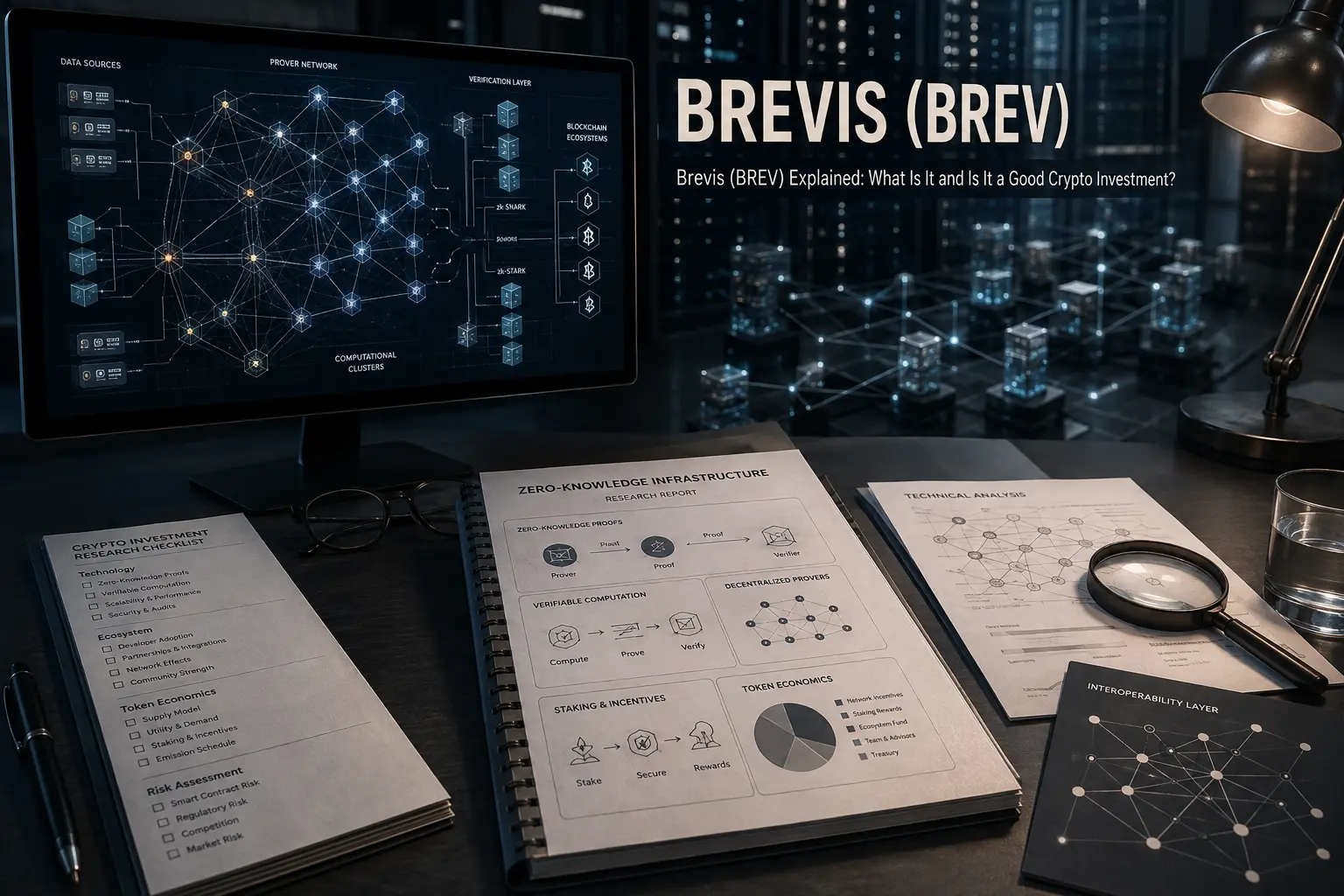
Brevis Explained: How Does It Work?
The cryptocurrency industry has spent years addressing a fundamental challenge: how can blockchain applications perform complex computations without requiring the blockchain itself to process everything?
Blockchains derive their strength from verification, transparency, and consensus, but these same properties can limit computational capacity. A task that takes little effort on a conventional computer may become costly and slow when every participant must verify it.
This is where Brevis comes in.
Brevis is a zero-knowledge infrastructure project focused on verifiable computing. Brevis lets applications do complex calculations off-chain and prove the results on-chain.
In simple terms, Brevis aims to let blockchains use more computation without having to perform it all themselves. The project describes this concept as an “infinite compute layer” for Web3.
The project is particularly interesting from an investment perspective because Brevis is not simply launching another Layer 1 blockchain or another token built around speculation. It is attempting to provide infrastructure that other blockchain applications can use.
Its technology stack includes Pico zkVM, the ZK Data Coprocessor, Pico Prism, and Brevis ProverNet, which went live on mainnet on January 6, 2026.
Understanding BREV’s investment potential starts with understanding what Brevis actually does.
What Problem Is Brevis Trying to Solve?
Traditional blockchain applications have an important limitation.
Smart contracts can verify on-chain information, but accessing large amounts of historical data and performing complex calculations can be expensive.
Imagine a decentralized application wants to determine:
- how much a user has traded over the past year,
- which tokens the user has held,
- whether the user interacted with a particular protocol,
- whether thousands of addresses qualify for rewards,
- or whether a complicated calculation was performed correctly.
A conventional approach might require substantial on-chain computation or rely on a centralized server to perform the calculation.
Both approaches have disadvantages.
On-chain computation can be expensive and constrained by blockchain resources.
A centralized server is cheaper and faster, but users must trust the server to provide the correct answer.
Brevis attempts to provide a third option:
Perform the computation elsewhere, but use zero-knowledge proofs to demonstrate that the result is correct.
That distinction is fundamental to understanding Brevis.
Why Zero-Knowledge Proofs Matter
Zero-knowledge proofs are often associated with privacy, but their usefulness extends beyond hiding information.
They can also establish that a particular computation was performed correctly.
This is important because blockchain systems generally operate under strict trust assumptions.
Instead of saying:
A zero-knowledge system can potentially say:
The blockchain does not necessarily need to know every detail of the computation.
It only needs to verify the proof.
This creates an important separation:
Computation can happen off-chain while verification remains on-chain.
That is the basic concept behind Brevis.
Brevis as a ZK Data Coprocessor
One of Brevis’s core technologies is its ZK Data Coprocessor.
A blockchain coprocessor is an additional computational layer that helps decentralized applications process information that would otherwise be difficult or expensive to handle on-chain.
The ZK component is particularly important because Brevis is designed to produce proofs demonstrating that the resulting computation is based on authentic blockchain data.
This enables applications to analyze historical blockchain activity when making user-specific decisions.
For example, a decentralized exchange could theoretically offer different fees based on a user’s trading history.
A rewards program could calculate distributions based on historical activity.
A DeFi protocol could determine eligibility using information spanning many transactions or blocks.
The main benefit is that applications can use historical data without putting the full processing burden on their smart contracts.
Brevis can perform the computation and provide a proof that the result is correct.
Brevis has previously described production applications involving personalised DEX pricing and large-scale reward calculations as examples of workloads its infrastructure can support.
A Simple Example
Consider a hypothetical decentralized exchange.
It offers users a discount if they traded more than $100,000 over the previous 30 days.
Without a system such as Brevis, the application could face a difficult problem.
It needs to determine:
- Which transactions belong to the user?
- How much did the user trade?
- Which transactions occurred during the relevant period?
- Whether the total exceeds $100,000.
- Whether the discount should therefore apply.
Brevis can potentially perform that calculation using historical blockchain data and generate a zero-knowledge proof of the result.
The smart contract can verify the data without relying entirely on a centralized database.
It can verify the proof.
That is the type of problem Brevis is designed to address.
Pico zkVM: Making Complex Computation Programmable
Another major component of the Brevis technology stack is Pico zkVM.
The term “zkVM” means zero-knowledge virtual machine.
A virtual machine provides an environment in which programs can execute.
A zkVM can generate cryptographic proofs that a program executed correctly.
This is significant because it makes zero-knowledge computation more programmable.
Instead of building a separate proof system for every calculation, developers can write programs that run in the zkVM and generate proofs of their results.
Brevis describes Pico as its general-purpose ZK virtual machine and uses it as a foundation for different types of verifiable computation.
For developers, this can be an important advantage.
The more flexible the computing environment becomes, the greater the range of applications that can potentially use verifiable computation.
Pico Prism and Real-Time Ethereum Proving
Brevis has also developed Pico Prism, which focuses on proving Ethereum block execution in real time.
This is a demanding zero-knowledge use case because the proving system must keep pace with Ethereum’s ongoing block production.
Brevis reports that Pico Prism has achieved 99.8% coverage using 16 GPUs and has been designed around the Ethereum Foundation’s stated $100,000 hardware target. These performance figures come from the project and have not been independently verified, so investors should consider them with caution.
Why does this matter?
Real-time block proving could eventually become an important component of infrastructure connecting blockchain execution with verifiable computation.
Instead of simply trusting that a blockchain executed according to its rules, systems can increasingly use cryptographic proofs to demonstrate what happened.
This illustrates a broader ambition behind Brevis:
Not merely providing one application-specific ZK tool, but building infrastructure for different types of verifiable computation.
Brevis ProverNet: Turning ZK Proof Generation Into a Marketplace
The newest major component of the Brevis ecosystem is ProverNet.
Generating zero-knowledge proofs can require substantial computing resources.
Different proofworkloads can also have entirely unique requirements.
Some applications may prioritize extremely low latency.
Others may need enormous computational throughput.
Another workload might require specialised GPUs or a particular proving architecture.
Brevis argues that no single proving configuration is optimal for every application.
ProverNet attempts to solve this problem by creating a marketplace connecting applications that need proofs with independent provers that have the hardware and expertise to generate them.
The basic process works roughly like this:
Application → Proof Request → Prover Competition → Proof Generation → Verification → Payment
Applications submit proof requirements.
Provers indicate what workloads they can handle and at what cost.
The marketplace matches proof requests with suitable proving capacity.
The prover generates the proof.
The result is verified.
The prover receives payment.
This creates an economic marketplace around zero-knowledge computation.
Where BREV Enters the Picture
This matters to investors because BREV plays a role beyond governance.
Brevis states that BREV is used within ProverNet for:
- proving payments,
- verification and settlement fees,
- prover staking,
- delegated staking,
- and governance.
At the January 6, 2026, ProverNet mainnet launch, BREV became the native payment token for proving fees, while provers were required to stake BREV to receive work.
This creates a potential connection between network activity and token utility.
If demand for verifiable computation increases, demand for proving services could increase.
If ProverNet captures that demand, BREV could potentially become more economically important within the network.
But potential utility does not automatically mean token appreciation.
That distinction will be one of the most important questions we examine later in this article.
Why Brevis Is Different From a Typical Crypto Project
Brevis is better understood as infrastructure rather than simply another cryptocurrency.
It is better understood as a ZK infrastructure project with a native economic asset.
This distinction is important when comparing Brevis with other technically focused crypto projects. For example, Xelis (XEL) takes a very different approach, focusing on its blockchain architecture, privacy-oriented technology, and mining-based network security.
The underlying stack is designed to provide several related capabilities:
ZK Data Coprocessor
→ Access and computation involving historical blockchain data.
Pico zkVM
→ General-purpose verifiable computation.
Pico Prism
→ Real-time Ethereum block proving.
ProverNet
→ Marketplace coordinating applications and ZK proving capacity.
These components are connected by one central idea:
Make computation more powerful while preserving cryptographic verifiability.
That is potentially a large market if zero-knowledge technology becomes increasingly important across decentralized finance, rollups, interoperability, privacy, gaming, identity, and other blockchain applications.
However, a large potential market does not mean Brevis will capture a large market share.
That is where adoption, competition, technical execution, token economics, and value capture become critical.
Brevis Has Already Reached Mainnet
One important distinction between Brevis and an early-stage crypto concept is that ProverNet is already live on mainnet.
Brevis launched ProverNet’s beta in December 2025 before moving to the full mainnet on January 6, 2026. At the mainnet launch, BREV payments, staking, and governance mechanisms became active.
Brevis has also reported that its infrastructure has generated beyond 340 million proofs across 50+ protocols and 8+ blockchains. Again, these are figures reported by Brevis itself, rather than independently audited figures.
That distinction matters.
A project can have impressive technology on paper but little real-world usage.
Brevis at least has evidence of production infrastructure and integrations that existed before the BREV token launched.
The investment question therefore becomes more interesting:
Can Brevis turn this technological infrastructure and existing activity into sustainable demand for the BREV token?
What Is BREV?
BREV is the native utility and governance token of the Brevis ecosystem.
BREV primarily supports Brevis ProverNet, a decentralized marketplace where applications can access zero-knowledge proofs from independent proving providers.
Since ProverNet’s full mainnet launch on January 6, 2026, BREV has served as the native payment token for proving fees. Proof generation, verification, and settlement are denominated in BREV.
BREV has three primary functions:
- Payment
- Staking
- Governance
This matters because the token has a direct role in the network rather than serving only as a speculative asset.
How BREV Is Used
1. BREV Pays for Zero-Knowledge Computation
BREV’s most important utility is paying for proving services.
Applications that need zero-knowledge computation submit jobs to ProverNet.
Provers compete to fulfill those jobs, generate the required proofs, and receive BREV as payment.
The network’s auction mechanism determines the appropriate allocation and pricing based on factors such as proof type, deadline, prover capacity, and cost.
This creates a potentially important economic relationship:
More proof demand → more proving jobs → more BREV used for payments.
However, that relationship should not be interpreted as automatic price appreciation.
The amount of BREV required by the network, token circulation, and the value captured by token holders all matter.
That question is especially important when evaluating BREV’s long-term investment potential.
2. Provers Must Stake BREV
BREV also helps secure the ProverNet marketplace.
Provers must stake BREV, or receive delegated stake from token holders, to qualify for proving jobs.
This creates an economic incentive for provers to perform their work correctly.
A prover that accepts a job but fails to meet the required conditions may lose part of its staked tokens. Brevis says the system uses staking for Sybil resistance, economic alignment, and capacity signaling.
This gives BREV another form of utility.
Tokens are not merely being transferred between buyers and sellers.
Some BREV can be locked as economic collateral inside the network.
3. Token Holders Can Delegate BREV
Not every BREV holder needs to operate proving hardware.
Token holders can delegate their BREV to professional provers.
Delegators can receive a portion of prover fees, but their delegated stake remains subject to the network’s staking and slashing rules.
This creates a potential income-generating role for BREV beyond simply holding the token.
But it also introduces risk.
Delegators are exposed to the performance of the prover they choose. If a prover fails to meet its obligations and is penalized, delegated stake can also be affected.
Therefore, staking BREV should not be viewed as a risk-free yield mechanism.
4. BREV Provides Governance
BREV is also the governance token for ProverNet.
Token holders can participate in decisions concerning important network parameters.
These include areas such as:
- Proof-size limits
- Security requirements
- Slashing rates
- Auction fees
- Other protocol parameters
At mainnet launch, Brevis set initial governance parameters, including a cryptographic security level above 100 bits, a proof-size limit below 1 MB, a 1% starting slashing rate, and a 3% auction market fee.
This gives BREV governance utility in addition to its payment and staking functions.
BREV has a maximum supply of 1 Billion Tokens
BREV has a maximum total supply of 1 billion tokens.
The allocation is divided across five major categories:
| Allocation | Percentage | Tokens |
|---|---|---|
| Ecosystem Development | 37.0% | 370 million |
| Community Incentives | 28.7% | 287 million |
| Team | 20.0% | 200 million |
| Investors | 10.8% | 108 million |
| Airdrops | 3.5% | 35 million |
| Total | 100% | 1 billion |
These figures align with published tokenomics data tracking Brevis allocation and vesting.
At first glance, the distribution appears heavily weighted toward the ecosystem and community.
That is generally preferable to a token where a massive percentage is concentrated among founders and private investors.
However, investors should not stop at the allocation percentages.
The unlock schedule matters just as much.
The Important Part: BREV Token Unlocks
One of the biggest risks for BREV investors is future supply expansion.
At its Token Generation Event, approximately 250 million BREV—or 25% of total supply—was unlocked according to Tokenomics.com.
That means a substantial amount of the eventual 1 billion-token supply was not immediately circulating.
Future token releases can therefore increase the number of BREV available to the market.
This creates potential dilution.
Imagine a cryptocurrency with 250 million tokens circulating today.
If another 250 million tokens gradually enter circulation while demand remains unchanged, the market has to absorb twice as many tokens.
That does not automatically mean the price will fall.
If network usage and demand grow quickly enough, the market can absorb additional supply.
But if demand fails to keep pace with new tokens entering circulation, the additional supply can create selling pressure.
This is one of the most important variables BREV investors need to monitor.
Team and Investor Unlocks
The team allocation represents 20% of the total supply, or 200 million BREV.
The investor allocation represents another 10.8%, or 108 million BREV.
These allocations matter because they were not immediately unlocked at the Token Generation Event.
Current vesting trackers show team and investor allocations subject to an initial one-year cliff followed by linear vesting.
This means investors should pay particular attention to the period beginning around late 2026 and into 2027, when previously locked team and investor tokens begin entering circulation.
That does not mean the team or investors will necessarily sell.
Long-term investors may continue holding their tokens.
Some may stake them.
Some may use them within the ecosystem.
Investors should still account for future token supply when valuing BREV.
Ecosystem and Community Allocations
BREV allocates the largest share of its supply to ecosystem development and community incentives.
Together, these categories represent 65.7% of the total supply.
That is significant.
A large ecosystem allocation can provide resources for:
- Developer incentives
- Network growth
- Liquidity programs
- Ecosystem applications
- Community rewards
- Prover participation
- Future strategic initiatives
This means investors should also consider how quickly tokens enter circulation and how they are used.
A large ecosystem allocation can help a network grow.
It can also create selling pressure if tokens are distributed aggressively without corresponding demand.
This means token distribution matters more than the headline percentage alone.
The Airdrop Allocation
Brevis allocated 3.5% of the total BREV supply, or 35 million tokens, to airdrops.
According to current vesting data, the airdrop allocation became fully unlocked in July 2026.
Airdrops can help bootstrap an ecosystem by distributing ownership to early users and contributors.
However, they can also create short-term selling pressure.
Some recipients may have received BREV at little or no monetary cost.
Immediate selling can add tokens to the market without generating enough demand to absorb the additional supply.
For BREV investors, the important question is therefore not simply whether an airdrop occurred.
It is whether the recipients eventually become long-term users, stakers, contributors, or supporters of the network.
Why Tokenomics Could Become a Major BREV Issue
The tokenomics create an interesting balance for BREV.
On one side, the token has genuine network utility:
Payments → Staking → Delegation → Governance
On the other side, a large portion of the total supply remains subject to future distribution and vesting.
That produces two competing forces.
Potentially positive force
More Brevis usage could create additional demand for BREV, as applications pay for proving services and provers stake tokens to participate.
Potentially negative force
Future unlocks could increase the available supply and create selling pressure if demand does not grow sufficiently.
The investment case therefore depends partly on whether network growth can outpace token dilution.
That is a much more useful way to think about BREV than simply asking whether its technology is impressive.
Brevis Already Has Significant Ecosystem Activity
BREV is not launching into an empty ecosystem.
Before ProverNet became fully operational, Brevis reported that its infrastructure had already generated hundreds of millions of zero-knowledge proofs across numerous blockchain applications.
Brevis said in December 2025 that ProverNet had surpassed 250 million proofs across more than 30 partners, including PancakeSwap, Uniswap, BNB Chain, Linea, and MetaMask.
Later, Brevis materials reported well over 340 million proofs across 50+ protocols and 8+ blockchains.
These metrics come from Brevis and should not be treated as independently audited adoption figures.
The network already had real usage before BREV became its native payment asset.
That is an important distinction.
Why Existing Adoption Is Relevant for BREV
Consider two hypothetical projects.
Project A
A blockchain launches a token first and promises that applications will eventually use its infrastructure.
Project B
The platform already supports real applications before introducing a token that becomes part of its economic system.
Brevis is closer to the second model.
ProverNet had already been generating proofs and working with protocols before its full mainnet launch.
These developments do not guarantee BREV will succeed.
But it provides a more substantial foundation than a project whose entire investment thesis depends on future adoption.
Existing Applications of Brevis
Brevis has positioned its technology for applications that require access to historical blockchain data and computationally intensive verification.
Examples include:
- Dynamic trading fees
- Reward distributions
- Loyalty programs
- Historical user activity
- Blockchain data analysis
- Ethereum block proving
- Other ZK-based computation
Brevis has also highlighted integrations involving protocols and infrastructure providers such as PancakeSwap, Uniswap, BNB Chain, Linea, and MetaMask.
The key investment question is not simply how many partnerships Brevis has announced.
It is:
How much economic activity will those integrations eventually generate for ProverNet?
That distinction becomes more important as the project expands from proving technology into a broader decentralized proving marketplace.
ProverNet Could Change the Economic Model
Before ProverNet, applications could use Brevis infrastructure for specific workloads.
ProverNet creates a broader marketplace where different proving providers compete for jobs.
This could potentially improve:
- Pricing
- Availability
- Proving capacity
- Hardware specialization
- Competition between providers
- Resistance to vendor lock-in
Brevis designed ProverNet around the TODA (Truthful Online Double Auction) mechanism, which matches proof requests with appropriate proving capacity.
The concept is relatively straightforward.
Instead of every application building and maintaining its own expensive proving infrastructure, it could potentially purchase proving capacity from a marketplace.
If successful, ProverNet could become an infrastructure marketplace for zero-knowledge computation.
And that is potentially much larger than simply being a tool for individual applications.
But Adoption Alone Is Not Enough
This is where investors need to be careful.
A project can generate millions of proofs without necessarily generating a substantial economic price for its token.
The critical variables are:
How much proofing demand exists?
How much BREV is required to service that demand?
How much BREV is locked in staking?
How much BREV is circulating freely?
How much revenue does the network generate?
How much does the cost ultimately accrue to BREV holders?
Those questions are more important than raw proof counts.
A network can be heavily used while its token remains weak if the token captures little of the cost generated by that activity.
The Early BREV Investment Picture
At this stage, the picture is mixed—but interesting.
What looks promising
Real technology: Brevis is building actual ZK infrastructure rather than simply marketing a speculative token.
Mainnet: ProverNet has been live since January 2026.
Token utility: BREV is used for payments, staking, delegation, and governance.
Existing integrations: Brevis reports usage across dozens of protocols and multiple blockchains.
Potential network effects: More applications could create more proof of demand, while more providers could increase available capacity.
What concerns investors should watch
Future dilution: A significant portion of the 1 billion-token supply remains subject to vesting.
Team and investor unlocks: These begin becoming particularly important after the one-year cliff.
Competition: Brevis operates in a rapidly developing ZK infrastructure market.
Value capture: Network growth does not automatically translate into BREV price appreciation.
Execution risk: ProverNet needs to attract both applications and proving providers at meaningful scale.
Token demand: BREV needs sustained demand from network activity, not just speculation.
Bottom Line
BREV has something many speculative crypto tokens lack: a direct role in an operating infrastructure network.
Applications pay proof fees in BREV.
Provers stake BREV to participate.
Token holders can delegate BREV.
Governance uses BREV.
And ProverNet is already live.
At the same time, investors should not overlook the other side of the equation.
BREV has a maximum supply of 1 billion tokens, with substantial allocations still subject to future vesting. Team and investor tokens, in particular, become an increasingly important consideration as their unlock periods approach.
The most important question is therefore not:
“Is Brevis good technology?”
It is:
“Can Brevis generate enough real economic activity to create sustainable BREV demand faster than new supply enters the market?”
The answer will show whether BREV is just an interesting ZK infrastructure token or has the potential to become a strong long-term investment.
Is Brevis (BREV) a Good Crypto Investment?
The most important question is no longer simply what Brevis does.
The bigger question for investors is whether the technology, network activity, token economics, and competitive position can eventually create enough demand for BREV to justify its valuation.
Brevis is an interesting project because BREV is not designed merely as a governance token. It is intended to have an economic role inside the Brevis ProverNet ecosystem, where it is used for payments, staking, rewards, and governance.
But that does not automatically make BREV a good investment.
Investors should evaluate BREV using the same principles that apply to other cryptocurrencies, including valuation, risk, tokenomics, adoption, and potential return. For a broader framework, see our complete guide to cryptocurrency investing.
A balanced investment thesis should examine both what could make Brevis valuable and what could undermine the investment case.
The Bull Case for Brevis
Brevis has several qualities that may make it attractive to investors.
1. BREV Has Actual Network Utility
One of BREV’s main strengths is its direct utility within the protocol.
According to Brevis, proving fees on ProverNet are paid in BREV. Provers receive BREV for completing proof-generation work, while provers and delegators use BREV as economic collateral for network security.
This creates a potentially important connection:
More proving demand → more network activity → more BREV used for services and economic security.
That is considerably different from a token whose primary purpose is speculation.
The model is particularly interesting if applications increasingly need verifiable computation across blockchain networks.
2. Brevis Is Positioned Around a Growing ZK Infrastructure Market
Zero-knowledge technology is becoming an important part of blockchain infrastructure.
ZK systems can move complex computations off-chain and use cryptographic proofs to verify the results on-chain.
Brevis is attempting to turn this concept into infrastructure that applications can use.
That gives the project exposure to several potentially important areas:
- Zero-knowledge infrastructure
- Cross-chain applications
- Verifiable computation
- On-chain data
- AI-related verification
- Decentralized proving markets
The broader decentralized infrastructure market also includes projects focused on AI rather than zero-knowledge computation. Bittensor (TAO), for example, takes a different approach by building a decentralized network for AI-related services and machine intelligence.
Brevis has also expanded its product ecosystem beyond its original ZK coprocessor concept, with ProverNet becoming a decentralized marketplace for proof generation. Its mainnet and BREV token launched in January 2026.
That shift matters because it moves Brevis from a technology concept toward a functioning economic network.
The Biggest Bullish Factor: Real Usage
For investors, technology alone is not enough.
The critical question is whether developers actually use Brevis.
A blockchain infrastructure project can have impressive cryptography, experienced developers, and strong venture backing but still be a poor investment if there is no lasting demand for its services.
Brevis, therefore, needs to demonstrate continued growth in:
- Proof-generation demand
- Developer integrations
- Applications using Brevis
- Prover participation
- Staking activity
- Network fees
- Cross-chain usage
- Recurring demand for verifiable computation
The stronger these metrics become, the stronger the fundamental argument for BREV becomes.
And importantly, Brevis’s ProverNet model is designed around actual computational work. Applications submit proof requests, while competing provers provide the necessary computation.
That creates a potentially measurable business model.
The Bear Case for BREV
The investment case becomes considerably more complicated when we examine the risks.
1. Brevis Faces Serious Competition
Brevis isn’t operating in an empty market.
The broader ZK infrastructure sector includes numerous projects working on proving, interoperability, coprocessors, ZK virtual machines, and verifiable computation.
This means Brevis doesn’t simply need to build useful technology.
It needs to become one of the technologies developers actually choose.
Competition could come from:
- Other ZK coprocessors
- General-purpose ZK infrastructure
- Alternative proving networks
- Layer-1 and Layer-2 native solutions
- Specialized infrastructure providers
- Internal proving systems developed by major protocols
This is one of the biggest risks investors should monitor.
If the market grows but Brevis captures only a small portion of it, BREV may not benefit as much as the overall ZK sector.
2. Token Unlocks Could Create Selling Pressure
This is perhaps one of the most important issues for prospective BREV investors.
BREV has a fixed maximum supply of 1 billion tokens.
The allocation is:
- 37%—Ecosystem Development
- 28.7%—Community Incentives
- 20% — Team
- 10.8% — Investors
- 3.5% — Airdrop
Brevis states that the initial circulating supply at token generation was 25%, or 250 million BREV. Team and investor tokens were locked for the first year and then scheduled to vest gradually over 24 months.
This distinction is significant.
A token can appear inexpensive based on its current market capitalization while still having substantial future dilution.
For example, CoinGecko currently reports roughly 250 million BREV circulating against a 1 billion maximum supply, meaning only about one-quarter of the maximum supply is currently circulating.
That means investors should not look only at today’s market capitalization.
They should also examine the fully diluted valuation (FDV).
Why FDV Matters
Suppose BREV trades at a certain price while only 25% of its maximum supply is circulating.
If the remaining tokens gradually enter the market, the amount of supply available to investors increases substantially.
For BREV, this makes the future relationship between:
token supply growth + network demand
particularly important.
If demand grows faster than circulating supply, dilution may be absorbed.
If supply grows faster than demand, the token price can face persistent pressure.
This is precisely why investors should monitor BREV’s unlock schedule rather than treating the token’s current circulating supply as permanent.
3. The Token Needs More Than Technology to Accrue Value
This is a subtle but critical point.
A successful protocol does not automatically mean its token becomes a successful investment.
For BREV to perform well over the long term, investors need to see a meaningful relationship between network growth and token demand.
Brevis has designed BREV to serve as:
- Payment currency
- Staking collateral
- Prover economic security
- Reward mechanism
- Governance asset
Those functions are positive.
But investors should still ask:
That is ultimately a quantitative question.
If network usage rises sharply while BREV demand remains low relative to its available supply, the investment case weakens.
Conversely, if proving activity generates significant recurring demand for BREV, the token’s utility becomes much more economically meaningful.
4. Zero-Knowledge Technology Is Extremely Complex
Brevis operates in one of the most technically sophisticated areas of cryptocurrency.
Zero-knowledge systems involve complicated cryptography, proving systems, virtual machines, smart contracts, and infrastructure.
That creates another risk:
Technical complexity creates a large attack surface.
A vulnerability in an important component could damage user confidence and adoption.
BREV’s clear role within the protocol is one of its main strengths.
It is intended to provide verifiable computational infrastructure for blockchain applications.
Security failures could therefore have consequences beyond token price.
Investors should monitor:
- Security audits
- Smart-contract upgrades
- Prover reliability
- Cryptographic assumptions
- Network incidents
- Bug disclosures
- Decentralization of proving infrastructure
The more value that flows through the network, the more important these factors become.
5. Adoption May Take Longer Than Investors Expect
Another risk is the difference between technological potential and actual adoption.
Blockchain infrastructure can take years to mature.
Developers may need to integrate Brevis into applications, test the technology, evaluate costs, and determine whether the benefits justify the additional complexity.
Therefore, investors should be careful with narratives such as:
That is not enough.
The real investment thesis needs to be:
That is a much stronger argument because it can eventually be tested against actual data.
Is BREV Undervalued?
This is where investors should be particularly careful.
CoinGecko currently shows BREV with a market capitalization of roughly $16.7 million, while its fully diluted valuation is around $66.9 million based on the reported circulating and maximum supplies. The token is also trading substantially below its January 2026 all-time high.
At first glance, that may make BREV look extremely cheap.
But a low market capitalization does not automatically mean undervaluation.
A cryptocurrency can have a tiny market cap because:
- The market believes the project has limited potential.
- The token is still very early.
- The token has experienced heavy selling.
- Future dilution is significant.
- Adoption is still limited.
- Investors have not yet recognized the project.
- The technology has not yet demonstrated sufficient demand.
The challenge is determining which explanation best reflects reality.
Therefore, I would not describe BREV as definitively “undervalued” simply because its market cap is small.
A better description is:
BREV is a small-cap, early-stage infrastructure token with significant upside potential but substantial execution, competition, adoption, and dilution risks.
What Would Make Me More Bullish on BREV?
Several developments could significantly strengthen the investment case.
Stronger ProverNet usage
Sustained growth in proof requests and computational workloads would indicate growing demand for the network.
Rising network fees
Increasing fees generated from actual proving activity would be particularly important.
More major applications
Brevis becoming deeply integrated into recognizable blockchain applications would demonstrate that developers consider the infrastructure valuable.
Growing staking activity
Increasing BREV staking and delegation could demonstrate stronger economic participation in the network.
Reduced dilution pressure
As the major team and investor unlock progress, the market may eventually have greater visibility into the token’s mature circulating supply.
Strong developer activity
Continued development, open-source contributions, integrations, and technical improvements would strengthen the fundamental thesis.
In other words, investors should watch usage rather than hype.
What Would Make Me More Bearish?
The opposite signals would be concerning.
For example:
- ProverNet usage remains weak.
- Network fees remain negligible.
- Developer adoption stagnates.
- Competitors gain substantially more market share.
- Large token unlocks overwhelm demand.
- Team or investor selling increases.
- Security problems emerge.
- BREV utility remains mostly theoretical.
- The ecosystem depends primarily on speculation rather than actual usage.
If several of these occur simultaneously, the investment thesis would weaken considerably.
BREV vs. Buying an Established Cryptocurrency
There is another important consideration.
Buying BREV is fundamentally different from buying an established cryptocurrency such as Bitcoin or Solana.
Investors comparing newer crypto projects with established blockchain networks may also want to compare Monad and Solana as investments.
An established network generally has:
- Larger user bases
- Deeper liquidity
- Longer operating histories
- Larger developer ecosystems
- Greater market recognition
BREV is much earlier in its development cycle.
That means the potential upside could theoretically be much greater if Brevis becomes a major ZK infrastructure network.
But the probability of failure is also significantly higher.
This is the classic small-cap asymmetric-risk trade-off.
You are not simply betting on a token price.
You are effectively betting that:
Brevis technology → developer adoption → network activity → economic demand → BREV value
Will develop successfully.
If one of these links breaks, it could weaken the entire investment case.
So, is Brevis (BREV) a Good Crypto Investment?
My answer: BREV may have strong potential, but its long-term investment case remains unproven.
The project has several characteristics that make it worth watching.
Brevis combines proven technology, a clear use case, a live ProverNet network, and a token with real protocol utility. BREV is used for payments, staking, economic security, and governance rather than existing solely as a speculative asset.
However, the investment case is still relatively young.
The biggest uncertainties are:
adoption, competition, token dilution, network revenue, technical risk, and long-term value capture.
That combination makes BREV potentially attractive to investors comfortable with early-stage crypto infrastructure, but less suitable for those seeking a lower-risk cryptocurrency.
My Investment Framework for Brevis
Rather than asking, “Should I buy BREV?” I would divide the thesis into five questions:
| Factor | Assessment |
|---|---|
| Technology | Promising |
| Token utility | Strong conceptually |
| Market opportunity | Potentially large |
| Competition | High |
| Investment risk | Very high |
The most important category to watch now is actual adoption.
If Brevis successfully turns its ZK infrastructure into a widely used service and ProverNet generates substantial recurring activity, today’s small valuation could eventually look completely unique.
But if adoption fails to materialize, the token’s low valuation could prove justified.
Final Verdict: Watch Brevis, But Don’t Confuse Potential With Proof
Brevis is one of the more interesting smaller cryptocurrency infrastructure projects because its investment story is connected to a genuine technological problem.
The project isn’t simply trying to create another blockchain token.
It is attempting to make verifiable computation and blockchain data more accessible to decentralized applications.
ProverNet creates a marketplace where applications purchase proving services from competing provers, with BREV supporting payments, staking, incentives, and governance.
This gives BREV a stronger fundamental basis than tokens driven primarily by community hype.
But the market still has to prove that Brevis can capture meaningful demand.
For that reason, I would place BREV in the category of:
High potential + high uncertainty + high risk.
If that happens, the network could have much greater economic value.
The question is whether Brevis can become infrastructure that developers actually depend on.
If that happens, the network could become much more economically valuable.
Without that value capture, even excellent technology may not make BREV a successful investment.
The technology is promising. The token has real utility. The opportunity is potentially large. But the investment thesis still needs to be proven through adoption, network activity, and sustainable economic demand.
That is ultimately what investors should watch next.
A low price alone is not a reason to buy BREV. Buy only if you understand the technology, token economics, dilution schedule, competitive landscape, and risks—and believe the network can generate substantially more real demand over time.
Bottom line
Brevis (BREV) is worth researching and watching, but it is not yet a low-risk investment. Its strongest argument is the combination of ZK infrastructure, real protocol utility, and a usage-based ProverNet economy. Its biggest weaknesses are early-stage adoption, intense competition, token unlocks, and the inherent technical complexity of zero-knowledge infrastructure.
For a diversified crypto portfolio, BREV is better suited as a small, high-risk speculative position than as a core holding.
And as with any cryptocurrency, the possibility of losing most or all of the investment remains real.