

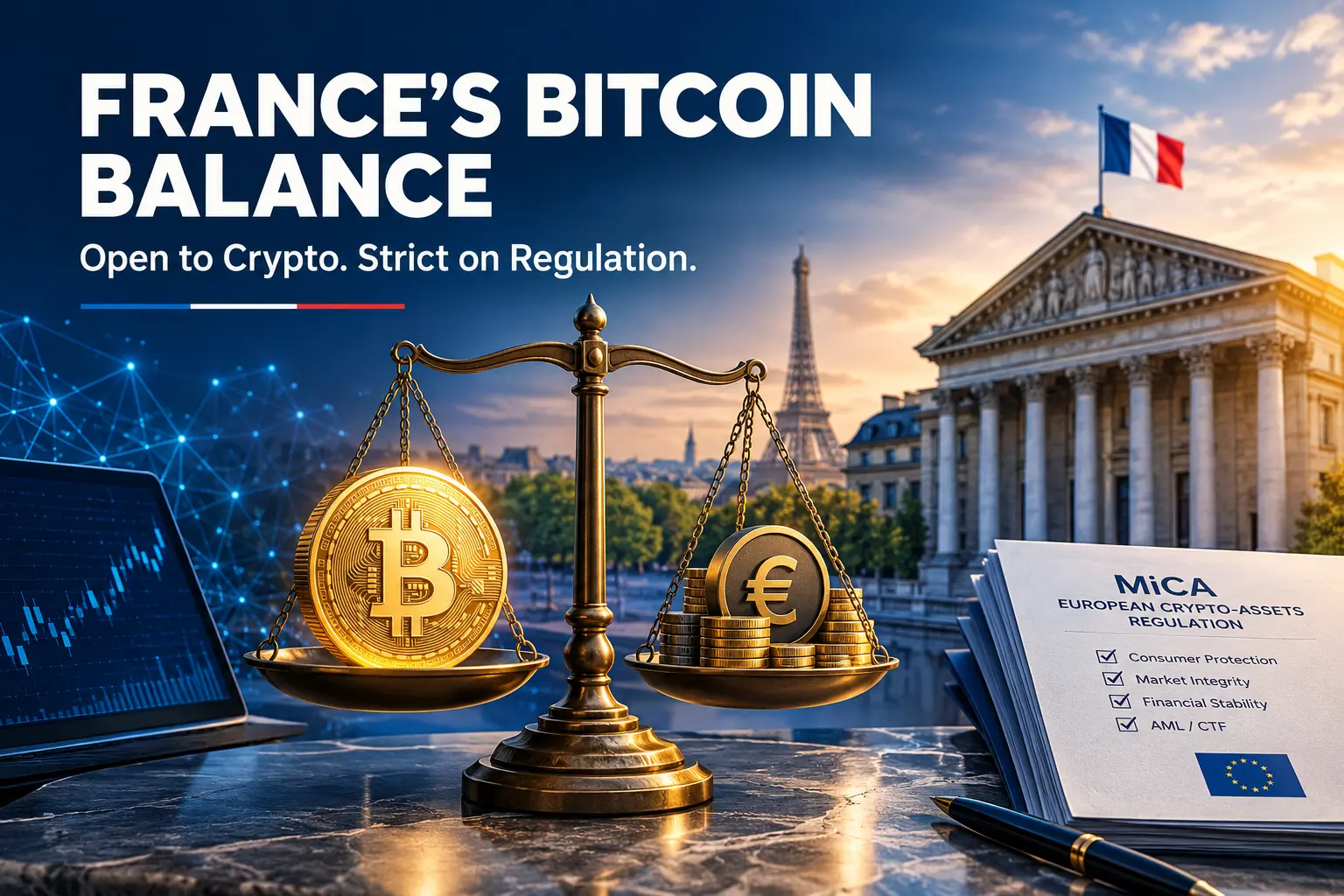
France does not ban Bitcoin. People can generally buy, hold, sell, and use Bitcoin when a merchant voluntarily accepts it.
However, France does not recognize Bitcoin as legal tender. The euro remains the country’s official currency, while Bitcoin is classified as a crypto-asset whose value fluctuates with market forces.
This creates an important distinction. France allows access to Bitcoin, but it regulates the companies and financial services connected to it. The government supports blockchain and digital-finance innovation, yet it also wants crypto businesses to follow rules designed to reduce fraud, money laundering, market abuse, and consumer losses.
France’s approach is therefore neither a complete rejection of Bitcoin nor unconditional support for the cryptocurrency industry. It is a regulated acceptance model.
France Allows Bitcoin but Does Not Treat It as Official Money
Individuals in France can legally buy, own, sell, and hold Bitcoin. Users can purchase it through a crypto platform, transfer it to a wallet they control, or sell it for euros at the current market price.
Businesses may choose to accept Bitcoin as payment, yet merchants face no general obligation to do so.
The French government draws a clear line between cryptocurrencies and official money. A merchant may accept Bitcoin, but Bitcoin does not have the same legal status as the euro.
The euro remains France’s legal tender. Neither the French authorities, the European Central Bank, nor the Banque de France issues or guarantees Bitcoin.
The French government further cautions that crypto-assets carry no state guarantee and that their value can fluctuate sharply.
economie.gouv.fr
This means that legal access does not equal government endorsement. France treats Bitcoin as a digital asset but does not guarantee its value or give it official monetary status.
Why Bitcoin Is Not Legal Tender in France
Legal tender refers to currency that creditors are, as a rule, bound by statute to accept in payment of debts.
France designates the euro as its sole legal tender. The euro is the only currency recognized as legal tender in France. Bitcoin does not share this status, as it operates outside central-bank control and without French state backing.
Bitcoin has several characteristics that distinguish it from government-issued money:
Its supply is determined by its protocol.
It records transactions on a decentralized network.
Its price changes according to market demand.
The French state provides neither financial support nor a guarantee for Bitcoin.
Merchants are not required to accept it.
Users do not receive a government guarantee against losses.
Bitcoin’s decentralized design is one of its main attractions. Bitcoin supports peer-to-peer transactions that operate independently of central-bank network management.
However, the same design also creates challenges for governments. France must still exercise authority over tax compliance, financial crime, consumer protection, and the resilience of its financial system.
The government can permit Bitcoin without recognizing it as an alternative national currency.
France Does Not Directly Control the Bitcoin Network
France can regulate businesses that interact with Bitcoin, but it does not control the Bitcoin blockchain itself.
Miners, node operators, developers, and users in different countries all help keep the network running. No French government agency determines:
How many bitcoins will ever exist
Which transactions are added to the blockchain
How Bitcoin mining operates
Whether a transaction should be reversed
How the protocol’s monetary policy should change
Bitcoin’s fixed maximum supply is embedded in its software protocol, not determined by any decision of the French government.
That is why Bitcoin requires a distinct regulatory approach, unlike the frameworks designed for banks or companies. France cannot simply control the Bitcoin network from within its borders.
Instead, it can regulate the platforms and services people use to access the crypto market.
These gateways include exchanges, brokers, custodians, payment providers, and other companies that offer professional crypto services.
France Regulates the Businesses Around Bitcoin
France mainly regulates companies and financial services connected to crypto-assets.
These businesses may provide:
- Buying and selling Bitcoin
- Exchange between crypto-assets
- Exchange between crypto-assets and euros
- Custody of digital assets
- Operation of trading platforms
- Brokerage services
- Crypto transfers
- Portfolio management
- Investment advice
- Other professional crypto services
A person may hold Bitcoin in a personal wallet. However, a company that professionally safeguards customer assets or operates a trading platform must comply with applicable regulatory requirements.
This approach allows the Bitcoin network to remain decentralized while placing obligations on businesses that handle customer money or provide financial services.
The distinction is important:
The Role of the PACTE Law
France created an early national framework for cryptocurrency businesses through the PACTE law, adopted in 2019.
The framework introduced rules for digital-asset service providers, commonly known in France as PSANs. It established registration and licensing mechanisms for businesses involved in certain crypto services.
The system covered activities such as:
- Digital-asset custody
- Buying or selling digital assets for euros
- Exchange between digital assets
- Operation of a digital-asset trading platform
- Other related services
The aim was to give legitimate businesses a clear legal framework while increasing transparency and reducing fraud and money-laundering risks.
The idea was that clear legislation could attract legitimate companies rather than push the entire crypto sector outside the formal financial system in France.
The PACTE framework also gave consumers a way to check whether a crypto business was registered or licensed by the French financial regulator, the Autorité des Marchés Financiers, or AMF.
However, France’s national framework was eventually replaced by a broader European system.
MiCA Changed the Rules for Crypto Businesses
MiCA refers to the Markets in Crypto-Assets Regulation.
It creates a common regulatory framework for crypto-asset activities across the European Union. Instead of each country relying entirely on its own national rules, crypto businesses must follow shared European requirements.
MiCA covers areas such as:
- Crypto-asset service providers
- Trading platforms
- Custody and administration of crypto-assets
- Exchange services
- Brokerage
- Portfolio management
- Crypto-asset transfers
- Token issuance
- Stablecoins
- Market integrity
- Consumer protection
The policy is not designed to ban Bitcoin. It aims to regulate professional services involving crypto-assets.
The AMF explains that MiCA establishes a harmonized European framework and imposes operational, organizational, and prudential requirements on service providers. The AMF says these requirements are intended to protect investors and support fair markets.
AMF France
MiCA also allows authorized providers to benefit from a European passport, meaning they may be able to offer their services across other EU countries under the framework’s conditions.
The French MiCA Transition Period Ended in 2026
France allowed certain businesses operating under the previous PACTE framework to continue during a temporary transition period.
The transition period ended on 1 July 2026. From that date, providers that had not obtained the required MiCA authorization generally had to stop providing regulated crypto-asset services in France.
The AMF warned that providers not authorized as crypto-asset service providers under MiCA had to cease their activities from 1 July 2026.
AMF France
The AMF said that digital-asset providers that missed the MiCA license deadline were no longer listed in the national register.
AMF France
The change represents an important shift for the industry, but individuals can still legally own Bitcoin.
The main effect is on companies that provide professional crypto services.
What MiCA Means for Bitcoin Users
For ordinary Bitcoin users, MiCA mainly affects the platforms and service providers they use.
A regulated crypto provider may be required to meet standards involving:
- Governance
- Financial resources
- Risk management
- Customer information
- Complaint handling
- Asset custody
- Operational security
- Anti-money-laundering controls
- Market-abuse prevention
These requirements may improve market transparency while reducing certain operational risks.
For example, regulated providers should clearly explain their services, maintain appropriate internal controls, and follow regulations concerning customer assets and business practices.
However, rules do not remove every risk.
Even if a platform is authorized, Bitcoin can still experience major price declines. A regulated exchange cannot guarantee investment profits, prevent every cyberattack, or protect investors from the market’s volatility.
This distinction should remain clear:
The AMF and ACPR Have Different Responsibilities
Two French authorities are particularly important in the crypto sector: the AMF and the ACPR.
The AMF
The Autorité des Marchés Financiers is France’s financial markets regulator.
Its responsibilities include areas involving:
- Investor protection
- Market integrity
- Crypto-asset service providers
- Information provided to consumers
- Authorization and supervision under the applicable framework
The AMF also warns the public about unauthorized platforms and misleading investment offers.
Its role is especially relevant when a company offers crypto trading, custody, brokerage, or investment-related services.
The ACPR
The Autorité de contrôle prudentiel et de résolution, or ACPR, is connected to the Banque de France and focuses on prudential supervision and financial-sector stability.
Its responsibilities include areas involving:
- Financial institutions
- Payment services
- Prudential requirements
- Anti-money-laundering and counter-terrorist-financing controls
- Certain crypto-asset service providers
- Stablecoin-related activities
The ACPR explains that MiCA covers the offer of crypto-assets, stablecoins, crypto-asset services, and the prevention of market abuse.
The two authorities therefore contribute to different parts of the regulatory system. The AMF focuses mainly on market conduct and investor protection, while the ACPR deals more with financial stability and payment-related matters.
Why France Supports Innovation but Maintains Controls
France wants to attract technology companies and strengthen its financial sector.
Blockchain technology may support applications involving:
- Digital identity
- Supply-chain tracking
- Financial settlement
- Tokenized assets
- Cross-border payments
- Document verification
- Digital ownership records
- Decentralized applications
The French government has described blockchain as a technology that can support crypto-asset transactions and other business applications.
Supporting blockchain does not mean supporting every cryptocurrency project.
France can encourage innovation while remaining cautious about:
- Fraudulent token offerings
- Unlicensed exchanges
- Money laundering
- Tax evasion
- Market manipulation
- Consumer losses
- Cybersecurity failures
- Financial instability
This is why the government’s position is more accurately described as support for regulated digital-finance innovation.
Bitcoin’s Decentralization Creates a Policy Tension
Bitcoin was designed to operate without a central authority controlling its supply or transactions.
Its supporters often value:
- Limited supply
- Decentralized ownership
- Permissionless transactions
- Financial independence
- Resistance to monetary manipulation
- Reduced dependence on traditional financial institutions
- These characteristics can sometimes conflict with government responsibilities.
France must maintain systems for:
- Tax collection
- Anti-money-laundering enforcement
- Fraud prevention
- Consumer protection
- Sanctions compliance
- Financial stability
Market supervision
The government may therefore accept Bitcoin while rejecting the idea that private cryptocurrencies should replace the euro or operate completely outside financial oversight.
This does not necessarily mean France is hostile to Bitcoin. It means that the government distinguishes between the technology itself and the financial activities built around it.
France Is Especially Cautious About Stablecoins
Stablecoins are different from Bitcoin because they are designed to maintain a relatively stable value, often by referencing a currency such as the euro or US dollar.
They may be used for:
- Trading
- Payments
- Transfers
- Liquidity management
- Settlement
- Decentralized finance
However, stablecoins raise additional concerns because they can become closely connected to the traditional financial system.
Regulators want to know:
- Whether the token is properly backed
- Whether users can redeem it
- Whether reserves are sufficient
- Who controls the issuer?
- Whether the token creates financial-stability risks
- Whether it complies with European rules
The ACPR has noted that certain stablecoin services may also fall under payment-services requirements, particularly when they involve electronic-money tokens.
acpr.banque-france.fr
This suggests that France and the EU may be open to regulated digital money while remaining cautious about privately issued currencies that could operate at a large scale.
What French Bitcoin Investors Should Understand
Crypto platforms and related businesses must follow French and European rules (especially MiCA).
Investors should consider the following:
Check the Provider’s Authorization
Before using an exchange or crypto service, users should verify whether the company is authorized under the applicable French or European framework.
A platform’s marketing claims are not enough. Users should check official regulatory information rather than relying only on advertisements, social-media promotions, or influencer recommendations.
For broader guidance, see The Complete Guide to Cryptocurrency Investing.
Understand That Bitcoin Is Not Guaranteed
These risks matter more when household budgets are under pressure, as discussed in Why France Is Facing a Cost of Living Crisis.
Bitcoin is not a bank deposit and does not have the same government protection.
Its price can decline sharply, and users can lose money through:
- Market volatility
- Hacking
- Fraud
- Phishing
- Lost private keys
- Platform failures
- Incorrect transfers
- Poor security practices
- Keep Records of Transactions
Crypto users should maintain records of purchases, sales, transfers, and other relevant activity.
The French government states that holding crypto-assets is generally not taxable, while certain realized gains from selling crypto-assets for fiat currency may be taxable. In a personal investment context, the government identifies a flat tax framework that includes income tax and social contributions.
Tax treatment can vary depending on the nature of the activity, so investors should consult current official guidance or a qualified tax professional.
Do Not Confuse Regulation With Safety
A regulated platform may offer stronger safeguards than an unauthorized service, but authorization does not mean that every product is suitable for every investor.
Bitcoin remains a volatile asset. Regulation can improve business conduct, but it cannot remove the fundamental risks of cryptocurrency markets.
Frequently Asked Questions (FAQs)
Yes. Owning, buying, selling, and transferring Bitcoin are generally legal in France. However, Bitcoin is not recognized as legal tender, and crypto-related businesses must follow applicable French and European rules.
No. Bitcoin is not legal tender in France. The euro is the official currency, and businesses are not generally required to accept Bitcoin as payment.
Yes. A French business may choose to accept Bitcoin if it has the necessary commercial and accounting arrangements. However, businesses are not generally obligated to accept it, and accepting Bitcoin does not make it an official currency.
France does not directly control the Bitcoin network. The Bitcoin network runs on a decentralized blockchain maintained by a globally distributed set of participants. French authorities mainly regulate the companies and financial services connected to Bitcoin.
MiCA stands for the Markets in Crypto-Assets Regulation. It is the European Union’s framework for regulating crypto-asset issuers and service providers. It covers areas such as trading platforms, custody, exchange services, brokerage, consumer protection, market abuse, and certain types of stablecoins.
The AMF, short for Autorité des marchés financiers, is France’s financial markets regulator. It supervises and regulates crypto-asset activities, supplies information to investors, and maintains the relevant lists and regulatory data on crypto-asset service providers.
The Autorité de contrôle prudentiel et de résolution, or ACPR, is France’s banking and insurance supervisory authority. Its mandate encompasses financial stability, anti-money-laundering oversight, and the supervision of certain financial and crypto-asset activities under European rules.
Crypto exchanges and other service providers must meet the authorization or registration requirements applicable to their activities. MiCA has brought many crypto services under a common European regulatory framework. Users should check whether a platform is properly authorized or otherwise permitted to operate in France.
No. Regulation may improve oversight, transparency, and consumer protection, but it does not remove Bitcoin’s risks. Bitcoin remains highly volatile, and investors can lose part or all of their money. A regulated platform also does not guarantee the value of the asset being traded.
Crypto taxation depends on the type of transaction and the taxpayer’s circumstances. For individuals managing crypto-assets as private investments, occasional sales for euros or other fiat currency may be taxable when gains are realized. Investors should keep accurate transaction records and consult current French tax guidance or a qualified tax professional.
France generally supports blockchain and digital-finance innovation, particularly when it is connected to regulated financial services, technological development, and economic activity. Its approach prioritises controlled and supervised innovation over any ambition to replace the euro or dismantle financial oversight.
France keeps Bitcoin ownership and access open to individuals, while focusing its policy support on regulated crypto services and blockchain innovation that meets regulatory requirements. The government does not treat Bitcoin as official money or endorse it as a replacement for the euro.
France takes an open approach to Bitcoin, supported by a regulatory framework for crypto businesses. The market remains accessible while operating under established rules and regulatory oversight. The country emphasizes authorization, investor protection, anti-money-laundering controls, and compliance with European rules.