

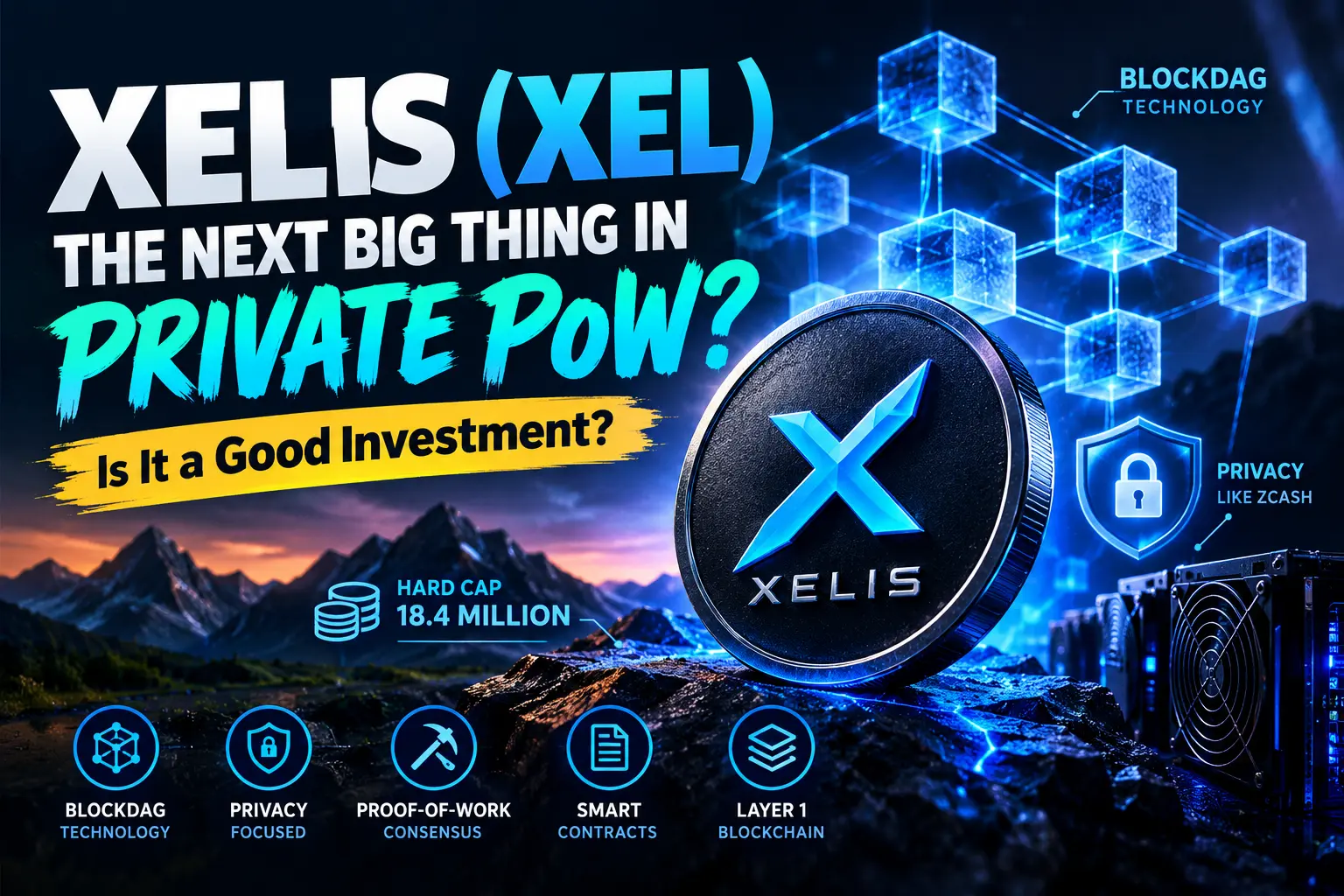
Xelis (XEL) is a relatively new cryptocurrency that combines several major blockchain technologies within a single network.
It has Proof-of-Work like Bitcoin and Monero, BlockDAG technology like Kaspa, privacy technology using homomorphic encryption and zero-knowledge proofs, and smart contracts like programmable Layer-1 networks.
It also has something investors who prefer scarce cryptocurrencies may find particularly interesting:
Only 18.4 million XEL can ever be created.
XEL has a maximum supply of 18.4 million coins, giving the network a defined supply limit rather than an unlimited monetary base. Mining will continue to introduce new XEL into circulation, but the emission rate declines progressively instead of relying on fixed halving events.
The project launched its mainnet on April 20, 2024.
According to the official documentation, Xelis is built from scratch around a BlockDAG architecture and combines privacy, speed, scalability, Proof-of-Work, and smart contracts. Its current target block interval is five seconds.
That combination makes Xelis interesting.
But it also creates a difficult investment question.
Is Xelis simply another small-cap cryptocurrency with impressive innovation, or could it eventually become one of the more important privacy-focused Layer-1 networks?
And perhaps the bigger question:
Could Xelis represent part of the future direction of cryptocurrency?
To answer that, investors need to look beyond the price.
Xelis (XEL) Quick Facts
| Feature | Xelis |
|---|---|
| Cryptocurrency | Xelis |
| Ticker | XEL |
| Network type | Layer-1 |
| Consensus | Proof-of-Work |
| Architecture | BlockDAG |
| Target block time | 5 seconds |
| Maximum supply | 18.4 million XEL |
| Supply model | Decreasing mining emission |
| Privacy | Homomorphic encryption + zero-knowledge proofs |
| Smart contracts | Yes |
| Smart-contract platform | XVM |
| Smart-contract language | Silex |
| Confidential assets | Yes |
| Mainnet launch | April 20, 2024 |
| Mining | CPU/GPU-focused XELIS Hash |
| Native fees | XEL |
| Maximum block size | 1.25 MB |
| Maximum transaction size | 1 MB |
These are protocol-level characteristics of Xelis, according to its current documentation. The project targets five-second blocks and has a maximum supply of 18.4 million XEL.
What Is Xelis?
Xelis is a Layer-1 cryptocurrency that uses Proof-of-Work and BlockDAG architecture.
Its goal is to combine four major characteristics:
- Privacy
- Scalability
- Speed
- Smart contracts
The network is account-based rather than using the traditional UTXO model.
Xelis also supports confidential balances and transaction amounts through cryptographic techniques that let the network validate transactions without publicly exposing the amounts being transferred.
The project describes its architecture as combining:
BlockDAG + Proof-of-Work + Privacy + Smart Contracts.
That combination is what makes Xelis different from a conventional cryptocurrency.
Why Was Xelis Created?
Blockchain technology has historically involved trade-offs.
Bitcoin prioritized decentralization, security, and monetary scarcity.
Ethereum prioritized programmable smart contracts.
Monero prioritized financial privacy.
Zcash developed sophisticated zero-knowledge-based privacy.
Kaspa uses BlockDAG technology to achieve high-speed Proof-of-Work.
Xelis is attempting to bring several of these concepts into one network.
That does not mean Xelis is automatically better than any of them.
It means the project is targeting a particularly ambitious niche.
The basic thesis is:
What if a cryptocurrency could combine the scarcity and decentralized mining of Proof-of-Work, the parallel processing potential of a BlockDAG, the privacy of a privacy-focused cryptocurrency, and the programmability of a smart-contract platform?
That is essentially the experiment Xelis is conducting.
Xelis Is Limited to 18.4 Million XEL
Xelis has a fixed maximum supply, which could appeal to investors who value scarcity. 18.4 million maximum supply.
This is a genuine protocol-level maximum supply.
Xelis documentation explicitly lists the maximum supply as 18.4 million XEL.
This matters because supply is a fundamental variable in cryptocurrency economics.
A project can have excellent innovation, but if its supply can expand without meaningful limits, investors must account for potentially greater dilution.
Xelis takes a different approach.
There can never be more than approximately:
18,400,000 XEL
under the current protocol rules.
However, this does not mean XEL is already scarce in practical terms.
New XEL continues to enter circulation through mining.
Emission gradually decreases as the supply approaches its maximum, which makes this model different.
Xelis does not use Bitcoin-style periodic reward halvings.
Instead, the mining reward gradually decreases based on the remaining supply and the network emission model.
This creates a smooth emission curve.
Hard cap versus current supply
This distinction is important.
Maximum supply: 18.4 million XEL
Current circulating supply: much lower than the maximum
Therefore, investors should not look only at the 18.4M number.
They should also monitor:
- Current circulating supply
- New XEL issued through mining
- Emission rate
- Mining difficulty
- Network demand
- Market liquidity
A hard cap is valuable.
But scarcity only becomes economically powerful when demand exists.
Why the 18.4M Supply Is Interesting
Xelis has a fixed maximum supply of 18.4M, compared with Bitcoin’s 21M maximum supply.
But investors should not interpret this as meaning Xelis is another Bitcoin.
Bitcoin has a completely different level of adoption, liquidity, security, infrastructure, brand recognition, and network effect.
The similarity is simply that both have relatively small fixed maximum supplies.
That makes XEL attractive to investors who prefer cryptocurrencies with a clearly defined monetary ceiling.
A limited supply matters more when the asset also provides useful functions.
This is where Xelis becomes particularly interesting.
XEL is designed to be more than a scarce digital asset.
It is also used within the network.
XEL is used for:
- Transactions
- Network fees
- Smart-contract interactions
- Smart-contract deployment
- Asset creation
- Value transfer
The official Xelis FAQ confirms these functions.
What Is BlockDAG?
Xelis is one of the most important technologies: BlockDAG.
DAG means:
Directed Acyclic Graph.
A traditional blockchain generally organizes blocks into a single linear sequence.
Block A → Block B → Block C → Block D
Unlike a traditional blockchain, a BlockDAG lets multiple blocks coexist and link within a graph structure.
This allows the network to keep competing blocks even when they are found at nearly the same time.
Xelis supports multiple blocks at the same height and uses topological ordering to establish a consistent processing order.
This is one factor that allows Xelis to target five-second block times.
Xelis and Kaspa: Both Use BlockDAG
This is one of the most important comparisons for understanding Xelis.
Xelis uses BlockDAG technology like Kaspa.
However, Xelis is not simply copying Kaspa.
Both projects use Proof-of-Work and DAG-based approaches, but their architectures and priorities are different.
Kaspa has built its identity around high-throughput Proof-of-Work and its own DAG-based consensus design.
Xelis uses BlockDAG as part of a broader system that also emphasizes privacy, confidential assets, and smart contracts.
A simplified comparison:
| Feature | Xelis | Kaspa |
|---|---|---|
| Proof-of-Work | Yes | Yes |
| BlockDAG | Yes | Yes |
| Fast block production | Yes | Yes |
| Privacy-focused | Yes | No |
| Confidential balances | Yes | No |
| Smart contracts | Yes | Different ecosystem approach |
| Maximum supply | 18.4M XEL | 28.7B KAS |
| Main differentiation | Privacy + PoW + BlockDAG + smart contracts | High-speed PoW + BlockDAG |
The important point is not that Xelis is “Kaspa with privacy.”
The architectures are different.
The more useful observation is:
Xelis belongs to the same broader technological movement toward DAG-based Proof-of-Work while pursuing a substantially different use case.
Why BlockDAG Could Matter
Traditional blockchains can waste mining work when multiple miners discover blocks at almost the same time.
A BlockDAG can make better use of blocks produced at nearly the same time by incorporating them into the network.
Xelis documentation explains that multiple blocks can exist at the same height and that the network uses topological ordering and cumulative difficulty to organize them.
This can potentially improve:
- Block production efficiency
- Confirmation speed
- Scalability
- Mining efficiency
- Network security
However, investors should be careful with the word scalability.
A BlockDAG does not automatically guarantee unlimited transactions per second.
Real-world performance depends on:
- Block size
- Transaction complexity
- Verification time
- Network bandwidth
- Node hardware
- Smart-contract execution
- Network adoption
Technology must eventually prove itself under real usage.
Xelis Targets Five-Second Blocks
Xelis currently targets an average block interval of approximately five seconds.
That is dramatically faster than Bitcoin’s approximately ten-minute target.
But again, block time alone does not define a cryptocurrency’s performance.
The more interesting combination is:
Five-second target + BlockDAG + Proof-of-Work.
The goal is to achieve faster block processing while still relying on mining-based consensus.
Xelis and Zcash: Similar Privacy Goals, Different Approaches
This is another major part of the Xelis thesis.
Xelis is a privacy-focused cryptocurrency like Zcash, but it does not use the same privacy architecture.
Zcash became famous for using zero-knowledge proofs to enable shielded transactions.
Xelis uses a combination of:
- Homomorphic encryption
- Zero-knowledge proofs
- Encrypted balances
- Encrypted transferred amounts
This allows nodes to verify transactions without knowing the actual amount transferred.
Xelis uses homomorphic encryption to protect balances and transaction amounts, while zero-knowledge proofs help verify that the encrypted amounts are valid.
Xelis vs. Zcash
| Feature | Xelis | Zcash |
|---|---|---|
| Privacy-focused | Yes | Yes |
| Zero-knowledge technology | Yes | Yes |
| Encrypted transaction amounts | Yes | Yes |
| Homomorphic encryption | Core part of Xelis design | Different architecture |
| Proof-of-Work | Yes | Yes |
| BlockDAG | Yes | No |
| Smart contracts | Yes | No comparable native general-purpose system |
| Maximum supply | 18.4M XEL | 21M ZEC |
| Main focus | Privacy + BlockDAG + smart contracts | Private digital money |
The comparison should therefore be:
Xelis is trying to combine privacy with programmable Layer-1 infrastructure.
Zcash’s historical strength is its mature privacy technology and established network.
What sets Xelis apart is its attempt to make privacy a core feature of a wider programmable blockchain ecosystem.
Is Xelis Completely Private?
No.
This is an important clarification.
Xelis provides transaction privacy without hiding all network information.
Xelis provides confidentiality for balances and transfer amounts, but it does not make the entire network anonymous. Addresses and transaction relationships remain visible, and smart-contract data is not private by default.
So the more accurate description is:
Xelis is a public blockchain with confidential balances and transaction amounts.
That is much more precise.
How Does Xelis Use Zero-Knowledge Proofs?
Xelis uses zero-knowledge proofs to prove that encrypted transactions are valid without revealing the underlying amounts.
The network needs to verify things such as:
- The transferred amount does not exceed the sender’s balance.
- The encrypted amount is valid.
- The transaction cannot create an invalid negative balance.
Xelis uses Bulletproofs for range proofs and has implemented batching and aggregation to improve verification efficiency.
This is an important technical advantage.
Xelis puts privacy at the core of its network instead of treating it as an optional feature.
It is integrated into transaction verification.
Xelis Smart Contracts
Privacy alone would make Xelis interesting.
Smart contracts expand Xelis beyond simple payments and make the project more ambitious.
Xelis has its own smart-contract platform called the XELIS Virtual Machine (XVM).
Smart contracts are written in Silex, a statically typed language created for the Xelis ecosystem.
The XVM provides a secure and predictable environment for executing smart contracts.
This gives Xelis more uses beyond basic payment transactions.
Potential applications include:
- Token issuance
- Decentralized exchanges
- Voting systems
- Automated financial applications
- Confidential assets
- Decentralized applications
Confidential Assets Could Give Xelis a Major Advantage
This may eventually become one of Xelis’s most interesting features.
Xelis allows users to create Confidential Assets directly at the base layer.
That is important.
Many blockchain tokens are simply smart contracts operating on top of another blockchain.
Confidential assets are built directly into the Xelis network.
The asset can have a defined supply policy:
- Fixed supply
- Mintable supply with a maximum limit
- Unlimited supply
The supply policy is established when the asset is created.
The balances and transferred amounts can also inherit Xelis’s confidential architecture.
This could potentially allow private versions of:
- Stablecoins
- Community tokens
- Business assets
- Governance tokens
- Digital currencies
If confidential assets become more widely used, this could give Xelis a meaningful advantage.
Xelis vs. Monero vs. Zcash vs. Kaspa
The easiest way to understand Xelis is to compare it with projects occupying adjacent niches.
| Feature | Xelis | Monero | Zcash | Kaspa |
|---|---|---|---|---|
| Proof-of-Work | Yes | Yes | Yes | Yes |
| BlockDAG | Yes | No | No | Yes |
| Privacy-focused | Yes | Yes | Yes | No |
| Confidential balances | Yes | Yes | Yes | No |
| Zero-knowledge proofs | Yes | Different privacy architecture | Core privacy technology | No |
| Smart contracts | Yes | No general-purpose smart contracts | Limited compared with smart-contract L1s | Different approach |
| Confidential assets | Yes | No equivalent general-purpose asset system | Different model | No |
| Maximum supply | 18.4M | No fixed maximum | 21M | 28.7B |
| Primary thesis | Private programmable PoW Layer-1 | Private digital money | Privacy-focused cryptocurrency | High-speed PoW BlockDAG |
This table reveals why Xelis is attracting attention.
It sits at the intersection of several important cryptocurrency categories.
It is not simply competing with one project.
It is potentially competing with different parts of several markets at once.
That is both its biggest opportunity and its biggest challenge.
XEL Tokenomics
XEL has a fixed maximum supply of 18.4 million coins.
Unlike Bitcoin, Xelis does not use a simple periodic halving mechanism.
Instead, the mining reward decreases gradually according to the remaining supply and emission model. The current documentation describes an emission speed factor of 20 and a smoothly asymptotic emission curve.
This means investors should think of XEL’s tokenomics as:
Hard cap + decreasing emission + Proof-of-Work distribution.
That is an attractive structure for investors who prefer:
- Scarcity
- Mining-based issuance
- No giant private token allocation
- Long-term emission reduction
But again, tokenomics are only one part of valuation.
Is Xelis Fairly Launched?
Xelis describes itself as a community-driven project rather than a conventional venture-funded token launch.
This is important because some newer cryptocurrencies reserve a significant share of their supply for investors, insiders, foundations, and teams.
Xelis’s supply enters circulation primarily through Proof-of-Work mining.
However, there is a development fee built into the network’s mining economics.
The current documentation states that the dev fee began at 10% and decreases to 5% after the specified block height.
This does not necessarily make the project centralized or unfair.
This is an important point for investors to consider.
A fair assessment should include both the advantages and the compromises.
Xelis Mining
Xelis uses XELIS Hash, a Proof-of-Work algorithm designed to be friendly to CPUs and GPUs.
Xelis aims to prevent specialized mining hardware from gaining an overwhelming advantage.
The project also uses a DAG-aware difficulty adjustment mechanism to target an average five-second block interval.
For investors who strongly prefer Proof-of-Work cryptocurrencies, this is a meaningful characteristic.
The network does not rely entirely on wealthy token holders staking their coins to validate transactions.
Mining provides an alternative path to network participation.
However, investors should still monitor actual hashrate distribution.
Supporting CPU and GPU mining can make participation easier, but it does not guarantee a decentralized mining network.
Xelis vs. Bitcoin
Bitcoin remains the benchmark for Proof-of-Work cryptocurrencies.
Xelis differs dramatically in its intended purpose.
| Feature | Bitcoin | Xelis |
|---|---|---|
| Consensus | Proof-of-Work | Proof-of-Work |
| Maximum supply | 21M BTC | 18.4M XEL |
| Block structure | Linear blockchain | BlockDAG |
| Target block time | ~10 minutes | 5 seconds |
| Privacy | Limited | Confidential balances/amounts |
| Smart contracts | Limited scripting | XVM smart contracts |
| Confidential assets | No native equivalent | Yes |
| Main thesis | Decentralized digital money | Private programmable Layer-1 |
The comparison shows why Xelis should not be marketed as “better Bitcoin.”
It is attempting something different.
The Bull Case for XEL
The strongest argument for Xelis is not one feature.
It is the combination.
1. Hard cap
18.4 million XEL creates genuine supply scarcity.
2. Proof-of-Work
Xelis uses mining rather than relying entirely on token-based validation.
3. BlockDAG
The architecture allows multiple blocks to coexist at the same height.
4. Fast block production
The current target is five seconds.
5. Privacy
Balances and transferred amounts are encrypted.
6. Zero-knowledge proofs
The network can verify important transaction properties without revealing the underlying amounts.
7. Smart contracts
XVM gives developers a programmable environment.
8. Confidential assets
Users can create assets with privacy features built into the base layer.
9. Small market capitalization
A small network has much more room for percentage growth if adoption eventually accelerates.
10. Multiple narratives
Xelis can potentially benefit from several long-term crypto trends:
Proof-of-Work + privacy + DeFi + confidential assets + scarce supply + BlockDAG.
That is a powerful combination.
The Bear Case for XEL
The same combination creates serious risks.
1. Small ecosystem
Technology is useless if nobody uses it.
2. Low liquidity
Small-cap cryptocurrencies can experience extreme volatility.
3. Developer competition
Developers already have established ecosystems.
4. Regulatory pressure
Strong privacy protections can create additional challenges when dealing with exchanges and regulators.
Different countries are taking different approaches to this challenge. France has taken a regulatory approach to Bitcoin, focusing on the businesses and services around it rather than banning the asset itself. See How France Regulates Bitcoin Without Banning It for a closer look at how this regulatory model works.
5. Young network
Xelis is still relatively new, having launched its mainnet in 2024.
6. Execution risk
Building the mechanism is one challenge.
Building a sustainable ecosystem is another.
7. Competition
Xelis competes indirectly with:
- Bitcoin
- Kaspa
- Monero
- Zcash
- Ethereum
- Solana
- Other privacy networks
- Other smart-contract Layer-1s
8. Market risk
Improving applications do not necessarily prevent a small-cap cryptocurrency from suffering steep losses.
Xelis Bull Case vs. Bear Case
| Bull Case | Bear Case |
|---|---|
| 18.4M hard cap | Small current market |
| Proof-of-Work | Limited liquidity |
| BlockDAG | Strong competition |
| Five-second target | Young ecosystem |
| Strong privacy architecture | Privacy regulation |
| Smart contracts | Developer adoption uncertain |
| Confidential assets | Software may not translate into demand |
| CPU/GPU mining | Mining could still become concentrated |
| Multiple use cases | Many competing Layer-1 networks |
| Early-stage upside | Extremely high volatility |
This is why XEL should be treated as a high-risk infrastructure investment, not as an established cryptocurrency.
Is Xelis the Future of Crypto?
This is the most interesting question.
And the honest answer is:
Maybe—but the technology is not enough to prove it.
Xelis represents several ideas that could become increasingly important in the next generation of cryptocurrency.
Scarcity
Bitcoin demonstrated that digital scarcity can create a new monetary asset.
Xelis has a similarly hard maximum supply of 18.4 million XEL.
Privacy
As more financial activity moves onto public blockchains, privacy may become increasingly important.
People may not want their salaries, purchases, business transactions, investment positions, or financial relationships permanently visible on a public ledger.
Xelis is designed specifically around confidential balances and transaction amounts.
Scalability
Users do not want to wait minutes for transactions.
Xelis targets five-second blocks and uses BlockDAG technology to process multiple blocks within its consensus structure.
Programmability
Future financial systems will probably require more than simple transfers.
Smart contracts and programmable assets can automate financial applications.
Xelis already supports XVM smart contracts.
Confidential programmable assets
This could be the most interesting combination.
Imagine a future where stablecoins, financial assets, business tokens, and decentralized applications can be programmable without exposing every user’s financial position publicly.
This is one of the core problems Xelis is designed to address.
But Is Xelis Really the Future?
There is a major difference between:
“This technology could be part of the future.”
and
“This cryptocurrency will become a major winner.”
The first statement is reasonable.
The second is speculation.
Xelis still needs to prove:
- Developer adoption
- User adoption
- Network activity
- Liquidity
- Wallet adoption
- Exchange support
- Smart-contract usage
- Confidential asset adoption
- Long-term mining decentralization
- Sustainable ecosystem growth
Until those things happen, Xelis remains a promising experiment rather than a proven future leader.
What Would Make Xelis a Major Cryptocurrency?
A few key developments will be worth watching.
1. More developers
The XVM ecosystem needs independent developers building applications.
2. Real applications
The network needs useful products, not just experimental contracts.
3. Confidential stablecoins
A private stablecoin ecosystem could be particularly important.
4. More liquidity
Deeper exchange liquidity could make XEL easier to trade and reduce the risk of significant price movements when buying or selling.
5. More users
The real test of network growth will be whether actual usage increases over time.
6. More decentralized mining
Hashrate should remain distributed across many participants.
7. Continued protocol development
The project must continue improving the technology as the network grows.
What Should Investors Monitor?
Instead of watching XEL’s price every day, investors should watch the network.
| Metric | Why It Matters |
|---|---|
| Circulating supply | Measures remaining dilution |
| Mining hashrate | Indicates network security |
| Miner distribution | Helps assess decentralization |
| Daily transactions | Measures actual usage |
| Active addresses | Shows user activity |
| Smart contracts | Measures developer adoption |
| Confidential assets | Tests the privacy ecosystem |
| Exchange liquidity | Measures market accessibility |
| Wallet support | Measures infrastructure |
| Developer activity | Indicates continued development |
| Network fees | Shows economic activity |
| Market capitalization | Shows overall market valuation |
This is a much better way to evaluate XEL than simply asking whether the price can reach $1, $10, or $100.
Xelis Investment Scorecard
| Category | Assessment |
|---|---|
| Maximum supply | Excellent |
| Scarcity | Strong |
| Proof-of-Work | Strong |
| BlockDAG technology | Very interesting |
| Transaction speed | Strong |
| Privacy | Very strong |
| Smart contracts | Promising |
| Confidential assets | Potentially significant |
| Decentralization thesis | Promising but needs monitoring |
| Ecosystem maturity | Early |
| Liquidity | Weak compared with major cryptocurrencies |
| Competition | Very high |
| Regulatory risk | High |
| Adoption risk | Very high |
| Long-term upside | Potentially very high |
| Overall risk | Very high |
Who Might Be Interested in XEL?
XEL may appeal particularly to investors who prefer cryptocurrencies with:
- A hard supply cap
- Proof-of-Work
- Mining
- Decentralization
- Privacy
- Low transaction costs
- Fast transactions
- Smart contracts
- Real blockchain utility
- Long-term infrastructure potential
It is less suitable for someone looking for a low-volatility cryptocurrency.
XEL is an early-stage project.
That means the potential upside can be substantial.
It also means the downside can be severe.
For a broader framework on how to evaluate technology, tokenomics, utility, decentralization, and risk before buying a cryptocurrency, see The Complete Guide to Cryptocurrency Investing: How to Evaluate Crypto Projects Before You Invest.
Xelis vs. the Three Big Narratives
One reason Xelis is interesting is that it sits at the intersection of three major cryptocurrency narratives.
The Bitcoin narrative
Scarcity + Proof-of-Work + decentralization
The Kaspa narrative
Proof-of-Work + BlockDAG + high-speed block production
The Zcash/Monero narrative
Financial privacy
Xelis then adds another layer:
The Ethereum-style narrative
Smart contracts + programmable assets
That combination is unusual.
It does not guarantee success.
But it gives Xelis a clear reason to exist.
Is Xelis (XEL) a Good Investment? The Final Verdict
Xelis is one of the more interesting small-cap cryptocurrency projects for investors who prioritize hard supply limits, Proof-of-Work, privacy, decentralization, fast transactions, and blockchain utility.
Its strongest characteristics are not isolated features.
They are the combination of:
18.4M hard cap + Proof-of-Work + BlockDAG + five-second target blocks + privacy + zero-knowledge proofs + smart contracts + confidential assets.
That is a compelling technological thesis.
But it is still a thesis.
Xelis has not yet achieved the network effects of Bitcoin, Ethereum, Monero, Zcash, or Kaspa.
The more important question is whether Xelis can turn its technology into a successful and widely used network.
It does.
The biggest question is:
Will people actually use it?
If Xelis can develop a meaningful ecosystem around private transactions, confidential assets, decentralized applications, and smart contracts, the project could occupy a unique position in the cryptocurrency market.
If adoption fails, the technology may remain an impressive experiment without producing corresponding investment returns.
My assessment
Technology: 9/10
Tokenomics: 9/10
Privacy: 9/10
Decentralization potential: 8/10
Scalability design: 8.5/10
Utility: 8.5/10
Ecosystem maturity: 4/10
Adoption: 4/10
Risk: 9/10
Long-term potential: 9/10
Current investment profile: High-risk, high-potential
Xelis gives investors several reasons to consider its long-term potential.
It combines several narratives that could become increasingly important:
** Scarcity, Proof-of-Work, privacy, scalability, and programmability.**
That is why Xelis deserves attention.
Investors should judge the technology and the investment potential on their own merits.
The next stage is adoption.
And that is where Xelis will ultimately prove whether it is merely an interesting cryptocurrency—or a serious candidate for the next generation of blockchain infrastructure.
Before buying XEL or any other small-cap cryptocurrency, investors should also examine the warning signs that can turn a technically impressive project into a poor investment. See 10 Red Flags Every Crypto Investor Should Know Before Buying a Token.
Frequently Asked Questions About Xelis (XEL)
Xelis is a Layer-1 Proof-of-Work cryptocurrency built around a BlockDAG architecture. Xelis brings privacy-focused transactions together with smart contracts and confidential assets.
Yes. Xelis has a maximum supply of 18.4 million XEL. New XEL enters circulation through mining, while mining rewards gradually decline as the supply approaches its maximum.
Yes, in one important technological respect. Both Xelis and Kaspa use BlockDAG-based Proof-of-Work architectures.
However, they are different projects with different designs. Xelis places much greater emphasis on privacy, confidential assets, and smart contracts.
Xelis and Zcash both focus heavily on cryptocurrency privacy and use zero-knowledge technology.
However, Xelis uses a different overall architecture and combines privacy with BlockDAG, Proof-of-Work, smart contracts, and confidential assets.
Xelis provides confidential balances and transaction amounts using homomorphic encryption and zero-knowledge proofs.
However, it is not accurate to say that every aspect of a Xelis transaction is invisible. Addresses and transaction relationships can remain visible, and smart-contract information is not automatically confidential.
Yes.
Xelis uses Proof-of-Work and its XELIS Hash mining algorithm, designed to support CPU and GPU mining.
Xelis is designed as a decentralized Proof-of-Work network.
However, investors should distinguish design from actual decentralization.
The key question is how widely control is distributed across nodes, miners, developers, exchanges, and the broader ecosystem.
Yes.
Smart contracts on Xelis run through the XELIS Virtual Machine (XVM) and are written in Silex.
Confidential Assets are native assets created directly at the Xelis base layer. Their balances and transferred amounts can use the same privacy model as XEL. Supply rules are defined when the asset is created.
Xelis mainnet launched on April 20, 2024.
The current target block interval is approximately five seconds. Individual block intervals can vary because block production is probabilistic.
In terms of target block production, yes. Xelis targets approximately five-second blocks, while Bitcoin targets approximately ten-minute blocks.
However, block time alone should not be used to declare one network “better” or “faster” overall.
Xelis is a high-risk, high-potential cryptocurrency.
Its hard cap, Proof-of-Work, BlockDAG architecture, privacy technology, and smart contracts make it technologically interesting.
But its relatively young ecosystem, small market size, limited liquidity, competition, and adoption risk mean it should be treated as speculative rather than an established core cryptocurrency.
Yes, it is possible.
But there is no guarantee.
For Xelis to become a major network, it would need sustained growth in users, developers, applications, liquidity, mining participation, and real-world use.
It could represent part of the future—but it is far too early to say that XEL itself will become a major winner.
The combination of hard-capped supply, Proof-of-Work, BlockDAG scalability, privacy, and smart contracts addresses several important problems in cryptocurrency.
The deciding factor will be adoption.
Technology creates the opportunity.
Users and developers create the network effect.