
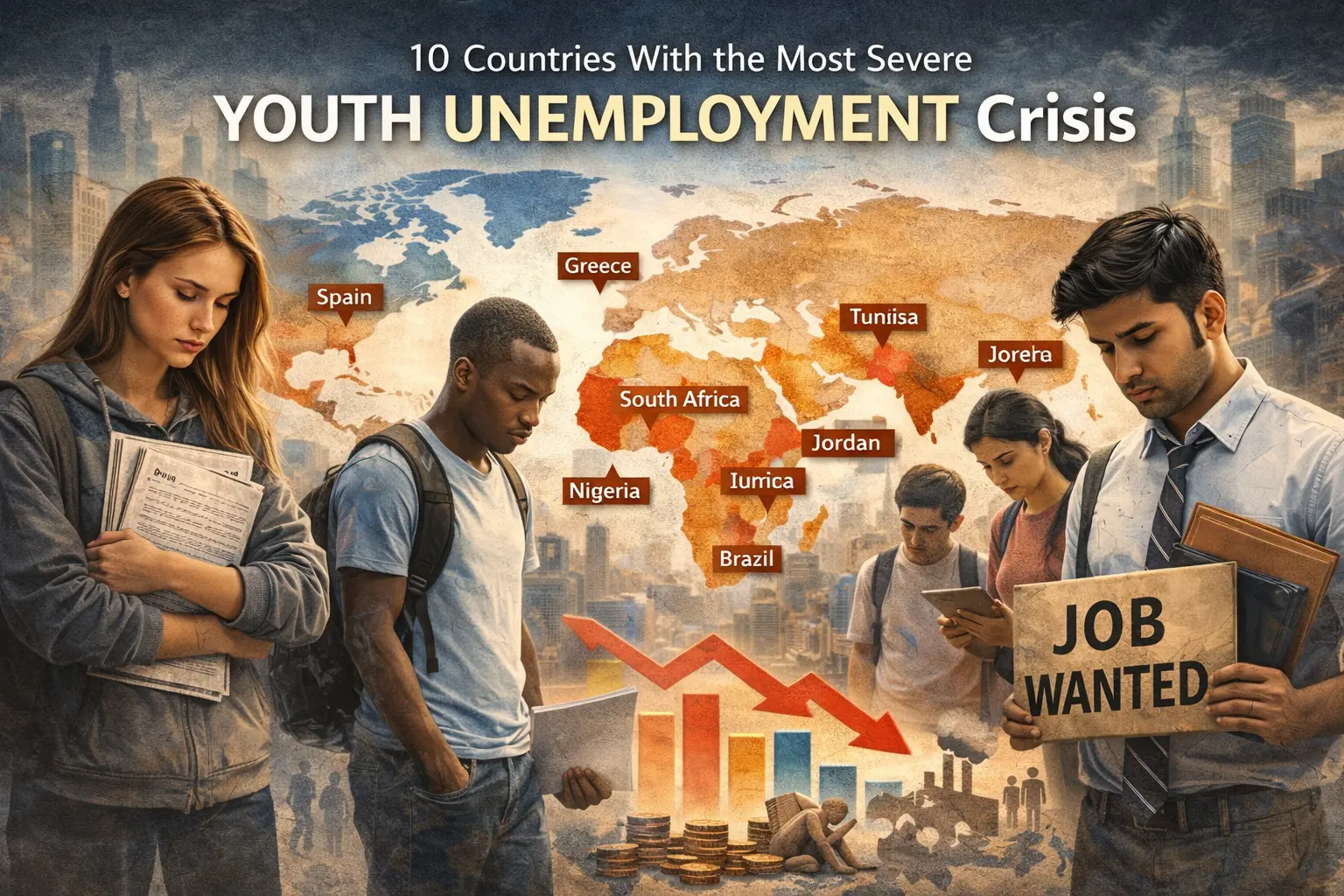
Youth unemployment has become one of the most urgent global socioeconomic challenges. Young adults entering the workforce often face limited opportunities, skill mismatches, and structural barriers that impede financial independence and long-term career growth.
The International Labour Organization and the World Bank report that youth unemployment rates are typically two to three times higher than those of adults.
Top 10 Countries with the Highest Youth Unemployment
1. Spain
Despite economic recovery in recent years, Spain continues to struggle with one of the highest youth unemployment rates in Europe.
Temporary contracts predominate in entry-level employment, leaving many young workers trapped in unstable employment cycles. The effects of the global financial crisis and the subsequent pandemic-era slowdown still shape the labor market for younger generations.
- High reliance on temporary employment contracts
- Limited entry-level opportunities in certain sectors
- Strong regional disparities in job creation
2. Greece
In Greece, youth unemployment remains elevated even after years of economic stabilization following the European debt crisis.
Many graduates face prolonged job searches or seek employment abroad, contributing to a significant brain drain that further weakens domestic economic recovery.
- Slow post-crisis labor market recovery
- High graduate unemployment
- Emigration of skilled young professionals
Reference: Where We Work
3. South Africa
South Africa ranks among the countries with the highest youth unemployment rates worldwide. Deep structural inequality, combined with a weak labor market and limited industrial expansion, has created a particularly difficult environment for young job seekers.
A significant proportion of youth are classified as NEET (Not in Education, Employment, or Training).
- Skills mismatch between education and labor demand
- Limited industrial job creation
- Persistent inequality in education and opportunity
4. Italy
In Italy, youth unemployment remains stubbornly high in several regions, especially in the south.
Young Italians frequently face extended job searches after graduation, and many rely on temporary or part-time employment before securing stable positions.
- Regional economic disparities
- Slow economic growth
- Rigid labor market structures
5. Nigeria
Nigeria has one of the fastest-growing youth populations in the world, yet job creation has not kept pace with demographic expansion.
Large cohorts of young Nigerians enter the workforce every year, while opportunities for formal employment remain few.
- Rapid population growth
- Dependence on oil sector revenues
- Large informal economy
6. Tunisia
Youth unemployment played a major role in the social tensions that preceded the Arab Spring in Tunisia, and the challenge remains significant today.
Highly educated graduates often struggle to find jobs that match their qualifications.
- Weak private-sector job creation
- Graduate unemployment
- Economic instability
7. Bosnia and Herzegovina
In Bosnia and Herzegovina, youth unemployment remains among the highest in Europe.
Limited job opportunities at home drive many young people to seek work abroad, fueling a steady outflow of talent.
- Slow economic development
- Small private sector
- Large youth migration
8. Jordan
Jordan has one of the highest youth unemployment rates in the Middle East.
Despite relatively high levels of education among young people, the labor market struggles to absorb graduates into meaningful employment.
- Public-sector job saturation
- Limited private-sector growth
- Regional economic pressures
9. Brazil
In Brazil, economic volatility and labor market inequality have created challenges for young workers.
Many young Brazilians enter informal employment or unstable gig work while searching for stable careers.
- Economic cycles and recessions
- Informal employment dominance
- Skills mismatch in urban labor markets
10. India
India’s enormous youth population makes the country’s employment challenge both urgent and immense.
Economic growth has not consistently created enough jobs to keep pace with the rising number of young people entering the workforce.
- Rapid demographic expansion
- Skills gaps between education and industry needs
- Urban-rural employment disparities
Global Drivers of Youth Unemployment
Across different regions, several structural factors repeatedly contribute to youth unemployment crises.
Skills Mismatch
Many education systems produce graduates whose skills do not align with labor market needs, leaving employers unable to fill positions while young workers remain unemployed.
Economic Slowdowns
Financial crises, recessions, and global disruptions often disproportionately affect entry-level employment opportunities.
Demographic Pressure
To prevent rising youth unemployment, countries with expanding young populations must create jobs at an accelerated pace.
Labor Market Barriers
Rigid labor laws and limited experience make employers hesitant to take on young talent.
| Country | Youth Unemployment Rate | Primary Drivers | Structural Challenge |
|---|---|---|---|
| Spain | High | Temporary contracts | Labor market instability |
| South Africa | Very High | Skills mismatch | Structural inequality |
| Italy | High | Slow growth | Regional disparity |
| Nigeria | High | Population growth | Limited formal jobs |
| India | Moderate–High | Labor market expansion | Skills gap |
Frequently Asked Questions (FAQs)
Why is youth unemployment higher than adult unemployment?
Inexperience and limited networks hinder many young people from entering the workforce.
How does youth unemployment affect society?
It can reduce lifetime earnings, fuel inequality, and increase migration and political discontent.
Which organizations monitor youth unemployment?
Key sources include the International Labour Organization and the World Bank.
Can policy reduce youth unemployment?
Yes. Skills training, labor market reforms, and economic incentives are essential.
- Top 10 Countries with the Strongest Anti-Corruption Systems
- 10 Countries Where Education and Opportunity Are Most Unequal
- 10 Countries Struggling With the Worst Air Pollution