
Education is a core driver of opportunity and social mobility.
Education that is unequal across wealth, gender, geography, or social groups fails to serve as a ladder of opportunity for many.
Despite global progress over recent decades, education inequality remains deeply entrenched in many parts of the world.
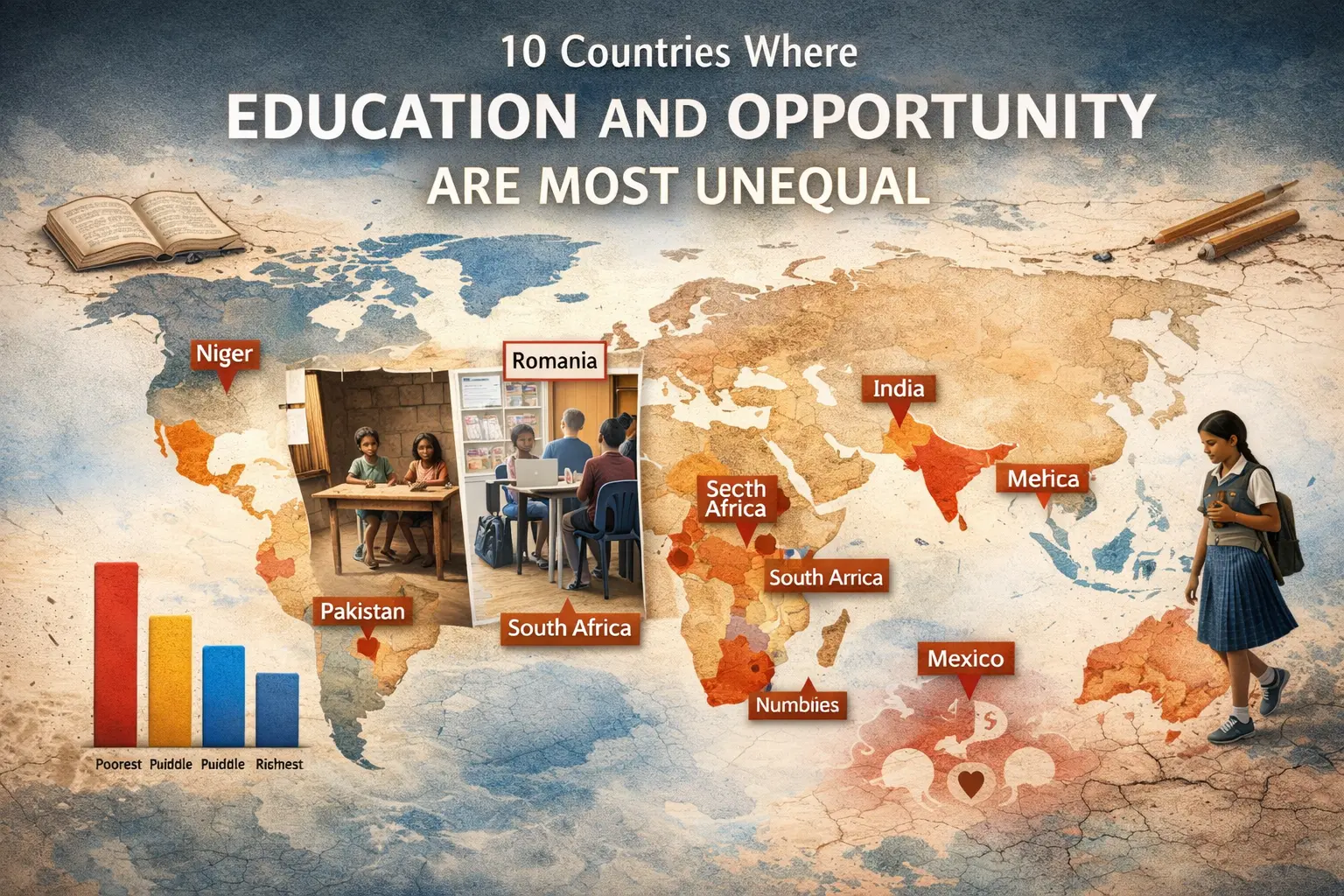
This article profiles ten countries where education and opportunity remain most unequal, revealing the dimensions of disparity and their societal impacts.
The Hidden Barriers Holding Students Back Around the Globe
1. Niger
Niger consistently ranks among the lowest globally in education outcomes. A minority of girls finish secondary education, while adult women continue to have much lower literacy rates than men.
Key inequality dimensions:
- Gender disparity in enrollment and completion
- Low literacy overall
- Barriers from poverty, child marriage, and school access
Why it matters: Educational gaps are both a cause and consequence of broader socioeconomic inequality, limiting opportunities for girls and women long-term.
2. Pakistan
Pakistan’s education inequality is stark, with millions of children out of school, and girls disproportionately affected. Female literacy and school participation lag far behind their male peers, creating a persistent gender gap in opportunities.
Education gaps widen as regional disparities, financial hardship, and cultural expectations affect family decisions about schooling.
3. South Africa
South Africa exhibits some of the most entrenched educational disparities in the world, driven by historical racial segregation and ongoing inequality in school quality. White and privileged students often attend well‑resourced schools, while Black learners remain in underfunded institutions — a pattern that directly limits opportunity.
Key markers:
- Massive gaps in math and science proficiency between advantaged and disadvantaged schools
- Underfunded rural schools with poor infrastructure
- Intersections with wealth inequality and labor market outcomes
Calls for reform have intensified, but systemic gaps persist decades after apartheid’s end.
4. Central African Republic
Across sub‑Saharan Africa, including the Central African Republic, many children—especially those in rural areas—face limited access to school and low completion rates. These gaps reflect unequal investment, conflict, and economic instability.
Indicators show that in many low‑income countries, less than half of adults attain upper secondary education, and disparities widen sharply by wealth.
5. Liberia
Liberia illustrates how geography and household wealth shape educational opportunity. Children from poorer homes are far more likely to become over‑age for their grade and far less likely to transition to secondary schooling. These markers reflect multiple hurdles, including inadequate school infrastructure, teacher shortages, and economic pressures that prompt early labor market entry.
6. India
Although India has made significant gains in enrollment, learning disparities persist at a deep level. According to a recent UNESCO report, many children in school still lack basic literacy and numeracy skills.
The rural–urban divide and household wealth gaps deepen this inequality, leaving children in poorer regions far behind in educational attainment.
7. Romania and Hungary
Evidence on Inequality of Opportunity suggests that in countries such as Romania and Hungary, family background plays a particularly strong role in shaping educational outcomes.
While these nations have broad access, attainment remains correlated with socioeconomic origins, limiting upward mobility.
8. Brazil
Many middle‑income countries feature stark internal divides. In Brazil, for instance, inclusive education laws do not fully offset disparities in learning and school completion between rich urban centers and poorer rural or peripheral urban communities.
This pattern is emblematic of how socioeconomic status intersects with regional inequality to shape opportunity.
9. Mexico
In Mexico — and much of Latin America — education inequality manifests as segregation not just by income but by ethnicity and locale, with wealthier communities accessing better resources and outcomes.
Even when enrollment rates are relatively high, quality and outcomes diverge sharply across populations.
10. Nepal
Mountains, poverty, and traditional gender expectations create significant barriers to schooling for children in Nepal. Girls in remote areas have especially high dropout rates, and many children remain excluded from secondary education altogether. It reflects how geographic factors contribute to educational inequality across low-income countries.
Patterns Behind Education Inequality
Across these countries, several themes recur:
- Gender gaps: Girls often have lower enrollment, completion, and literacy — compounding opportunity gaps.
- Wealth and household background: Children from richer families consistently attain higher education levels than those from poorer households.
- Geographic divides: Urban schools typically have better infrastructure, more teachers, and higher-quality learning outcomes than rural schools.
- Socioeconomic and ethnic segregation: Marginalized groups often attend lower-quality schools, reinforcing intergenerational inequality.
| Country | Gender Gap in Literacy | Rural‑Urban Attainment Gap | Primary Completion Rate |
|---|---|---|---|
| Niger | Women 23% vs Men 39% | High | Low |
| Pakistan | Female ~46% vs Male ~70% | High | Moderate |
| South Africa | Moderate but variable | Very high | High but unequal |
| India | Moderate | High | High (but learning gaps) |
Frequently Asked Questions (FAQs)
What causes education inequality?
Multiple factors, including gender norms, poverty, geography, and household income, influence unequal access and outcomes.
How is inequality measured in education?
Measures include gender literacy gaps, regional and income-based attainment differences, and profiles showing inequality of opportunity.
Are there global efforts to reduce education inequality?
Does gender parity mean equal education quality?
No. Enrollment parity alone cannot guarantee that every student, irrespective of gender or socioeconomic status, benefits equally in learning and resources.
Can education inequality be reduced?
Effective policy interventions, inclusive resource allocation, and community engagement are key to reducing disparities.
- Is the German Education System Quietly Falling Behind?
- 10 Reasons Japan’s Education System Remains One of the World’s Best
- 10 Countries With the Most Severe Youth Unemployment Crisis