
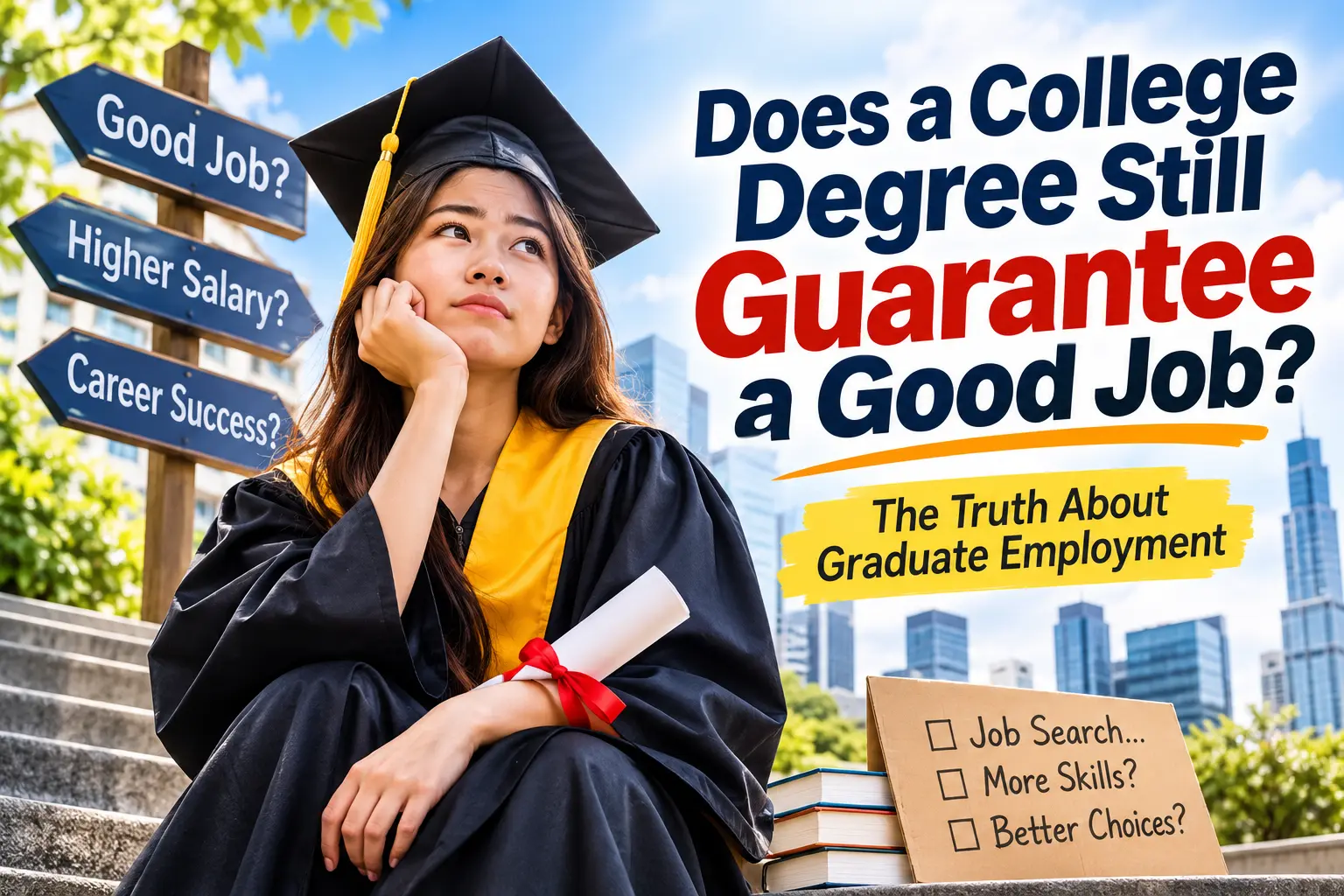
For generations, people have viewed a college degree as a stepping stone to a better future.
Parents encourage their children to attend university. Students spend years completing their courses. Families make financial sacrifices because they believe education will eventually lead to stable employment and a comfortable life.
But what happens when graduation does not lead to the job a student expected?
Some graduates struggle to find employment. Many graduates end up working outside their chosen fields or accepting salaries that undervalue their education.
This raises an important question: Does a college degree still guarantee a good job?
A university education can improve career opportunities, but a diploma alone cannot guarantee employment, financial stability, or professional success.
The challenge is understanding why the gap between education and employment continues to affect graduates.
1. A College Degree Still Has Value
A university degree remains essential for many professional careers.
Fields such as medicine, engineering, law, and education require specialized knowledge and, in some cases, professional qualifications or licenses.
Higher education can also develop critical thinking, communication, research, and problem-solving skills.
OECD data show that people with bachelor’s degrees generally earn more than those whose highest qualification is upper secondary education.
This demonstrates that higher education can provide significant economic benefits.
However, averages do not guarantee individual success. Graduates still face different employment conditions depending on their qualifications, location, experience, and chosen profession.
A degree can improve someone’s opportunities, but it cannot guarantee a particular outcome.
2. Why Do Some Graduates Struggle to Find Jobs?
One major problem is the difference between the number of graduates entering the labor market and the number of suitable jobs available.
Higher education continues to produce qualified workers, but the economy does not always create enough positions for them.
Some industries have strong demand for workers, while others offer fewer vacancies. Fresh graduates may also compete against experienced applicants for the same positions.
Employment opportunities are not evenly distributed. Many are concentrated in major cities, making it harder for graduates in smaller towns and rural areas to find work.
As a result, even qualified applicants can spend months searching for work.
The problem is not always a lack of education or effort. Job seekers may encounter vacancies that offer little connection to their education, skills, or professional goals.
3. When a Degree Does Not Match the Job
Finding employment does not necessarily mean finding work related to one’s education.
A business graduate might work in customer service. An engineering graduate might enter sales. Someone with a teaching degree might pursue a different occupation.
This situation is known as education-job mismatch.
Research by the Philippine Institute for Development Studies (PIDS) has identified educational mismatch as a concern in the Philippine labor market. Its 2022 study found that approximately 39 percent of employed individuals in its analysis were overeducated for their jobs.
This figure applies to the study’s broader group of employed workers, not specifically to recent college graduates.
Nevertheless, it highlights an important concern: some workers have more education than their jobs require.
When graduates cannot find suitable positions, their specialized knowledge may remain underused.
4. Are Universities Teaching What Employers Need?
Employers value academic knowledge, but they also want graduates who can apply what they have learned.
A student may understand business theories but struggle with actual workplace responsibilities. Another may have studied information technology but lack experience using tools commonly required in the industry.
This highlights the importance of practical learning.
Universities should give students opportunities to build workplace skills through internships, research, laboratory work, industry partnerships, and practical assignments.
Students also need transferable skills such as communication, teamwork, adaptability, and problem-solving.
Preparing students for life requires more than academic achievement. Is the Philippines Preparing Its Children for Life—or Just for Exams? explores this challenge in the Philippine education system.
Universities cannot predict every future job requirement. However, they should regularly review their programs to ensure that students receive relevant knowledge and meaningful opportunities to apply it.
5. The Experience Problem Facing Fresh Graduates
Many new graduates encounter a frustrating situation when applying for their first jobs.
Employers often prefer applicants with previous work experience, yet fresh graduates need employment to gain that experience.
This creates a difficult cycle.
Internships, apprenticeships, supervised work placements, and industry-based projects can help bridge this gap.
These experiences help students understand workplace expectations before graduating and show employers what they can do.
A degree provides academic preparation. Practical experience helps graduates show that they can perform the work.
6. Does a Degree Guarantee a High Salary?
No. Graduates with similar qualifications can earn very different salaries.
Income depends on several factors, including occupation, industry, location, experience, and demand for particular skills.
PIDS examined the economic benefits of educational attainment in the Philippines in research covering the years 2005 through 2022. It found that returns had declined over the period, with a particularly notable decrease among college graduates.
This does not mean that college education has become worthless.
It means that the financial benefits of higher education can change as the economy, workforce, and demand for qualifications evolve.
Students and families should look beyond a university’s reputation or a course’s popularity when choosing a degree. They should also examine education costs, career opportunities, professional requirements, and potential earnings.
Students should weigh education costs against potential earnings when choosing a degree. Should Schools Teach Financial Literacy as a Core Subject? Explains why financial literacy belongs in the school curriculum.
7. Is College the Only Path to a Successful Career?
A university degree is not the only route to meaningful employment.
Technical-vocational education and training (TVET) can prepare learners for occupations that require specific practical skills.
Examples include electrical installation, welding, automotive servicing, caregiving, and computer systems servicing.
In the Philippines, TESDA provides training programs and competency-based qualifications that support these career pathways.
For some students, vocational training may offer a more suitable route into employment than a traditional four-year degree.
However, neither pathway guarantees success. Both require quality training, relevant skills, and actual employment opportunities.
The best educational pathway is the one that matches a person’s abilities, goals, and realistic career opportunities.
8. What Should Universities and Students Do Differently?
Improving graduate employment requires cooperation between educational institutions, employers, government agencies, and students.
Universities should strengthen industry partnerships, improve practical training, provide career guidance, and monitor graduate outcomes.
Employers should communicate the skills they need and create reasonable opportunities for entry-level applicants.
Government agencies should improve labor-market information, support skills development, and encourage productive employment.
Students also have an important responsibility.
Before choosing a degree, they should consider their interests, abilities, possible career paths, education costs, and the qualifications required for their preferred occupations.
They should also look for opportunities to develop practical skills and gain experience while studying.
Students should choose degrees based on informed decisions rather than trends or pressure from others.
Frequently Asked Questions (FAQs)
No. A degree can improve employment opportunities, but it does not guarantee a job. Employment depends on qualifications, experience, industry demand, and other labor-market conditions.
Some graduates cannot find suitable positions in their fields. Some graduates redirect their careers, using skills developed during their education to pursue other opportunities.
On average, higher educational qualifications are associated with higher earnings in many countries. However, individual salaries vary significantly by occupation, industry, location, and experience.
Neither is universally better. University education prepares students for many professional careers, while vocational training equips them for skilled occupations. The right choice depends on individual goals and career requirements.
Universities cannot guarantee employment because hiring and economic conditions are beyond their control. However, they should provide relevant education, practical training, and career guidance.
Conclusion
A college degree remains an important investment in education and career development. It can provide specialized knowledge, improve employment prospects, and increase earning potential.
But graduating does not automatically mean finding a suitable job or building a successful career.
The growing gap between education and employment shows why universities must pay closer attention to the knowledge and skills students need after graduation.
Employers must also provide opportunities for new workers, while governments need policies that support skills development and productive employment.
Students, meanwhile, should understand that education does not end when they receive their diplomas. Learning, gaining experience, and adapting to change remain important throughout their careers.
Ultimately, a degree should create opportunities, not guarantee success. But graduates also need the skills, experience, and support to walk through them.