

The crypto industry moves quickly.
Projects that dominate headlines today can become forgotten tomorrow.
New technologies emerge.
Narratives shift.
Investor attention moves elsewhere.
Yet throughout every market cycle, one question remains remarkably important:
Which blockchains are future-proof?
This question is becoming increasingly relevant as investors focus less on hype and more on long-term sustainability.
Two projects that often appear in these discussions are Cosmos (ATOM) and Near Protocol (NEAR).
Both seek to solve major blockchain challenges.
Both have active communities.
Both continue developing despite fierce competition.
But they pursue very different visions for the future.
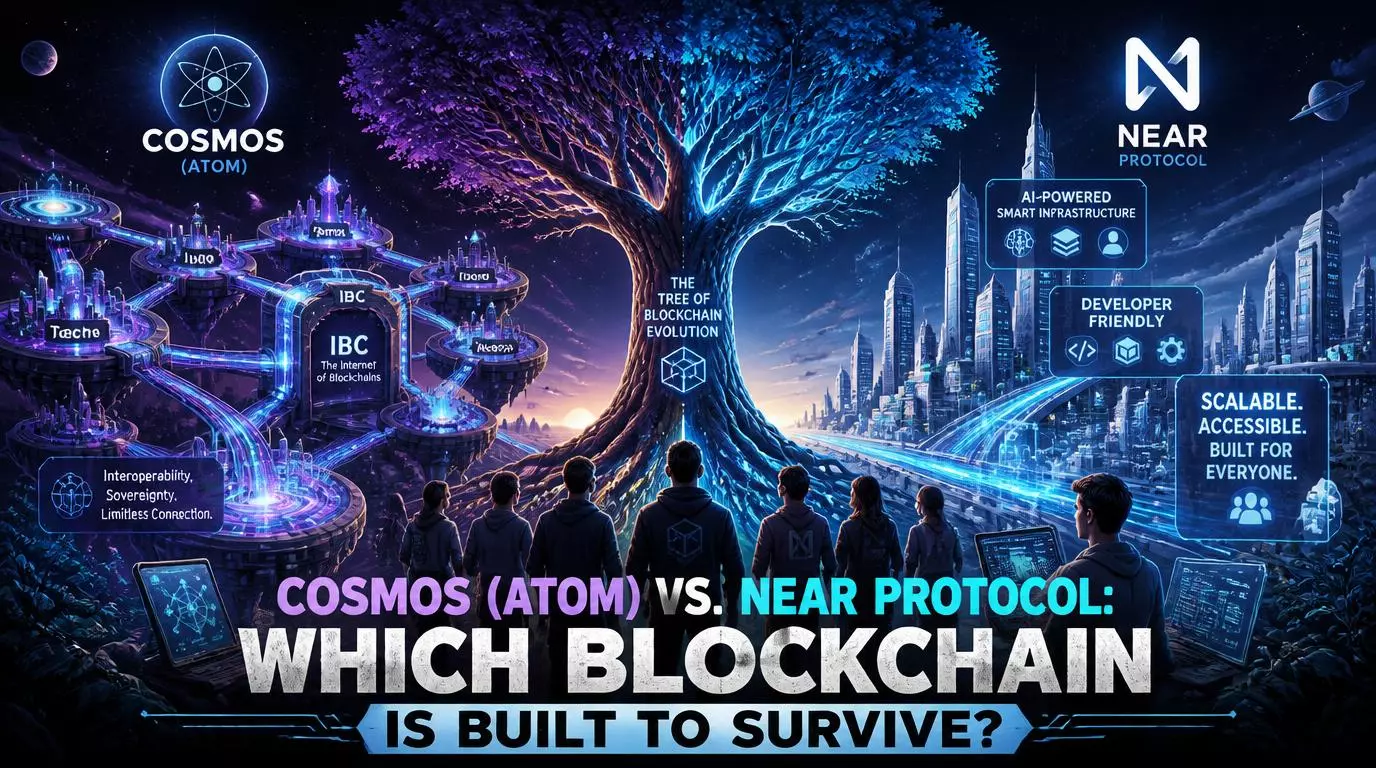
Cosmos focuses on connecting blockchains.
Near focuses on making blockchain technology easier to use and scale.
That raises an important question:
Cosmos vs Near Protocol: Which blockchains are future-proof?
Understanding Their Core Missions
Before comparing long-term survival potential, it helps to understand what each project is trying to accomplish.
Cosmos aims to:
- Connect independent blockchains
- Improve interoperability
- Reduce ecosystem fragmentation
- Create an Internet of Blockchains
→ Can Cosmos (ATOM) Still Play a Major Role in the Future of Crypto?
Near Protocol aims to:
- Improve usability
- Simplify onboarding
- Scale blockchain applications
- Support future Web3 adoption
→ Why Near Protocol (NEAR) Is Getting Attention Again in Crypto
Both projects address important challenges, but they do so in very different ways.
Cosmos: The Case for Interoperability
As the blockchain industry expands, communication between networks becomes increasingly important.
Without interoperability:
- Ecosystems remain isolated
- Assets become fragmented
- User experiences become more complex.
Cosmos built its entire identity around solving this problem.
Its vision is straightforward:
Instead of one blockchain dominating everything, multiple blockchains should work together.
If crypto continues expanding into hundreds of interconnected ecosystems, interoperability could become even more valuable.
That possibility keeps Cosmos relevant.
Near Protocol: The Case for Usability
While Cosmos focuses on connectivity, Near focuses on accessibility.
Blockchain adoption still faces significant obstacles.
Many platforms remain difficult for ordinary users.
Near attempts to address this challenge through:
- Simpler user experiences
- Developer-friendly tools
- Scalable infrastructure
- Easier onboarding
If blockchain adoption reaches mainstream audiences, usability may become one of the industry’s most important advantages.
Which Narrative Has More Momentum?
Crypto markets often reward powerful narratives.
Investors now focus increasingly on:
- AI infrastructure
- Scalability
- Developer ecosystems
- Blockchain adoption
→ The Biggest Crypto Narratives Investors Are Watching for the Next Bull Run
Near Protocol frequently appears in these conversations.
Its focus on future infrastructure and usability aligns with several emerging trends.
Cosmos remains highly relevant but often receives less attention from mainstream crypto discussions.
Narrative momentum currently favors Near.
Developer Growth Matters
Technology alone rarely determines success.
Developers build:
- Applications
- Ecosystems
- Communities
- Innovation
Strong developer activity correlates with long-term blockchain survival.
Cosmos and Near sustain significant investment in developer tools and infrastructure.
The ecosystem that attracts more builders over time may gain a significant advantage.
Adoption vs Infrastructure
One way to view the comparison is:
Near Protocol
Focuses on adoption.
Cosmos
Focuses on infrastructure.
Near aims to help more people use blockchain technology.
Cosmos aims to help more blockchains communicate.
Both goals could become increasingly important as the industry matures.
Risks Facing Both Projects
Neither blockchain is guaranteed to succeed.
Cosmos faces:
- Increasing competition
- Alternative interoperability solutions
- Lower retail visibility
Near faces:
- Competition from larger ecosystems
- Adoption uncertainty
- Developer acquisition challenges
Long-term survival depends on execution as much as technology.
Which Blockchain Has the Stronger Survival Case?
The answer lies in how the market evolves.
Cosmos may thrive if:
- Blockchain fragmentation increases
- Interoperability becomes essential
- Cross-chain communication expands
Near may thrive if:
- Mainstream adoption accelerates
- Usability becomes critical
- Web3 applications continue growing.
Both projects solve real problems.
And projects that solve real problems often survive longer than those built primarily around speculation.
Cosmos vs Near Protocol
| Category | Cosmos (ATOM) | Near Protocol (NEAR) |
|---|---|---|
| Primary Focus | Interoperability | Usability & Adoption |
| Ecosystem Vision | Internet of Blockchains | Scalable Web3 Platform |
| Developer Tools | Strong | Strong |
| Scalability | High | High |
| Narrative Momentum | Moderate | High |
| Retail Visibility | Moderate | Growing |
| Long-Term Relevance | trong | Strong |
Frequently Asked Questions (FAQs)
They serve different purposes. Cosmos focuses on interoperability, while Near focuses on usability and adoption.
Many investors are attracted to Near because of its scalability, developer ecosystem, and focus on making blockchain easier to use.
Cosmos is best known for its vision of connecting independent blockchain networks through interoperability.
Yes. Blockchain adoption does not necessarily require a single winner. Multiple ecosystems can thrive simultaneously.
Both possess strong long-term potential, but their success may depend on which industry challenges become most important in the future.