
In a traditional classroom, a teacher often explains a lesson, students take notes, and everyone practises the same skill. This approach can help children build essential knowledge, but it is not the only way to organise learning.
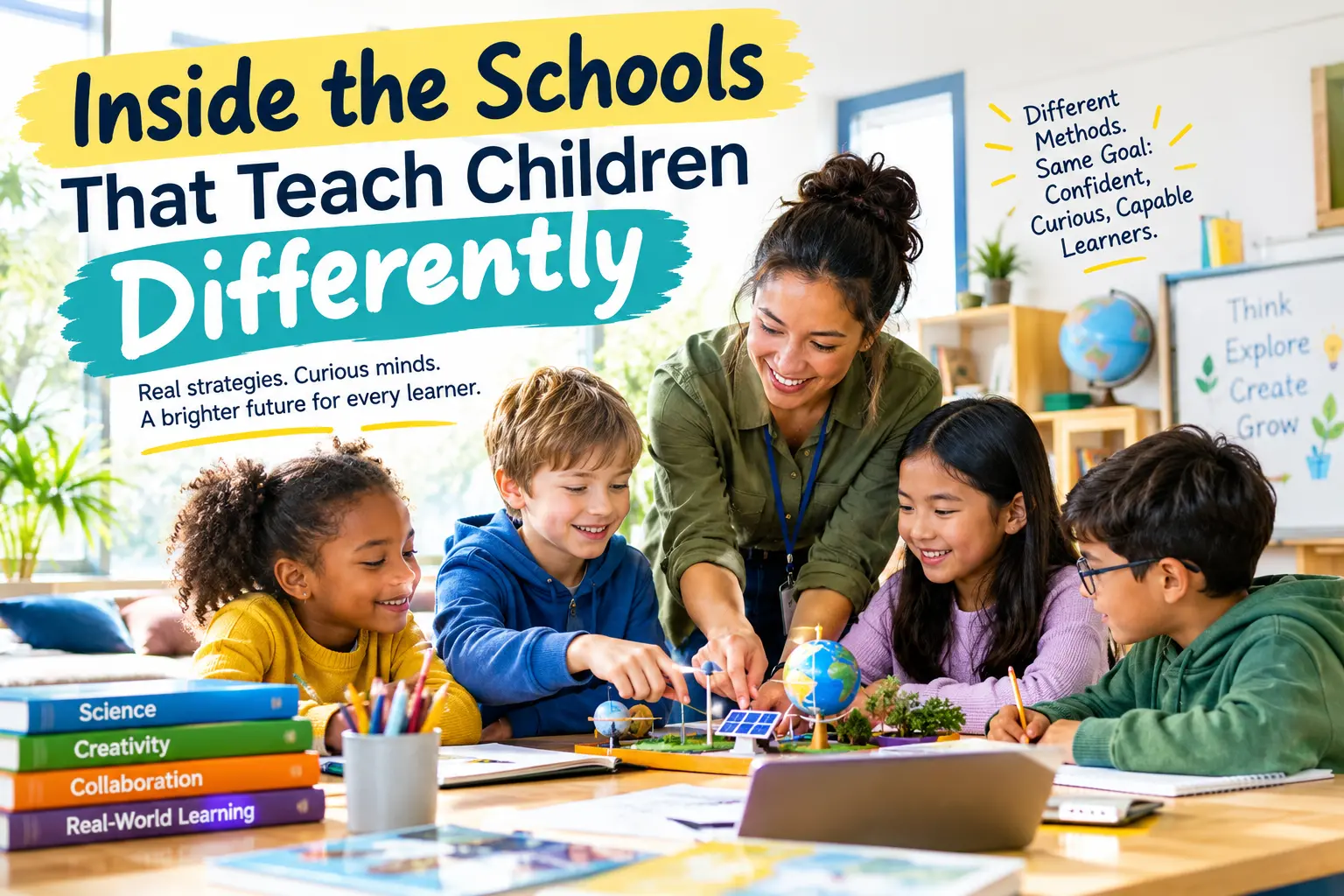
Some schools give students more opportunities to investigate questions, work independently, collaborate with classmates, and connect lessons to real-life situations. Teachers still guide the process, but students take a more active role in developing their understanding.
For a broader look at alternative approaches to education, see Schools Around the World That Break the Rules of Traditional Education, which examines how schools challenge conventional approaches to learning.
These approaches are not simply about making school more entertaining. They change how lessons are planned, how teachers support students, and how children demonstrate what they know.
Understanding these differences can help parents and educators see which teaching practices may be useful—and why no single method is guaranteed to work for every child.
1. What Makes These Schools Different?
Schools that teach children differently do not necessarily abandon textbooks, structured lessons, or academic standards. Instead, they change how students engage with knowledge.
In some classrooms, children spend more time investigating questions before discussing possible answers. In others, they work with specialised learning materials, develop projects, or explain their thinking to classmates.
Different school environments can also shape how children learn, as discussed in The World’s Most Unusual Schools—and What They Teach Us About Learning.
The teacher remains important. Rather than simply delivering information, the teacher can design activities, ask guiding questions, observe student progress, and provide feedback when children struggle.
Consider a lesson about water pollution.
A conventional lesson might introduce the causes of pollution through a textbook, followed by questions and written exercises. An inquiry-based lesson could begin by asking students why a nearby river or stream might become polluted.
Students could examine photographs, read scientific information, compare possible causes, and suggest ways to reduce the problem. The teacher would help them distinguish evidence from assumptions and connect their findings to scientific concepts.
Both approaches can teach important knowledge. The difference lies in how students participate in the learning process.
2. Montessori Schools: Learning Through Independent Work
Montessori education gives children more responsibility for their own learning.
Developed by Italian educator and physician Maria Montessori, the method uses a carefully prepared learning environment where children can work with age-appropriate materials and develop skills at a suitable pace.
In a Montessori classroom, students may choose from teacher-introduced activities, work independently for sustained periods, or collaborate with classmates. Teachers observe their progress and provide guidance when needed.
Specially designed materials can help children investigate concepts through direct experience. For example, a child learning mathematics might use physical objects to understand quantities before moving toward more abstract calculations.
Montessori schools often group children of different ages. Trained teachers support children as they learn, while longer work periods give them time to concentrate, work independently, and gain practical experience.
The American Montessori Society explains these core elements in its guide to the Montessori classroom.
What students may gain
This approach gives children opportunities to make decisions, organize their work, and develop independence. Students may also receive more opportunities to repeat an activity until they understand it.
However, independence does not mean leaving children to teach themselves everything. Teachers must prepare appropriate activities, identify misconceptions, and ensure students develop essential knowledge.
The approach also requires suitable materials, trained educators, and a classroom environment that supports its principles. A school should not be considered genuinely Montessori simply because it uses the label.
Research on Montessori education has found encouraging results, although the evidence varies in strength and some studies have limitations. A review published in npj Science of Learning explores the main features of Montessori education and the challenges of evaluating its effectiveness.
Read the review: Montessori Education: A Review of the Evidence Base.
3. Project-Based Learning: Turning Lessons Into Real Problems
Project-based learning connects academic content with a question, problem, or challenge that students investigate over an extended period.
Instead of treating a project as a decorative activity at the end of a lesson, students learn important concepts while working toward a meaningful outcome.
For example, a class studying mathematics, science, and environmental issues could investigate how to reduce waste at school.
Students might measure how much rubbish the school produces, organise the information into charts, research recycling methods, and propose a practical solution. They would then present their findings to classmates or school administrators.
The project gives students a reason to use several academic skills together.
PBLWorks describes project-based learning as an approach in which students investigate meaningful challenges and demonstrate their knowledge through a product or presentation for an audience.
Its explanation is available in What Is Project-Based Learning?.
Why the method needs careful planning
Projects can help students connect knowledge with practical situations, but not every group activity qualifies as effective project-based learning.
When decoration takes priority, a poster project may leave less room for students to examine ideas and build a deeper understanding. Students might also divide the workload unevenly, allowing some children to do most of the thinking while others contribute very little.
Teachers therefore need clear learning objectives, appropriate research materials, realistic deadlines, and ways to evaluate each student’s understanding.
Students should learn the underlying concepts, not just produce an impressive final result.
4. Inquiry-Based Learning: Teaching Children to Ask Better Questions
Inquiry-based learning begins with questions that encourage students to investigate a topic, examine evidence, and develop explanations.
Instead of being told what to think, students learn to ask questions, look for evidence, explore possible answers, and decide what they can learn from the process.
Imagine a science lesson about evaporation.
The teacher could ask why a puddle disappears after a sunny day. Students might suggest explanations, compare observations, and investigate how temperature, sunlight, and airflow affect evaporation.
The teacher then helps them connect their observations to the scientific principles involved.
This process gives students opportunities to practise reasoning and evidence-based thinking.
The International Baccalaureate Primary Years Programme, designed for children aged 3 to 12, provides one example of an inquiry-based curriculum framework. It encourages students to investigate concepts, reflect on learning, and connect ideas across subject boundaries.
Learn more through the IB Primary Years Programme.
Does inquiry mean students discover everything alone?
No. Effective inquiry still requires instruction.
Children may need background knowledge, vocabulary, worked examples, carefully chosen questions, and explicit explanations before they can investigate a topic productively.
If a task is too difficult or open-ended, students can become confused or rely on guesses rather than evidence.
The teacher’s role is to provide enough structure for students to think meaningfully while allowing them to participate actively in the investigation.
5. Reggio Emilia: Taking Children’s Ideas Seriously
The Reggio Emilia approach originated in municipal early-childhood schools in Reggio Emilia, Italy. It emphasizes children’s curiosity, relationships, creativity, and active involvement in learning.
Children can follow their curiosity, strengthen relationships, explore new ideas, and become more involved in their learning. They may communicate through speech, drawing, movement, building, dramatic play, and other forms of creative work.
Consider preschool children exploring shadows through drawings, hands-on experiments, and group discussions, returning to their work as each discovery deepens their understanding.
Teachers observe children’s interests, ask questions, document learning, and plan further activities based on what emerges.
The physical learning environment and families’ involvement also help shape how the approach works.
Reggio Children, the organisation that promotes and supports the educational philosophy, explains these principles in its overview of the Reggio Emilia approach.
What makes this approach distinctive?
It treats children’s ideas as meaningful starting points for learning rather than assuming that every activity must follow a fixed sequence.
However, it is particularly associated with early-childhood education. Its practices should not automatically be treated as a complete model for every age group or school subject.
Teachers still need to support language development, early mathematics, social interaction, and other essential skills.
6. Collaborative Learning: Students Learn With One Another
Another approach changes how students work together.
In collaborative learning, students may solve problems in small groups, explain concepts to classmates, compare different answers, or work toward a shared goal.
For example, a mathematics teacher could ask groups to solve the same problem using different strategies. Each group would explain its reasoning, compare approaches, and discuss why one method might be more efficient than another.
Explaining an idea can reveal whether a student understands it. Listening to classmates can also expose students to alternative ways of thinking.
However, group work is not automatically effective.
A confident student might dominate the discussion, while quieter students contribute very little. Some children may copy an answer without understanding how it was reached.
Teachers can reduce these problems by assigning meaningful roles, asking each student to explain part of the solution, and checking individual understanding.
The Education Endowment Foundation’s Teaching and Learning Toolkit reviews collaborative learning alongside other educational approaches. Its evidence summaries underscore that an approach’s effectiveness depends not only on its design but also on how it is carried out.
How the teaching approaches compare
| Teaching approach | How students learn | Main consideration |
|---|---|---|
| Montessori | Independent work with specially designed materials | Requires prepared environments and trained teachers |
| Project-based learning | Investigating real-world questions and creating a product | Projects need clear learning goals and individual accountability |
| Inquiry-based learning | Asking questions, examining evidence, and developing explanations | Students need appropriate guidance and background knowledge |
| Reggio Emilia | Exploring ideas through creativity, relationships, and different forms of expression | Primarily associated with early-childhood education |
| Collaborative learning | Solving problems and sharing ideas with classmates | Every student needs meaningful participation |
These approaches can overlap, and their effectiveness depends on implementation, student needs, and learning goals. The table provides a quick comparison rather than a ranking of which method is best.
7. What Does Research Say About Different Teaching Methods?
Different teaching approaches can support learning in different ways, but the evidence does not justify declaring one method the best choice for every student.
The Education Endowment Foundation’s Teaching and Learning Toolkit reviews evidence across several educational practices. It identifies feedback, metacognition, and self-regulation as important approaches, while noting that evidence strength varies between interventions.
Metacognition means thinking about how we learn. Students practise this skill by planning how to solve a problem, checking whether their approach is working, and reflecting on what they could improve.
For example, after completing a writing assignment, a student might ask:
- Did I understand the question correctly?
- Which part of my explanation is weakest?
- What evidence supports my main point?
- What should I change next time?
These questions encourage students to take greater responsibility for improving their work.
The Education Endowment Foundation’s review of metacognition and self-regulation explains that these strategies can be effective when teachers explicitly teach them and integrate them into ordinary subject lessons.
Inquiry research- and problem-based teaching also offers useful evidence. A study of ten field experiments across four countries found improvements in mathematics and science test scores following these approaches. However, the results do not guarantee the same outcomes in every school or classroom.
See the Inter-American Development Bank’s report, Inquiry and Problem-Based Pedagogy: Evidence from 10 Field Experiments.
The broader lesson is that teaching methods should be evaluated by what students actually learn, not simply by whether a classroom appears innovative or enjoyable.
To determine whether a method is suitable, schools should consider what students are learning, how effectively they are taught, what support they need, and whether the approach works in their setting.
8. Could These Teaching Methods Work in Ordinary Public Schools?
Schools do not necessarily need expensive facilities or a complete curriculum overhaul to introduce more varied teaching practices.
A teacher could begin by asking students to explain their reasoning rather than only provide an answer. A science lesson could include a simple investigation using available materials. A history class could compare primary sources, while a mathematics lesson could connect calculations to a practical problem.
Teachers could also include structured group discussions, short projects, and regular feedback.
Teachers can introduce these changes in ways that fit their current lessons, textbook activities, and assessment requirements.
However, implementation is not always easy. Large classes, limited supplies, demanding workloads, and tight schedules can make individual guidance and complex projects difficult.
Teachers need adequate preparation time, relevant training, and support from school leaders. Activities should also match students’ ages, abilities, and learning goals.
In schools with limited resources, carefully chosen teaching practices may be more realistic than adopting an entire educational model.
The aim is not to copy another school’s approach exactly. The aim is to find practices that work in the local setting.
Schools can also rethink traditional practices themselves. In What If School Had No Classrooms, Exams, or Homework?, we examine the potential benefits and limitations of changing three familiar parts of school life.
9. Is One Teaching Method Better Than the Others?
No single approach guarantees better outcomes for every child, subject, or age group.
Independent work may help students practise responsibility, but some learners need more direct instruction. Projects can connect ideas to real situations, but students still need sufficient background knowledge. Inquiry can encourage reasoning, but it works best when children receive appropriate guidance.
These approaches are not necessarily competitors. Teachers can combine them according to the learning objective.
A lesson might begin with a clear explanation, continue with a teacher-guided investigation, and finish with independent practice. Another lesson might use a collaborative project to help students apply knowledge they have already developed.
The important question is not whether a school follows a particular educational label. It is whether its teaching methods help students understand essential concepts, practise useful skills, and recognise where they need to improve.
This also raises the question of whether everything taught in school is useful in everyday life. For example, Is Algebra Really Necessary in School? examines why students may struggle to see how mathematics connects to everyday life and why its practical value matters.
References
- American Montessori Society: Inside a Montessori Classroom — outlines key features of Montessori education.
- Marshall, C. (2017), npj Science of Learning: Montessori Education: A Review of the Evidence Base — reviews Montessori principles and limitations in the research.
- PBLWorks: What Is Project Based Learning? — explains the principles of project-based learning.
- International Baccalaureate: Primary Years Programme — describes an inquiry-based curriculum framework for children aged 3 to 12.
- Education Endowment Foundation: Teaching and Learning Toolkit — provides summaries of research on educational approaches and their implementation.
- Inter-American Development Bank: Inquiry and Problem-Based Pedagogy: Evidence from 10 Field Experiments — reports findings from field experiments on inquiry- and problem-based teaching.
Schools that teach children differently are not all following the same philosophy. Some emphasise independence, others focus on projects, inquiry, creativity, or collaboration. What connects them is the effort to make teaching responsive to how students develop understanding.
The most useful lesson is not that traditional education must be replaced. It is that schools can examine how children learn, retain effective teaching practices, and introduce alternatives when they serve a clear educational purpose.
Frequently Asked Questions (FAQs)
It means the school uses teaching approaches that change how students participate in learning. Examples include independent work, inquiry-based lessons, project-based learning, and structured collaboration.
Not automatically. Their effectiveness depends on the subject, the students’ needs, the quality of instruction, and how well the approach is implemented. Direct instruction can be valuable, and it can work alongside more active learning methods.
Montessori is a broader educational approach that includes a prepared environment, specialised materials, child-directed work, and other principles. Project-based learning is a teaching method in which students investigate a meaningful problem or question over time and demonstrate what they learn through a project.
Yes. Public schools can introduce selected practices, such as guided investigations, collaborative problem-solving, practical assignments, and regular feedback. How much schools use these approaches depends on their teachers, available resources, class sizes, and curriculum demands.
Freedom can support independence, but students still need structure and guidance. Teachers should help children set realistic goals, understand key concepts, and learn from their mistakes. The right balance depends on students’ development and the task.