
What does a school need to look like for children to learn? Most people imagine classrooms with rows of desks, a teacher at the front, textbooks on the tables, and a blackboard on the wall. Yet education does not always happen in buildings like these.
In some parts of the world, children learn aboard boats that travel through flooded communities. Others attend lessons remotely because their homes are hundreds of kilometers from the nearest town. From open learning spaces that resemble public gathering areas to classrooms established in caves, some schools adapt their designs and locations to meet educational needs in unconventional ways.
These schools are more than unusual places to study. They demonstrate how schools adapt their educational methods and environments to local geography, infrastructure, technology, and community needs.
Some schools also challenge conventional education through student-led learning, outdoor classrooms, and alternative teaching methods. Read more in our article, Schools Around the World That Break the Rules of Traditional Education, to see how different approaches are changing the classroom experience.
Here are some of the world’s most unusual schools and the important lessons they offer about learning.
1. The Cave School in China: When Education Reaches Remote Communities
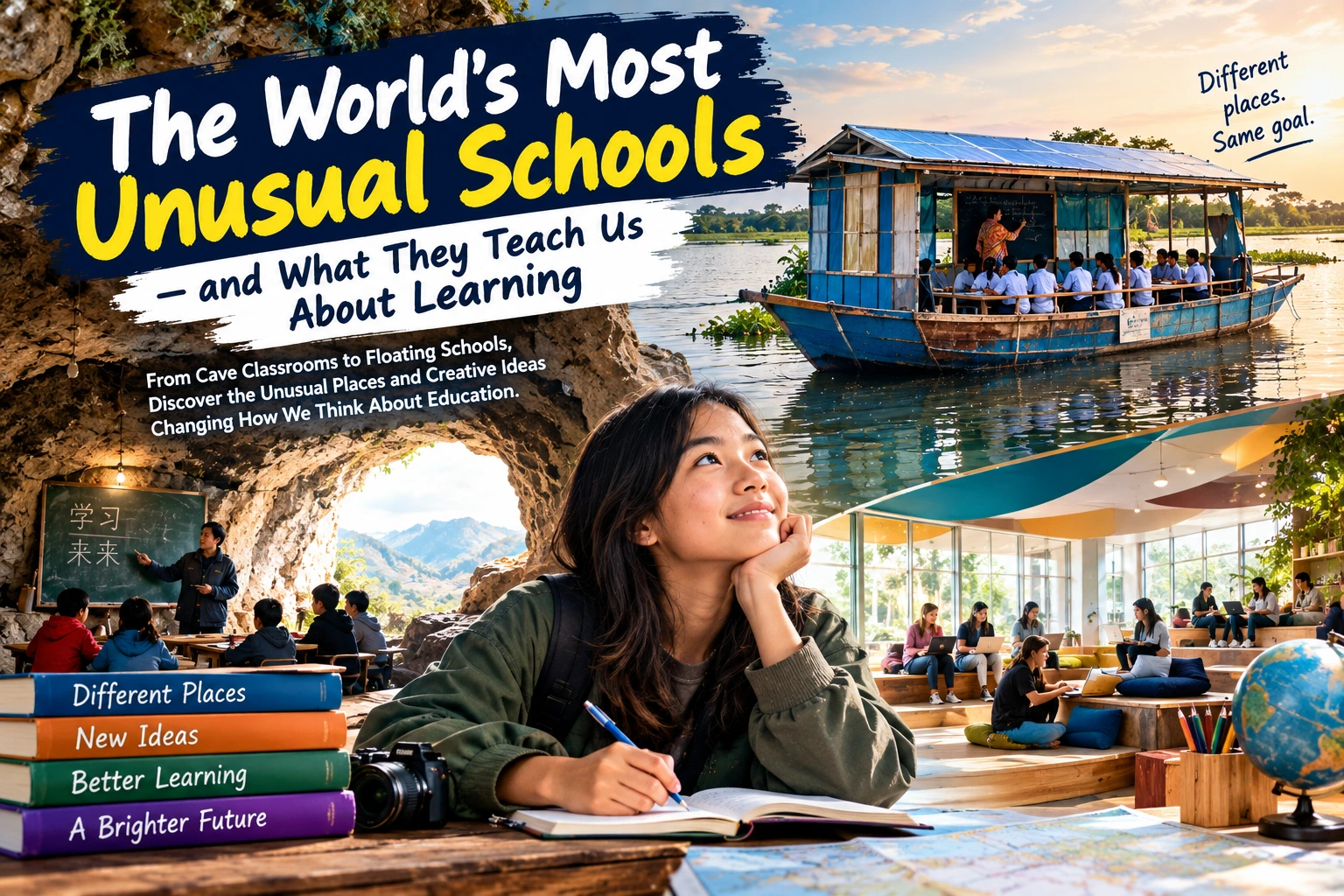
In parts of rural China, difficult terrain has historically made access to education a serious challenge. One widely reported example was a primary school established inside a cave in Guizhou Province, where the surrounding landscape made conventional construction and transportation difficult.
The cave school attracted international attention because of its unusual location. The natural rock formation served as the classroom, allowing children to gather for lessons without a purpose-built school building.
This example shows that access to education depends on more than the curriculum. Roads, travel distances, construction costs, and the availability of suitable land can all affect whether children can attend school.
However, the historical example should not be taken as proof that cave classrooms are a suitable long-term solution. A natural cave may lack proper lighting, ventilation, sanitation, weather protection, and emergency exits. Recent sources are needed to establish whether the widely reported cave school is still operating.
What it teaches us: Education systems must account for local conditions. Children in remote communities may need different infrastructure and support from those living in well-connected cities.
A school’s effectiveness should be assessed by more than its appearance or design. Its safety, accessibility, teaching quality, and ability to support students over time matter far more.
2. Floating Schools in Bangladesh: Bringing the Classroom to the Children
In flood-prone parts of Bangladesh, seasonal flooding can cover roads, isolate villages, and interrupt children’s education. When water levels rise, children in some communities may struggle to reach school safely.
Floating schools provide a practical way to address this challenge. Organizations such as Shidhulai Swanirvar Sangstha operate schoolboats that bring lessons closer to children in vulnerable communities.
Boat-based schooling allows teachers to reach children in waterway-dependent communities, reducing the need for students to travel long distances to conventional schools. Some programs also provide educational materials and other forms of community support.
This approach does not eliminate the challenges of poverty, flooding, or unequal access to education. It does, however, show how school services can be adapted to the environment instead of relying on a single model.
What it teaches us: Schools can change how they deliver education when the usual approach does not work.
In flood-prone areas, the issue may not be that children lack interest in learning. They may have no reliable way to get to school. Understanding that difference is essential when designing educational solutions.
3. School of the Air in Australia: Learning Across Vast Distances
Australia has enormous rural and remote areas where families may live far from the nearest town or school. For children in these locations, attending a conventional school every day may be impractical.
School of the Air programs were created to help students in remote areas continue their education without moving away from home. Australia’s distance-education system has evolved, using correspondence materials, telephone communication, online resources, and direct teacher support.
For example, the School of the Air in Broken Hill serves students in geographically isolated communities. Its educational model includes learning materials and personalized interactions among teachers, students, and adults who support learning at home.
This is different from simply handing children a collection of worksheets. Distance education requires planning, regular communication, feedback, and coordination between the school and the household.
However, studying remotely can also create difficulties. Students may have fewer opportunities for daily social interaction, group activities, and immediate help from classmates. Reliable internet access and suitable learning resources can also make a difference.
What it teaches us: Learning does not have to stop when students cannot attend a physical classroom.
Distance education can extend access to children who live far from schools. Its success, however, depends on more than sending lessons. Students still need teacher guidance, feedback, motivation, and opportunities to interact with others.
4. Ørestad Gymnasium in Denmark: A School With an Unusual Interior
Some unusual schools are not located in remote landscapes. They stand in modern cities but challenge the traditional idea of what a school building should look like.
Ørestad Gymnasium in Copenhagen, Denmark, is known for its striking interior and open learning spaces. Its architecture features a large central atrium, broad staircases, flexible study areas, and a combination of open spaces and more enclosed classrooms.
According to the Danish Architecture Center, the building was designed to encourage communication, interaction, and different ways of organizing learning.
The school combines group activities with more traditional classroom lessons. This allows teachers to choose the setting that best suits each lesson instead of using the same arrangement every time.
Still, an open design is not automatically better for every student. Some students focus better in quiet spaces, while others learn well through discussion and group activities. School environments should account for noise, privacy, and potential distractions.
What it teaches us: The physical environment can influence how students interact and learn.
A well-designed school should offer a range of spaces for different needs. The goal is not to remove every classroom wall, but to create environments that support concentration, discussion, cooperation, and independent study.
5. Schools That Travel With Nomadic Communities
Some communities move regularly because of their work, traditions, climate, or access to grazing land. For nomadic families, remaining in one location for an entire school year may not be practical.
Schools may need flexible learning arrangements to help children continue their education as their families move from place to place. Depending on the country and community, these arrangements can include mobile teaching teams, boarding facilities, flexible attendance, learning centers along migration routes, or distance education.
Educating children in nomadic communities requires more than one solution. What works in one place may not work in another because laws, languages, livelihoods, infrastructure, and family needs differ.
A fixed school schedule may not fit families who travel seasonally or need children to help with family work. On the other hand, frequent movement can make it harder for students to follow a consistent curriculum, build friendships, and complete formal assessments.
What it teaches us: A school system needs to understand the lives of the children it serves.
Flexible scheduling and accessible learning materials may help reduce barriers to education. But flexibility should not mean that mobile children receive a lower-quality education. They still need qualified teachers, consistent learning goals, and a clear path to further study.
6. Schools Built for Their Communities, Not Just for Lessons
An unusual school does not always need a cave, a boat, or an impressive architectural design. Occasionally, the most important difference is how a building uses its limited space.
In crowded cities, schools may have to work with small plots of land. In remote areas, transporting construction materials can be expensive. Schools in areas exposed to extreme weather need structures designed to withstand the environmental hazards common to their locations.
Architects and education planners can create more adaptable schools through flexible rooms, shared facilities, natural light, shaded outdoor spaces, and multipurpose areas. Shared spaces such as libraries, community halls, and multipurpose rooms can serve several educational purposes, helping schools use limited resources more efficiently.
However, attractive design should not take priority over basic needs. Safe structures, accessible toilets, clean drinking water, ventilation, lighting, and reliable maintenance are fundamental parts of a suitable learning environment.
What it teaches us: A school should be designed around the needs of its students and community.
The best design is not necessarily the most expensive or visually impressive. Its real value lies in creating a safe, practical environment where students can learn and thrive.
7. What These Schools Reveal About the Meaning of Education
These examples differ in appearance, location, and purpose. Yet they point toward several broader lessons about education.
Access comes before innovation
A creative teaching method cannot help children who have no reliable way to attend school or receive lessons. Floating schools and distance education illustrate a basic principle: educational improvements can benefit students only when they can access learning in the first place.
The learning environment matters
A classroom’s layout can influence concentration, communication, movement, and group work. Schools should consider how students use their surroundings, rather than assuming one room arrangement will suit everyone.
The learning environment is only one part of the wider question of what schools teach and why. Some subjects also raise questions about their practical value in everyday life. Our article, Is Algebra Really Necessary in School?, examines why students learn algebra and how mathematical knowledge can be useful beyond the classroom.
Different students need different forms of support
Some children thrive in group discussions. Others require quiet spaces or individual guidance. Students in remote areas may depend on reliable technology and teacher guidance to access learning opportunities that are more readily available in urban schools.
A flexible education system can respond to these differences without lowering expectations.
Technology is useful when it solves a real problem
Online lessons and digital resources can help students who live far from schools. But technology alone does not guarantee learning. Students also need understandable lessons, feedback, reliable access to materials, and adults who can support them.
Unusual does not automatically mean better
A school may look extraordinary in photographs but still face problems with teaching quality, funding, safety, or student outcomes. The important question is whether its approach helps children learn and develop.
The same principle applies when evaluating students. Test scores can provide useful information, but they may not capture every skill a student has developed or everything they understand. Read Why Exam Results Don’t Always Reflect What Students Know to learn more about the limits of using examination results as the only measure of learning.
Comparing the World’s Unusual Schools
| School or model | What makes it unusual | Main lesson |
|---|---|---|
| Historical cave school in China | Lessons were held in a natural cave | Remote communities need schools that are safe and easy to reach. |
| Floating schools in Bangladesh | Lessons travel by boat through flood-prone areas | Schools can adapt to environmental challenges. |
| School of the Air in Australia | Students learn across long distances | Distance education can serve geographically isolated children |
| Ørestad Gymnasium in Denmark | Open and flexible learning spaces | School design can support different forms of learning |
| Flexible schooling for nomadic communities | Education must accommodate family movement | School systems need to respond to students’ circumstances |
| Community-focused school design | Buildings are adapted to local space and needs | Practical design can make learning environments more useful |
Could These Ideas Work in Ordinary Schools?
Not every school needs to become a floating classroom or adopt an open-plan building. These approaches reflect specific local needs, and adopting them without understanding their purpose may introduce new challenges.
Ordinary schools can still apply some of their underlying ideas.
- Make learning accessible: Provide support for students who face transportation, disability, financial, or geographic barriers.
- Use spaces more effectively: Create suitable areas for group activities, independent study, practical work, and quiet concentration.
- Adapt to local conditions: Consider climate, community needs, available resources, and the daily experiences of students.
- Support students beyond the lesson: Provide clear instructions, useful feedback, and access to teachers when difficulties arise.
- Evaluate results: Examine student learning, attendance, well-being, and access instead of judging a school by its appearance alone.
These changes do not mean schools must stop using textbooks, regular lessons, or exams. Traditional methods can remain useful when combined with approaches that address students’ needs.
The aim is not to copy other schools, but to learn from their successes and adapt their ideas to local needs.
Frequently Asked Questions (FAQs)
No single definition captures every unusual school, as they differ in their physical settings, architectural designs, and educational methods. Floating schools in Bangladesh, Australia’s distance-education programs, and Denmark’s open-plan Ørestad Gymnasium are notable examples for different reasons.
In flood-prone areas of Bangladesh, rising water can make roads and ordinary school buildings difficult to reach. Floating schools bring lessons closer to communities and can help children continue learning during difficult seasons.
Yes. Distance education and other flexible arrangements can provide effective learning opportunities when students receive suitable teaching materials, regular feedback, teacher support, and opportunities for interaction. The results depend on how well the program is designed and delivered.
Not necessarily. A school’s appearance or unusual location does not prove that students learn more effectively. Educational quality depends on teaching, resources, student support, safety, and learning outcomes.
The Real Lesson Behind Unusual Schools
The world’s most unusual schools show that education does not depend on one building design or a single way of delivering lessons. Schools can adapt to local challenges, from flooding and geographical isolation to space constraints and differing community needs.
But unusual settings are not the main measure of success. A school’s purpose is to help children develop knowledge, skills, confidence, and opportunities for the future.
The most important lesson is not that every school needs to be extraordinary. The essential principle is for every school to understand its students’ needs and adapt its approach to support their learning.
When education is designed around those needs, even an ordinary classroom can become a better place to learn.
Sources
- Shidhulai Swanirvar Sangstha—Floating school programs in Bangladesh
- NSW School Infrastructure—School of the Air, Broken Hill
- Danish Architecture Center—Ørestad Gymnasium
- Ørestad Gymnasium—Architecture and learning environments
Note: The cave-school example is historical and should not be interpreted as confirmation that the school is currently operating. School arrangements and programs can change over time.