
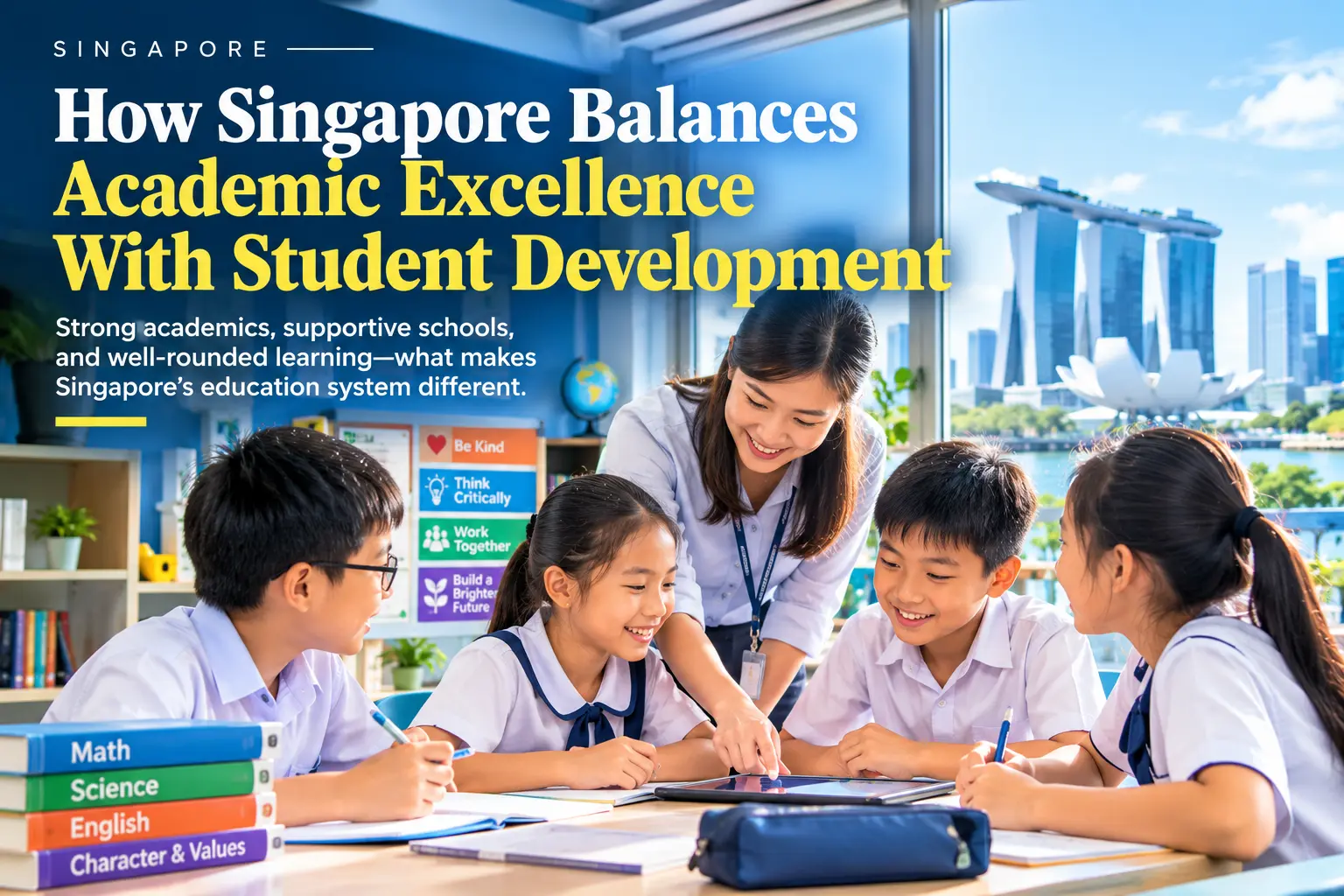
Singapore is widely recognized for its strong academic performance. Its students perform well in mathematics, reading, and science, and its education system draws interest from policymakers worldwide.
But academic performance is only one measure of educational success.
Schools must also help children develop confidence, resilience, social skills, and the ability to apply knowledge beyond examinations.
Singapore has been working to balance these objectives. Its education policies emphasize strong academic foundations while giving greater attention to holistic development, student well-being, and learning beyond examination results.
Education should do more than produce strong academic results. It should equip young people with knowledge, critical thinking, adaptability, and the ability to make responsible decisions.
Why Singapore Places High Expectations on Academic Learning
Singapore prioritizes strong academic foundations and high student achievement.
Students study core subjects such as English, mathematics, science, and their mother tongue. Schools use assessments to monitor learning, identify gaps, and determine whether students are meeting expected standards.
The system demonstrates strong academic performance in international comparisons.
In the OECD’s Programme for International Student Assessment (PISA) 2022, Singapore ranked among the highest-performing participants in mathematics, reading, and science. Approximately 92% of Singaporean students reached at least Level 2 proficiency in mathematics, compared with an OECD average of 69%.
These results indicate that most participating students had developed essential mathematical skills, while a substantial proportion demonstrated advanced abilities.
However, strong national averages do not mean every student achieves the same results. The OECD also identified performance differences associated with socioeconomic background.
Academic achievement matters, but it cannot fully describe the broader student experience.
Source: OECD, PISA 2022 Results
Singapore Is Moving Beyond Examination Results Alone
For many years, examinations have played a prominent role in Singapore’s education system. They give schools a way to assess achievement and track students’ learning progress.
However, an excessive focus on scores can narrow how students and parents understand success.
Children may begin to measure their abilities mainly by their grades. Parents may become more concerned about rankings than whether their children understand the material. Students who struggle academically may overlook strengths in other areas.
Singapore has introduced education reforms that place greater emphasis on learning beyond academic results.
The ministry gradually phased out mid-year examinations in primary and secondary schools, completing the process in 2023. The policy was intended to reduce excessive assessment pressure and create more space for teaching, learning, and student development.
This does not mean examinations have disappeared. Schools continue to assess students, and formal assessments remain an important part of the education system.
The distinction is that assessment should support learning rather than become the only purpose of learning.
When teachers use feedback to identify misunderstandings and guide improvement, assessment becomes more useful than a mark alone.
What Holistic Development Means in Singapore
Holistic development focuses on helping children grow in different aspects of life rather than measuring their progress only through academic results.
Education in Singapore extends beyond academic knowledge to include values, social and emotional skills, learning habits, and practical abilities.
Finland also takes a distinctive approach to early education, as explained in Why Finland Takes a Different Approach to Elementary Education.
These goals are especially clear in the country’s early childhood education framework, which recognizes that children develop across interconnected areas of learning.
In practical terms, schools can help students develop:
- Critical thinking: Examining evidence and understanding why an answer is correct.
- Communication: Explaining ideas clearly and listening to others.
- Social responsibility: Respecting classmates and contributing to the school community.
- Emotional development: Learning to understand feelings and cope with challenges in healthy ways.
- Independence: Taking responsibility for learning and everyday decisions.
- Adaptability: Applying knowledge to unfamiliar problems and changing circumstances.
These abilities complement academic subjects such as mathematics, science, and language rather than replace them.
Instead, they help students apply their knowledge and prepare for situations that require more than memorization.
Source: Nurturing Early Learners Framework
Why Singapore Has Reduced Some Assessment Pressures
Singapore has sought to ease examination pressure by reducing the emphasis on frequent, high-stakes assessments, especially during the early years of primary school.
The ministry has removed school-based weighted assessments and examinations that count toward students’ overall marks or grades in Primary 1 and Primary 2.
Teachers still monitor learning through classroom activities, observations, assignments, and feedback.
The objective is to allow younger children to develop foundational skills without placing unnecessary weight on formal grades too early.
This distinction matters because assessment serves different purposes.
A test can measure what a student knows at a particular moment. Regular feedback can also help teachers identify misunderstandings, adjust instruction, and show students how to improve.
During the early school years, this second function deserves particular attention.
Reducing certain examinations does not mean abandoning academic standards. It reshapes how schools evaluate student progress and apply what they learn from those assessments.
The approach also recognizes that students develop at different rates and may demonstrate understanding in different ways.
Teachers Still Play a Central Role
Education reforms depend heavily on teachers.
A policy can encourage holistic development, but teachers must translate that goal into classroom practice.
They need to explain difficult concepts, identify learning gaps, provide constructive feedback, and help students develop confidence without lowering appropriate expectations.
Singapore emphasizes using evidence of learning to identify student needs and improve instruction.
For example, if several students misunderstand the same mathematics concept, a teacher can revisit the lesson rather than record low scores.
If a student struggles with written work but explains ideas effectively in discussion, the teacher may use different activities to understand the student’s progress completely.
These approaches require professional judgment, sufficient time, and proper support.
They also illustrate why educational reform cannot depend on curriculum documents alone. Teachers need the capacity and resources to implement those policies effectively.
Academic Competition Remains a Challenge
Academic pressure remains a concern in Singapore despite efforts to broaden student development.
Parents may still worry about examinations, school placement, and future opportunities. Academic expectations can create pressure, especially when students compare their results with those of their peers.
The OECD highlights why academic achievement is only one measure of educational success.
Despite their strong academic performance, not all Singaporean students felt included. While 73% said they belonged at school, 20% felt like outsiders or reported being left out. The corresponding OECD averages were 75% and 17%, respectively.
PISA data also indicated that bullying was still an issue in schools. Among students in Singapore, 15% of girls and 26% of boys reported experiencing bullying at least a few times a month.
These figures do not establish that academic competition caused the reported experiences. They do demonstrate that strong academic results can coexist with challenges involving student relationships and well-being.
Singapore’s education system has not necessarily failed; rather, its experience shows why academic results alone cannot reveal the full picture of student success.
What Philippine Schools Can Learn From Singapore
Philippine schools can learn from Singapore’s experience, but they must consider differences in resources, class sizes, teacher workloads, and local conditions before adopting similar policies.
The goal should be to identify useful principles that Philippine schools can apply in their context.
1. Make Assessment More Useful
Grades should help students and parents understand learning progress.
Teachers can provide clear criteria, specific feedback, and opportunities to correct mistakes. Schools can also ensure that parents understand how grades are determined.
Assessment should identify what students know, what they need to improve, and how teachers can help them progress.
2. Protect Time for Meaningful Learning
Reducing unnecessary examinations can create more opportunities for discussion, practical activities, feedback, and in-depth understanding.
However, removing tests alone does not guarantee better learning. Schools need effective teaching methods and appropriate ways to monitor progress.
The goal should be to ensure that classroom time helps students understand concepts rather than prepare for the next examination.
3. Develop Life Skills Alongside Academic Knowledge
Students need opportunities to practice communication, cooperation, critical thinking, and responsible decision-making.
Students can strengthen these skills by participating in class discussions, working on group projects, completing practical assignments, and taking on responsibilities.
They should not be treated as optional extras to consider only after academic work is complete.
Read more in The Life Skills Schools Still Fail to Teach.
4. Address Student Well-Being and Bullying
Academic standards and student protection should reinforce each other.
Effective school policies should explain how to address bullying, support students facing difficulties, and communicate important concerns to parents.
Students should understand that good behavior, respect, and responsibility are part of school life—not merely expectations mentioned during disciplinary incidents.
5. Adapt Reforms to Local Conditions
Singapore and the Philippines have different institutions and economic conditions that influence their education systems.
Some reforms may require additional staffing, teacher training, learning materials, or administrative changes before they can be implemented effectively.
For a broader discussion of these structural challenges, see The State of Philippine Education: Challenges, Reforms, and What Every Parent Should Know.
The objective should not be to imitate another country. The goal should be to identify approaches that improve learning and student development in Philippine schools.
Academic Excellence and Student Development Should Work Together
Singapore shows that academic excellence and broader student development can go hand in hand within the same education system.
Its experience also shows that this balance requires ongoing adjustment.
Reducing selected examinations can create more room for learning, but schools must still monitor academic progress. Encouraging well-being matters, but students also need clear expectations and strong instruction. Building good character matters, but students still need the knowledge required for success.
No single policy can achieve all these goals.
The more significant question is whether schools consistently help students develop knowledge, understand their strengths and weaknesses, work with others, and respond constructively to challenges.
Education should prepare students not only to perform well in examinations but also to use what they know, continue learning, and contribute responsibly to society.
Frequently Asked Questions (FAQs)
Singapore has achieved strong results in international assessments, including PISA. Its system emphasizes foundational knowledge, structured teaching, and assessment while also supporting broader student development.
No. Singapore continues to use examinations while promoting holistic development. Its Ministry of Education has also adjusted assessment policies to reduce the emphasis on selected school-based examinations, particularly for younger primary students.
Yes. Singapore has reduced or removed certain school-based examinations, but assessment continues. Formal examinations remain at selected stages, including the Primary School Leaving Examination (PSLE).
It means supporting students’ academic learning alongside values, social and emotional competencies, learning dispositions, and other skills required for personal development.
Academic pressure remains a concern for some students, even as the education system changes. PISA findings also show that high academic performance does not eliminate challenges involving belonging, bullying, or student well-being.
Philippine schools can adapt selected principles, including clearer assessment feedback, fewer unnecessary examinations, and greater attention to student development. Successful implementation depends on local needs and available resources.
Academic standards and student development should complement each other. Schools must evaluate academic learning while helping students build the skills and confidence to handle real-world challenges.
Authority References
- Singapore Ministry of Education—Nurturing Early Learners Framework
- Singapore Ministry of Education—Holistic Development