

Bitcoin introduced digital scarcity.
Ethereum introduced programmable smart contracts.
The next decade may be defined by something much larger:
Digital infrastructure.
The blockchain industry is steadily evolving beyond speculation into an ecosystem that powers financial markets, artificial intelligence, digital identity, privacy, decentralized applications, tokenized assets, and entirely new internet services.
As this transformation continues, investors are asking a different question.
Instead of simply searching for the next coin to rise, many are looking for the projects building the infrastructure that future applications will depend on.
Infrastructure often creates the largest long-term opportunities because every new application, developer, and user relies on the underlying network.
Several blockchain ecosystems are positioning themselves to become that foundation.
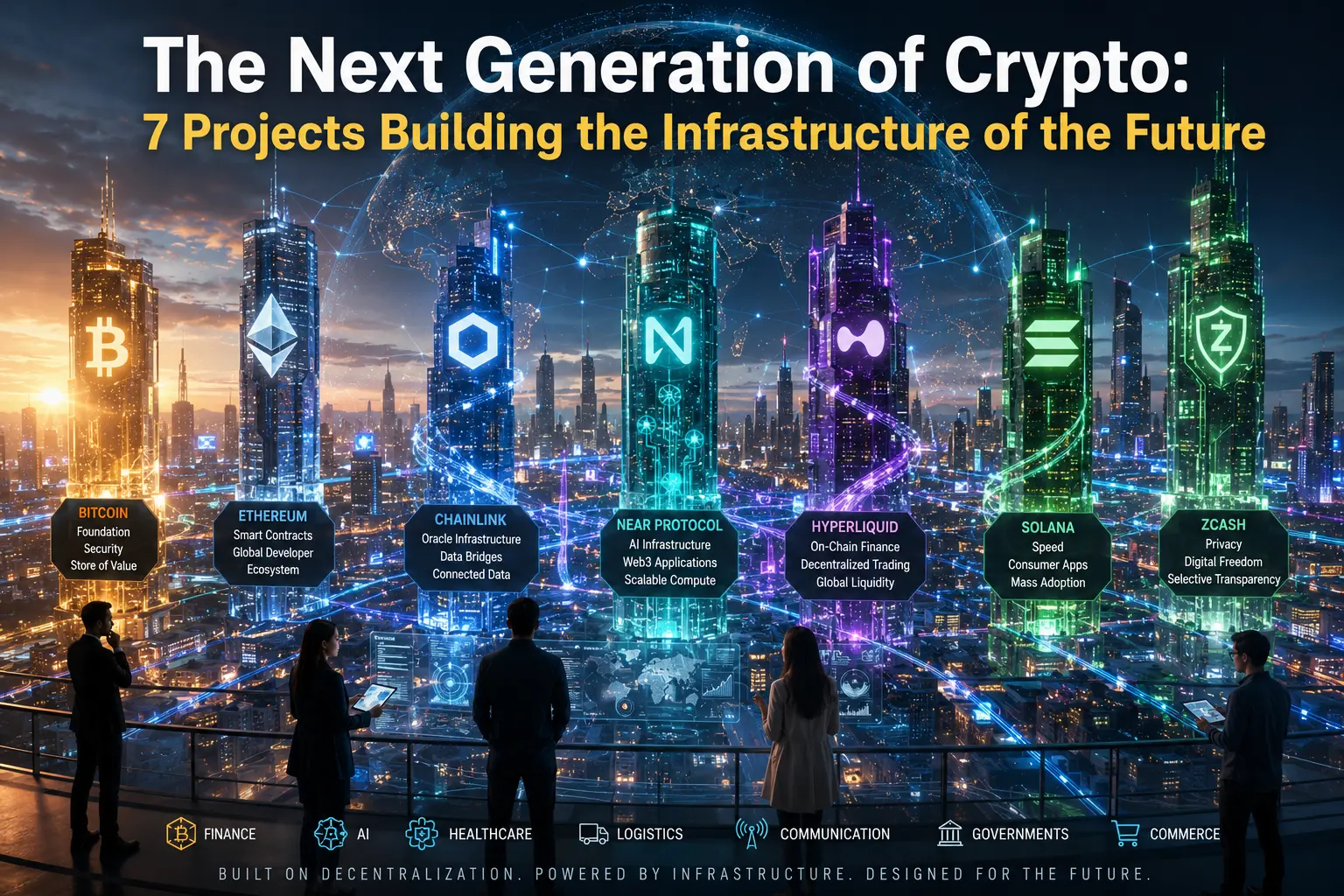
Here are seven projects that stand out.
What Makes Infrastructure Projects Different?
Infrastructure projects typically focus less on creating a single application and more on enabling thousands of applications to exist.
They often provide:
- Smart contract platforms
- High-performance blockchain networks
- Privacy technologies
- Developer ecosystems
- Financial infrastructure
- Cross-chain connectivity
- AI-ready architecture
History shows that companies providing infrastructure often become among the largest winners during major technology shifts.
Blockchain may follow a similar pattern.
1. Near Protocol (NEAR)
Near Protocol aims to become one of the most accessible blockchain ecosystems for developers and everyday users.
Its long-term strategy centers on:
- Scalable infrastructure
- Developer-friendly tools
- User experience
- AI integration
- Web3 applications
Rather than focusing on one niche, Near seeks to support an entire ecosystem of decentralized applications.
This broad positioning gives it exposure to multiple growth narratives at once.
→ Internal Link: Near Protocol Vs. Solana: Which Protocol Is Future-Proof?
→ Internal Link: Near Protocol Vs. Sui: Which Blockchain Could Power the Next Generation of Web3?
2. Hyperliquid (HYPE)
Trading remains one of crypto’s largest industries.
Hyperliquid focuses almost entirely on improving that experience.
Its ecosystem emphasizes:
- On-chain trading
- High-speed execution
- Perpetual futures
- Capital efficiency
- Decentralized financial infrastructure
Instead of trying to become everything, Hyperliquid specializes in one of crypto’s most active sectors.
If decentralized trading continues expanding, this specialization could become a significant competitive advantage.
→ Internal Link: Hyperliquid vs Binance: Can On-Chain Trading Compete With Centralized Exchanges?
3. Zcash (ZEC)
Privacy remains one of blockchain’s most debated topics.
While transparency benefits many applications, individuals and businesses often require financial confidentiality.
Zcash pioneered zero-knowledge cryptography through zk-SNARK technology.
Its ecosystem focuses on:
- Privacy
- Secure transactions
- Cryptographic innovation
- Financial sovereignty
As digital surveillance increases globally, privacy infrastructure may become increasingly valuable.
4. Ethereum (ETH)
Ethereum remains the largest programmable blockchain ecosystem.
Its advantages include:
- Massive developer community
- Mature DeFi ecosystem
- NFT infrastructure
- Layer-2 expansion
- Enterprise adoption
Although newer blockchains offer higher performance, Ethereum remains one of the strongest ecosystems in crypto.
Infrastructure leadership often depends as much on ecosystems as technology.
5. Solana (SOL)
Solana has built its reputation around speed and scalability.
Its ecosystem continues attracting:
- Consumer applications
- Payment solutions
- NFT marketplaces
- Gaming platforms
- DeFi protocols
Its high transaction capacity makes it a strong candidate for large-scale blockchain adoption.
6. Chainlink (LINK)
Smart contracts require reliable external information.
Chainlink provides a decentralized oracle infrastructure that connects blockchains with real-world data.
Its technology supports:
- Financial markets
- Tokenized assets
- Cross-chain communication
- Enterprise applications
- Automated smart contracts
Rather than competing with Layer-1 blockchains, Chainlink strengthens the broader ecosystem.
7. Cosmos (ATOM)
The future of blockchain may involve multiple specialized networks rather than one dominant chain.
Cosmos focuses on interoperability.
Its ecosystem enables independent blockchains to communicate securely.
As the crypto industry becomes increasingly interconnected, interoperability infrastructure may become one of the sector’s most important foundations.
Five Powerful Trends Supporting Infrastructure Projects
Several long-term trends continue to strengthen the investment case for blockchain infrastructure.
1. Artificial Intelligence
AI applications increasingly require decentralized computing, secure data, and digital ownership.
Infrastructure projects positioned around AI could benefit as both industries evolve.
→ Internal Link: The 5 Crypto Narratives That Could Define the Next Decade
2. Tokenization
Real-world assets are gradually moving onto blockchain networks.
Infrastructure providers may become the platforms supporting these digital economies.
3. Decentralized Finance
Financial services continue expanding beyond centralized exchanges.
Trading, lending, derivatives, and payments increasingly rely on blockchain infrastructure.
4. Privacy
Digital privacy remains a growing global concern.
Projects specializing in privacy technologies could become increasingly relevant.
5. Web3
The transition toward decentralized internet services remains one of crypto’s largest long-term opportunities.
Projects enabling developers to build scalable applications may benefit the most.
Why Infrastructure May Create the Biggest Long-Term Winners
History provides useful examples.
Few people remember most websites from the early internet.
Many remember the companies that built the infrastructure powering those websites.
Cloud computing.
Search engines.
Payment networks.
Operating systems.
Infrastructure often compounds value over decades because many independent businesses build on top of it.
Blockchain could follow a similar path.
Not Every Infrastructure Project Will Win
Building technology is only one part of long-term success.
Projects must also attract:
- Developers
- Liquidity
- Businesses
- Applications
- Communities
- Institutional interest
Competition remains intense.
Many technically advanced projects never achieve widespread adoption.
Execution ultimately determines long-term outcomes.
Comparing the Seven Infrastructure Projects
| Project | Primary Focus | Long-Term Narrative |
|---|---|---|
| Near Protocol | Web3 & AI Infrastructure | Broad ecosystem growth |
| Hyperliquid | On-chain Trading | Decentralized finance |
| Zcash | Privacy | Digital financial confidentiality |
| Ethereum | Smart Contracts | Largest developer ecosystem |
| Solana | High-Speed Blockchain | Consumer-scale applications |
| Chainlink | Oracle Infrastructure | Connecting blockchains to real-world data |
| Cosmos | Interoperability | Multi-chain future |
Frequently Asked Questions (FAQs)
Infrastructure projects build the underlying technology that supports decentralized applications, financial services, digital assets, and blockchain ecosystems rather than focusing on a single product.
The future of blockchain relies on infrastructure that can scale with growing demand.
Yes. Hyperliquid is building infrastructure for decentralized trading and on-chain financial markets rather than functioning solely as a cryptocurrency.
Near has positioned itself around scalable Web3 infrastructure while increasingly participating in conversations about AI-powered decentralized applications and future internet architecture.
Many investors believe privacy will remain an important part of the digital economy, particularly for individuals and businesses seeking greater financial confidentiality.
Yes. Just as today’s internet relies on many specialized technologies, blockchain infrastructure may also consist of multiple successful ecosystems serving different purposes.
Final Perspective
The future of crypto may be shaped less by the coins generating the most headlines today and more by the infrastructure quietly enabling tomorrow’s digital economy. Projects focused on scalability, privacy, decentralized finance, interoperability, and developer ecosystems are positioning themselves to support the next generation of blockchain innovation. While no project is guaranteed to succeed, infrastructure remains one of the strongest long-term themes for investors seeking exposure to the evolution of the digital economy.