

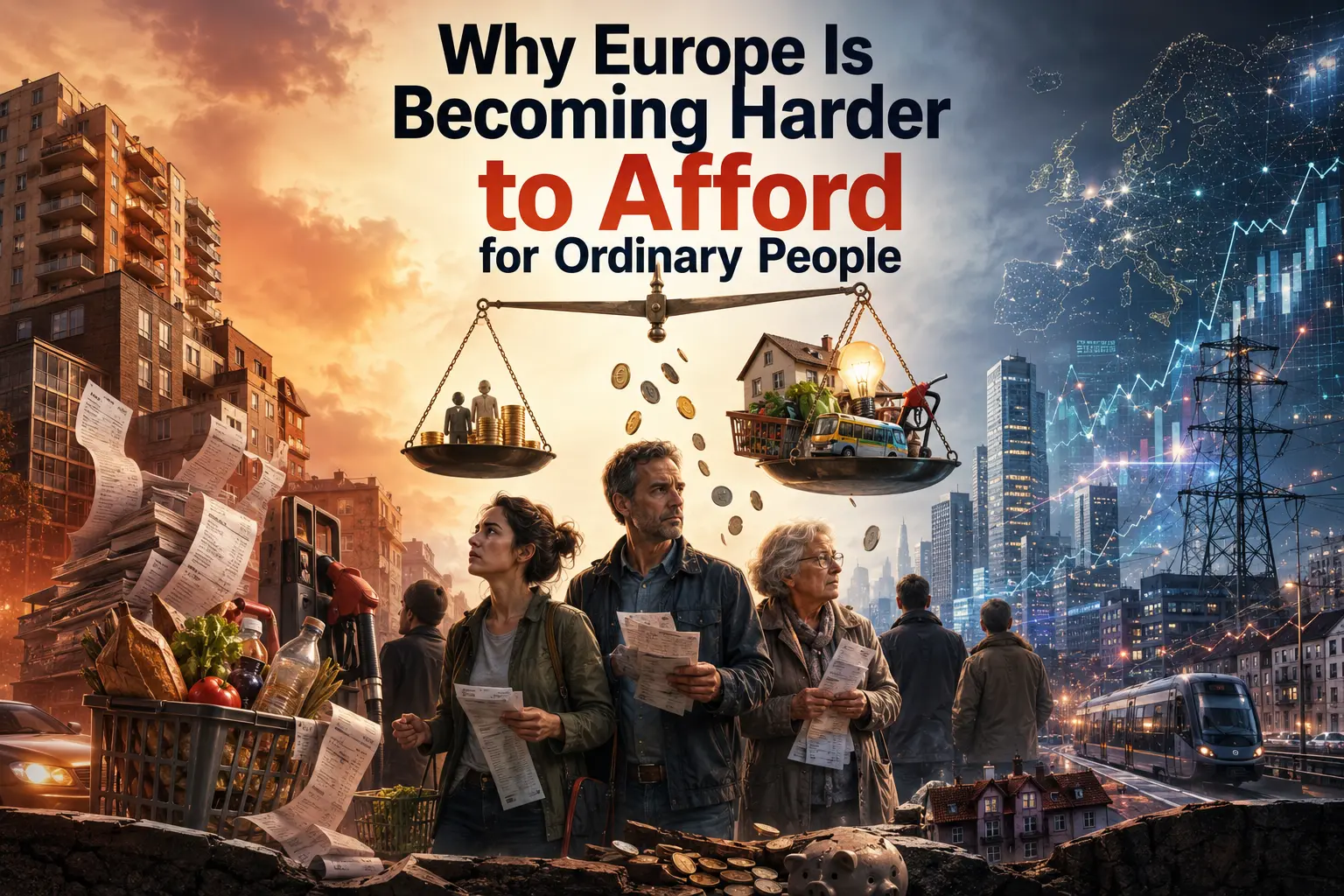
Europe built its identity on economic stability, dependable public services, and quality of life.
For generations, many households could reasonably expect that stable employment would provide access to housing, transportation, healthcare, and a comfortable quality of life.
This assumption faces growing scrutiny.
Across much of Europe, the cost of everyday essentials has climbed faster than incomes can keep up. Housing has become less affordable, food prices have increased, energy bills remain volatile, and saving for the future has become more difficult for many households.
Despite high global living standards, a growing number of Europeans struggle with financial pressures in daily life.
This growing financial strain reflects a broader structural shift discussed in Why Europe Is Entering a New Era of Economic Uncertainty, where housing, energy, demographics, and wage pressures are analyzed as interconnected forces shaping Europe’s economic future.
This affordability pressure reflects structural challenges in The Cost of Living Crisis in Europe Is Getting Worse and Why Housing Is Becoming Unaffordable Across Europe—rising costs driving financial insecurity.
Why Europe is becoming harder to afford
| Affordability Factor | Main Challenge | Impact on Households |
|---|---|---|
| Housing | Rising rents and home prices | Lower disposable income |
| Food | Persistent inflation | Higher grocery costs |
| Energy | Price volatility | Budget uncertainty |
| Transport | Rising fuel and travel costs | Reduced mobility |
| Childcare | Increasing expenses | Family financial pressure |
| Wages | Slower growth than expenses | Reduced purchasing power |
| Savings | Less surplus income | Lower financial security |
Indicators shaping affordability in Europe
| Indicator | Current Trend | Source |
|---|---|---|
| Housing costs | Rising in many major cities | Eurostat |
| Food prices | Elevated compared to pre-pandemic levels | OECD |
| Energy costs | Remain volatile | International Energy Agency (IEA) |
| Real wage growth | Uneven across Europe | European Commission |
| Household savings | Under pressure in some countries | World Bank |
1. Housing is consuming a larger share of income
Housing has become one of the largest financial burdens for many European households.
In numerous cities, rents and property prices have increased faster than wages, making homeownership increasingly difficult and placing greater pressure on renters.
Why Housing Is Becoming Unaffordable Across Europe explores this widening gap—rising prices and structural shortages driving the crisis.
2. Food costs continue to strain household budgets
Food inflation affects every household regardless of income level.
Even modest increases in the prices of everyday essentials such as bread, dairy products, vegetables, and household goods can significantly affect monthly budgets over time.
For lower-income households, food price increases often have a disproportionate impact.
3. Energy bills remain a source of uncertainty
Energy costs have become one of the most unpredictable household expenses in Europe.
Electricity and heating prices can influence everything from monthly budgets to industrial competitiveness.
Why Energy Prices Are Reshaping the Economy in Europe reveals how energy costs have become central to continental economic performance.
4. Wages are struggling to keep pace with expenses
Although wages have increased in many countries, real purchasing power has not always improved at the same rate.
Many households experience a situation where:
- Housing costs rise
- Food prices increase
- Utility bills become more expensive
- Every day, services cost more.
As a result, income growth often feels insufficient despite nominal wage increases.
5. Transportation is becoming more expensive
Transportation costs influence access to work, education, and essential services.
Rising fuel prices, vehicle ownership costs, and public transportation expenses contribute to broader affordability concerns across Europe.
For commuters, these costs can represent a significant share of monthly spending.
6. Childcare and family expenses continue to rise
Families face additional financial pressure from:
- Childcare services
- Education-related costs
- Healthcare expenses
- Housing requirements for larger households
These factors can influence decisions regarding family formation and long-term financial planning.
7. Saving for the future is becoming more difficult
One of the less visible consequences of affordability pressure is the decline in saving capacity.
When a greater share of income is devoted to essentials, households often have less money available for:
- Emergency funds
- Retirement savings
- Home purchases
- Investment opportunities
It can reduce long-term financial resilience.
8. Affordability is becoming especially difficult for young adults.
Younger Europeans often encounter a combination of:
- High housing costs
- Slower wealth accumulation
- Delayed homeownership
- Rising living expenses
These pressures are increasingly influencing migration decisions, a trend examined in Why Young People Are Leaving Europe.
9. Regional inequality is widening across Europe
Affordability pressures vary significantly between regions.
Some major cities offer higher salaries but also face much higher living costs, while lower-cost regions may provide fewer economic opportunities.
This imbalance continues to shape migration and labor mobility patterns within Europe.
10. Affordability is becoming a long-term structural concern
Many affordability pressures are now considered permanent fixtures.
Instead, they reveal deeper structural problems, including:
- Housing supply
- Demographic change
- Energy systems
- Wage growth
- Economic competitiveness
As these pressures intersect, affordability is becoming one of the defining economic and social issues facing Europe.
How affordability pressures affect everyday life
| Category | Main Pressure | Long-Term Impact |
|---|---|---|
| Housing | Rising costs | Reduced homeownership |
| Food | Inflation | Lower purchasing power |
| Energy | Volatility | Household uncertainty |
| Transport | Higher expenses | Reduced mobility |
| Childcare | Rising costs | Family financial strain |
| Savings | Lower surplus income | Reduced financial resilience |
Frequently Asked Questions (FAQs)
Housing costs, food inflation, energy prices, and slower real wage growth have increased financial pressure on many households across Europe.
Housing is often considered one of the largest affordability challenges, particularly in major cities where rents and property prices have risen significantly.
In many cases, wage growth has struggled to fully offset increases in housing, energy, food, and transportation costs.
Young adults often face higher housing costs, lower asset ownership, and slower wealth accumulation compared to previous generations.
Energy costs influence household bills, transportation, manufacturing, and inflation, making them an important component of overall living expenses.
Many analysts believe affordability challenges increasingly reflect structural factors rather than short-term economic fluctuations.