
Most students spend over a decade in classrooms preparing for the future.
They learn mathematics.
Science.
History.
Languages.
They complete assignments, take exams, and work toward graduation.
They grew up believing that education guarantees success.
But after leaving school, many graduates discover a surprising reality:
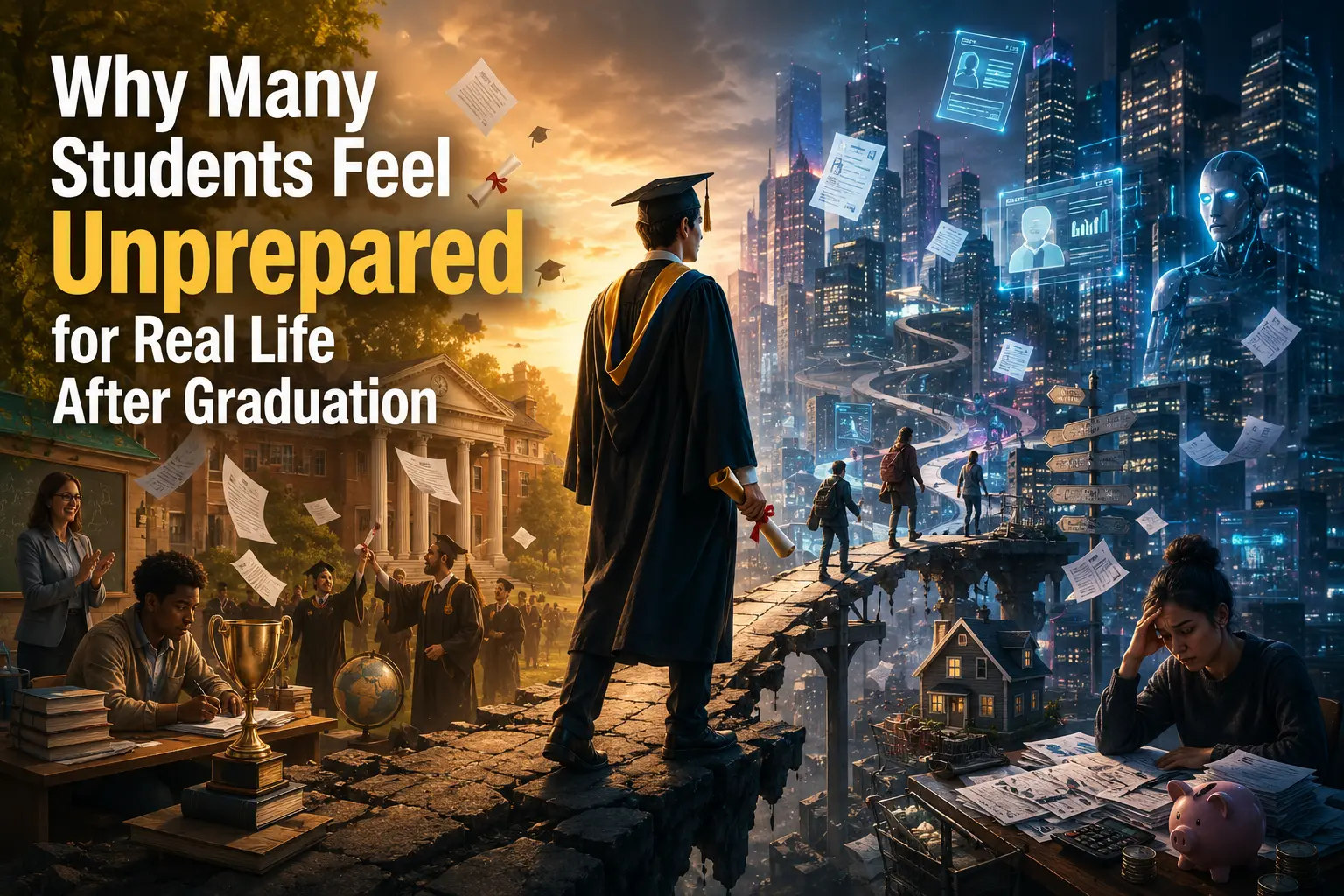
They feel unprepared for the challenges that matter most.
Managing money.
Finding a job.
Handling responsibilities.
Making important life decisions.
Building professional relationships.
If education is supposed to prepare students for life, why do so many graduates feel lost once school ends?
The answer lies in a growing disconnect between what schools traditionally teach and what modern life increasingly demands.
The Promise School Was Supposed to Deliver
For generations, education has been the pathway to opportunity.
The formula seemed simple:
Study hard.
Get good grades.
Graduate.
Build a successful future.
In many ways, this model helped millions improve their lives.
Education continues to provide valuable knowledge, qualifications, and opportunities.
But the modern world has changed dramatically.
Technology evolves faster than ever.
Industries transform rapidly.
Career paths are no longer predictable.
As a result, many students discover that academic success alone does not automatically translate into real-world readiness.
Why Graduation Doesn’t Always Feel Like Preparation
Graduation marks the end of formal education, but it often marks the beginning of a completely different set of challenges.
Suddenly, young adults must navigate:
- Personal finances
- Career decisions
- Job interviews
- Workplace expectations
- Housing costs
- Professional communication
- Long-term planning
Many of these responsibilities receive little attention in traditional classrooms.
As a result, graduates often feel academically educated but practically inexperienced.
The transition can be far more difficult than many expect.
The Life Skills Many Students Never Learn
Modern education faces criticism for rarely teaching essential life skills in depth.
Students may spend years studying academic subjects while receiving limited instruction in areas such as:
- Budgeting and money management
- Taxes and financial planning
- Negotiation and communication
- Time management
- Networking
- Career development
- Emotional intelligence
- Decision-making
These skills often play a major role in long-term success.
Yet many graduates only begin learning them after entering adulthood.
The Growing Disconnect Between School and Reality
The world outside the classroom is evolving rapidly.
Artificial intelligence, automation, globalization, and digital technologies are transforming how people live and work.
Meanwhile, many education systems continue relying on structures designed decades ago.
Critics claim that education systems still favor academic performance over real-world preparation. This concern is explored further in The Hidden Damage of an Incompetent Education System, which examines how students can leave school with qualifications but still struggle to navigate real-world challenges.
The result is a growing gap between education and reality.
Students may learn how to pass exams but not necessarily how to navigate the increasingly complex challenges of modern life.
Why Employers Want More Than Academic Success
Strong grades remain valuable.
However, employers increasingly recognize that academic performance is only one piece of the puzzle.
Today’s workforce often rewards individuals who can:
- Adapt to change
- Solve problems independently
- Communicate effectively
- Work in teams
- Learn continuously
- Embrace new technologies
Strong grades can open doors, but employers increasingly look beyond academic performance when evaluating candidates. This shift is discussed further in Why Good Grades No Longer Guarantee Success in Real Life, which explores why adaptability and practical skills are becoming increasingly valuable.
Organizations such as the World Economic Forum have repeatedly emphasized the growing importance of human-centered skills and lifelong learning in the future economy.
Skills Students Need vs Skills Schools Often Prioritize
| Often Prioritized in School | Increasingly Important in Real Life |
|---|---|
| Memorization | Problem-solving |
| Test Scores | Adaptability |
| Individual Assignments | Collaboration |
| Academic Knowledge | Communication |
| Following Instructions | Initiative |
| Fixed Curriculum | Continuous Learning |
What Future-Ready Education Looks Like
A growing number of education systems are adjusting to new realities.
Rather than focusing exclusively on academic achievement, they are placing greater emphasis on:
- Critical thinking
- Problem-solving
- Digital literacy
- Career readiness
- Collaboration
- Creativity
- Adaptability
Around the world, schools are beginning to rethink how they prepare students for modern careers. How Schools Around the World Are Preparing Students for the Future of Work explores how education systems are adapting to rapidly changing workforce demands.
UNESCO Education and OECD Education prioritize lifelong learning and employment readiness over exam-focused education.
Why This Matters More Than Ever
The future of work is growing increasingly unpredictable.
Students entering school today may eventually work in careers that do not yet exist.
Many people will change careers multiple times throughout their lives.
Technology will continue to reshape industries at an unprecedented pace.
Future success will increasingly depend on a person’s ability to:
- Learn continuously
- Adapt quickly
- Solve new problems
- Build meaningful relationships
- Navigate uncertainty
These are abilities that extend far beyond traditional academic achievement.
The Bigger Question Education Must Answer
The real issue is not whether schools provide value.
They do.
The question is whether education is evolving quickly enough to prepare students for the realities of modern adulthood.
Graduates should leave school with more than academic knowledge.
They should leave with the confidence, skills, and adaptability needed to navigate an increasingly complex world.
As society changes, education systems face growing pressure to close the gap between classroom success and real-life readiness.
The toughest challenge for students begins after graduation.
Frequently Asked Questions (FAQs)
Many graduates report feeling unprepared because schools often focus heavily on academic subjects while spending less time on practical life skills such as financial literacy, career planning, and decision-making.
Commonly overlooked skills include budgeting, taxes, communication, negotiation, networking, time management, and emotional intelligence.
Opinions vary, but many educators and policymakers believe schools should play a larger role in preparing students for real-world responsibilities.
Employers increasingly prioritize adaptability, communication, problem-solving, and teamwork because these abilities are essential in modern workplaces.
Many graduates experience a gap between academic knowledge and practical responsibilities, such as managing finances, navigating careers, and making major life decisions.
Many schools are integrating digital literacy, career readiness, project-based learning, and skills-focused education to prepare students for future challenges.
Today’s essential skills: adaptability, communication, critical thinking, emotional intelligence, and problem-solving.