

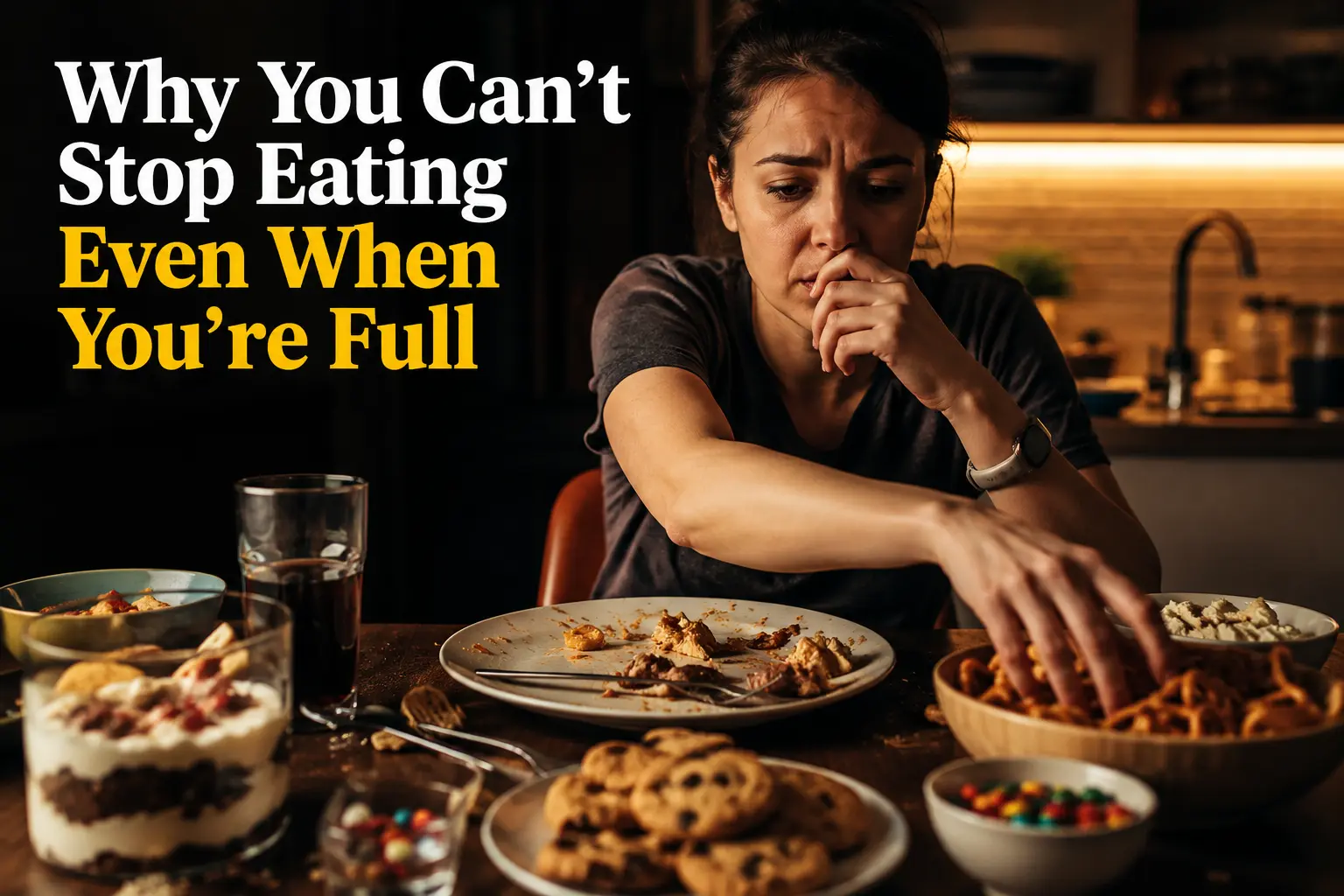
You already ate.
You know you’re full.
Your stomach is telling you to stop.
But something doesn’t feel finished yet.
You keep eating anyway.
A few more bites.
Then a snack.
Then something sweet.
And later, you wonder:
It is not a lack of discipline.
It’s a mismatch between your body’s fullness signals and your brain’s reward system.
Quick Truth
What “Full” Actually Means in Your Body
Fullness is not instant.
It is a signal system involving:
- stomach expansion
- hormone release
- brain interpretation
It takes time for the brain to register fullness signals:
So if you eat fast or are distracted.
That signal arrives too late.
The Hidden Delay Most People Don’t Notice
Your stomach can be physically full.
But your brain is still catching up.
This delay creates a dangerous gap:
- stomach = already full. brain = still “searching for satisfaction.”
So you keep eating.
Why Your Brain Overrides Fullness
There are 3 major reasons:
1. Reward system activation
Highly palatable food keeps activating dopamine signals even after fullness.
2. Distracted eating
When you eat while watching something or scrolling:
3. Habit loops
If you are used to finishing meals with snacks:
True Hunger vs Overeating Behavior
| Normal Eating | Overeating Pattern |
|---|---|
| Stops when full | Continues past fullness |
| Aware of hunger signals | Disconnected from signals |
| Mindful eating | Distracted eating |
| Satisfaction after meal | Craving continues |
Why It Feels Impossible to Stop Sometimes
Your brain is not tracking calories.
It is tracking:
- pleasure
- reward
- habit completion
So even if your body is full.
Your brain may still want:
How This Fits Into Your Current Cluster System
This article fits into your behavioral nutrition framework:
→ True Hunger vs Emotional Hunger
explains how emotional signals mimic real hunger.
→ Why Stress Makes You Eat More Even When You’re Not Hungry
shows how emotional states override physical signals.
→ Why You Wake Up Hungry or Craving Food at Night
shows how reward + fatigue influences eating timing.
→ Why You Crave Sugar at Night
breaks down dopamine-driven food behavior.
Together, they explain:
The Overeating Loop
Once this pattern forms:
eat → pleasure → delay fullness signal → continue eating → habit reinforcement
It becomes automatic.
And your brain starts expecting continuation beyond fullness.
Why Dieting Doesn’t Fix This
Strict dieting fails here because:
- It ignores brain reward systems
- It doesn’t fix eating speed or awareness
- It doesn’t change habit loops.
So people think:
When the real issue is:
Insight
You continue eating when the brain’s “stop” cue from fullness has not fully registered.
Frequently Asked Questions (FAQs)
The brain receives fullness signals with a delay, allowing reward systems to override them.
No. It is often about habit, emotion, or reward response.
Because dopamine and habit loops reinforce continued eating.
Yes. It gives your brain time to register fullness signals properly.
Yes. Distracted eating reduces awareness of fullness signals.
Authority Note
Research in behavioral nutrition and neuroscience shows that eating rate, distraction, and reward system activation significantly influence satiety signaling and total food intake.