
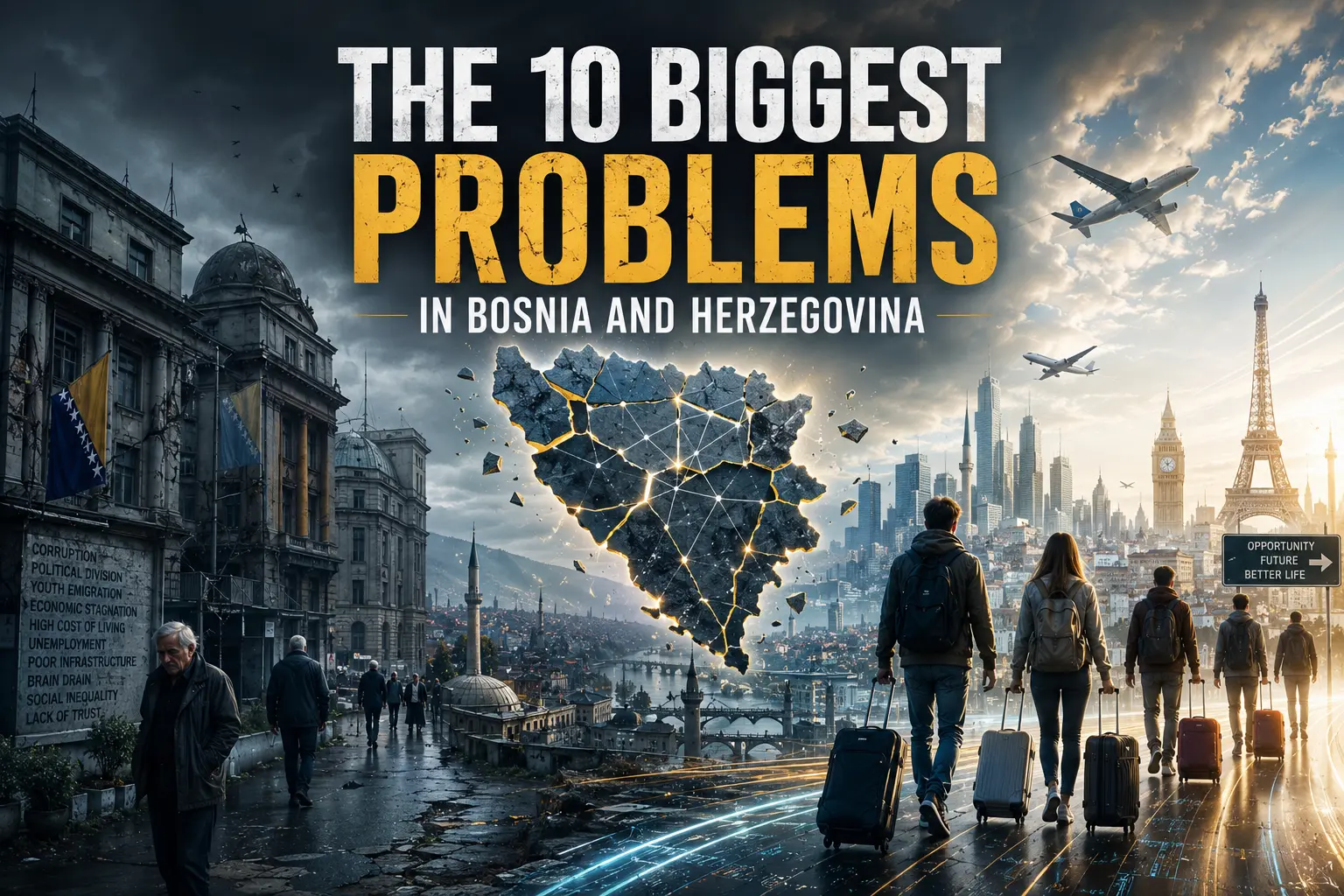
Bosnia and Herzegovina moves in long historical cycles.
Stability tends to give way slowly, as institutions strain, economies tighten, and political uncertainty develops almost imperceptibly in the background.
Long-term structural pressures are also evident in articles such as “The 10 Biggest Problems in Serbia” and “The 10 Biggest Problems in Portugal,” highlighting how different parts of Europe are experiencing similar economic, political, and social challenges.
Meanwhile, daily life continues—people go to work, cities keep functioning, and younger generations quietly try to plan futures within systems that feel constrained rather than visibly breaking down.
Quick Overview of Bosnia and Herzegovina’s Biggest Problems
| Problem | Main Impact | Who Is Most Affected |
|---|---|---|
| Political division | Government instability and slow reforms | The broader population |
| Corruption | Weak public trust and inequality | Workers and businesses |
| Unemployment | Financial insecurity | Young adults |
| Mass emigration | Population decline and brain drain | Rural communities |
| Low wages | Rising cost-of-living pressure | Lower- and middle-income households |
| Ethnic tensions | Social fragmentation | National institutions and communities |
| Weak healthcare | Limited medical access | Older adults and vulnerable communities |
| Judicial inefficiency | Slow legal processes | Businesses and residents |
| Air pollution | Public health concerns | Urban residents |
| Economic stagnation | Limited economic opportunity | Younger generations |
Here Are The 10 Biggest Problems in Bosnia and Herzegovina
1. Political Division Still Controls Much of the Country
One of the biggest problems in Bosnia and Herzegovina is the political system itself.
The country remains deeply divided along ethnic and administrative lines after the war of the 1990s. Decision-making is often slow, fragmented, and blocked by competing political interests.
Many citizens feel exhausted by constant political disputes while basic reforms move slowly.
Among younger generations, there is a growing sense that politics is no longer about solutions, but about constant deadlock.
These issues are not unique to Serbia and reflect wider European trends discussed in The Biggest Problems in Europe.
2. Corruption Continues to Frustrate the Public
Corruption remains one of the most criticized issues in the country.
Many people believe political connections matter more than merit when it comes to jobs, contracts, and opportunities.
It weakens public trust and discourages investment.
Small businesses often struggle within systems viewed as overly bureaucratic and vulnerable to favoritism.
Corruption often leaves ordinary people feeling that advancement is determined by who you know rather than individual effort.
3. Young People Keep Leaving the Country
Bosnia and Herzegovina continues to experience major emigration.
Many young professionals move to countries like Germany, Austria, or Slovenia in search of higher wages and better opportunities.
Entire towns have seen declining populations as younger generations leave while older residents remain behind.
It creates a dangerous long-term cycle:
- Fewer workers
- Lower economic growth
- Aging population
- Smaller tax base
- More pressure on public systems
Many families now live across multiple countries because migration has become so common.
4. Wages Often Feel Too Low for Modern Living Costs
While wages differ across sectors and regions, a significant number of workers continue to face pressure from rising living costs.
The cost of necessities has climbed significantly, yet wages across many sectors still lag behind those in Western Europe.
For some households, financial stability depends heavily on:
- Remittances from relatives abroad
- Multiple jobs
- Informal work
- Family support networks
This economic pressure is one reason why many younger citizens no longer see long-term stability inside the country.
5. Unemployment Remains a Serious Challenge
Youth unemployment has remained a major concern for years.
Even educated graduates sometimes struggle to find stable employment connected to their field.
It creates frustration among younger workers who feel trapped between limited opportunities and rising expectations.
Some eventually leave the country entirely, while others accept lower-paying jobs outside their qualifications.
The result is a workforce that often feels underutilized and economically insecure.
6. Ethnic Tensions Still Affect Daily Politics
Although the war ended decades ago, ethnic tensions continue to influence political life.
Nationalist rhetoric still appears during elections and political disputes.
Many critics argue that political leaders sometimes benefit from division because it keeps voters emotionally polarized.
For ordinary citizens, this constant tension can create fatigue and uncertainty about the future.
Younger generations are increasingly pushing for policies focused on economic opportunity, quality of life, and long-term development rather than continued political division rooted in ethnic conflict.
7. Healthcare Systems Face Pressure
Healthcare quality varies across different regions and institutions.
Many hospitals struggle with:
- Aging infrastructure
- Staff shortages
- Limited funding
- Long wait times
Medical professionals also leave the country for better-paying opportunities abroad, contributing to workforce shortages inside the healthcare system.
Older adults and lower-income families may face unequal access to quality care, particularly where geographic location and financial constraints limit the availability or affordability of services.
8. Air Pollution Is a Growing Health Concern
During colder months, air quality in several cities across Bosnia and Herzegovina often deteriorates significantly, with pollution levels reaching concerning thresholds.
Factors contributing to pollution include:
- Coal-based heating
- Industrial emissions
- Older vehicles
- Geographic conditions trap polluted air.
Poor air quality has become a major public health concern, especially for children, older adults, and people with respiratory conditions.
During winter, pollution levels in some urban areas can become severe enough to trigger international attention.
9. The Legal and Judicial System Is Often Seen as Slow
Many citizens and businesses complain about legal inefficiency.
Court cases can take years to resolve, creating frustration and uncertainty.
Slow judicial systems can discourage foreign investment because businesses often prefer environments with faster legal processes and stronger enforcement mechanisms.
Critics also argue that political influence sometimes weakens confidence in institutional independence.
10. Economic Growth Still Feels Fragile
Despite tourism growth and some development in urban areas, many citizens feel the broader economy remains fragile.
Large parts of the country still face:
- Limited industrial growth
- Weak infrastructure investment
- Dependence on foreign financial support
- Slow modernization
While some sectors are improving, many people believe the country has not yet unlocked its full economic potential.
The widening perception gap between local opportunity and Western European living standards continues to shape the decisions of many young people.
Why So Many People Feel Stuck
One of the hardest realities in Bosnia and Herzegovina is the feeling of stagnation.
Many citizens do not necessarily expect perfection.
What they want is simple:
- Stable jobs
- Fair institutions
- Better healthcare
- Functional politics
- Long-term security
But when reforms move slowly for years, frustration builds across society.
That frustration is one reason so many young people continue looking abroad for the future they struggle to find at home.
Bosnia and Herzegovina by the Numbers
| Category | Current Situation | Long-Term Risk |
|---|---|---|
| Population | Declining due to emigration | Aging society |
| Economy | Slow growth | Worker shortages |
| Politics | Highly fragmented | Reform paralysis |
| Healthcare | Under pressure | Medical staff shortages |
| Youth retention | Large outward migration | Brain drain |
| Environment | Seasonal pollution problems | Public health burden |
Frequently Asked Questions (FAQs)
Many experts and citizens point to political division and corruption as two of the country’s biggest long-term problems because they slow reforms and weaken public trust.
Many people leave for better salaries, stronger economies, and more stable opportunities in Western Europe.
The country has made progress in some sectors, but unemployment, low wages, and slow growth still create financial pressure for many households.
The issue of corruption persists as a dominant public concern and is often at the center of political and economic critique.
Despite political and economic challenges, many parts of the country are considered safe for tourists and are known for natural beauty, history, and hospitality.
Sources & References
- World Bank — economic development and regional growth data
- Transparency International — corruption perception and governance reports
- European Commission — Balkan political and institutional assessments