
For generations, people have believed that school is the most reliable path to a successful future.
Go to class. Study hard. Get good grades. Build a stable career.
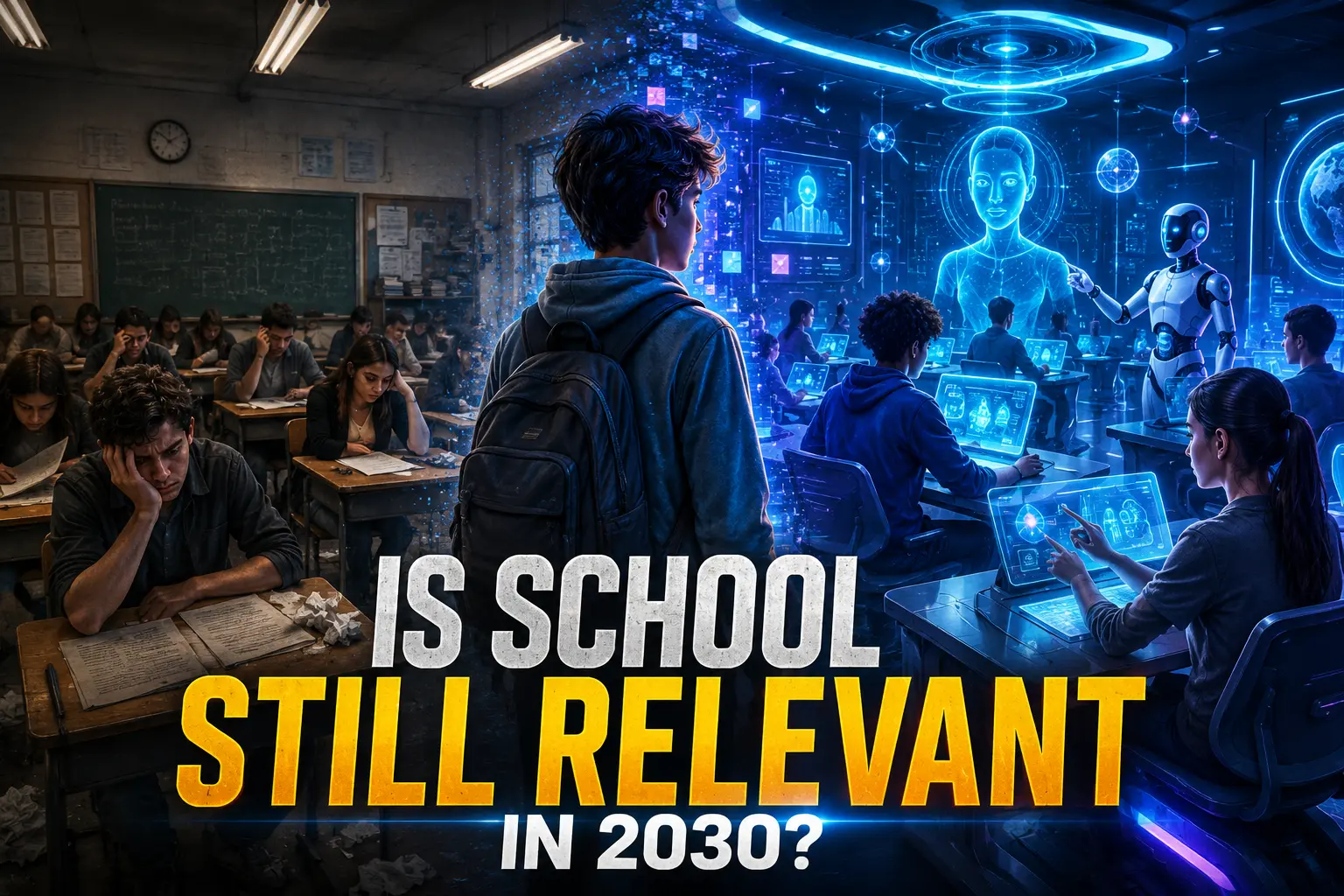
But by 2030, that entire model may look very different.
Artificial intelligence can already explain lessons instantly. Online platforms teach millions globally. Some students now learn faster through AI tutors than they do in traditional classrooms.
At the same time, frustration with outdated school systems continues to grow worldwide.
And this is raising a question that once sounded impossible:
Will traditional schools still matter in the age of AI?
The debate is no longer futuristic.
It is already happening.
Millions of Students May Experience Education Very Differently Within the Next Decade
The criticism is not only about technology.
It is also about frustration with outdated systems.
Many students feel traditional education still relies too heavily on:
- Memorization
- Standardized testing
- Rigid structures
- Outdated career preparation
- Slow adaptation to modern reality
At the same time, technology is evolving at an extraordinary speed.
AI systems can now:
- Explain complex topics instantly
- Personalize lessons
- Answer questions 24/7
- Adapt to different learning styles
- Provide unlimited practice and feedback
It creates a difficult comparison for traditional schools.
Organizations such as the World Economic Forum and OECD Education Reports have repeatedly emphasized that automation, AI, and rapid technological change are reshaping the skills future workers will need.
The Rise of AI Education
AI is no longer just a futuristic concept inside classrooms.
It is already becoming part of education worldwide.
Students increasingly use AI tools to:
- Solve math problems
- Learn coding
- Practice languages
- Summarize lessons
- Generate study materials
- Receive tutoring support
For some learners, AI already feels:
- Faster
- More patient
- More accessible
- Less intimidating
than traditional classroom experiences.
Global organizations, including UNESCO Education Research and UNICEF Education, continue studying how digital learning and technology are transforming classrooms worldwide.
Why Some People Believe AI Could Replace Incompetent Teachers
One of the most controversial parts of this debate involves teaching quality.
Critics argue that AI could outperform:
- Inconsistent instruction
- Teacher absenteeism
- Outdated teaching methods
- Emotionally hostile classrooms
- Poor communication
Unlike humans, AI systems do not:
- Get tired
- Lose patience
- Arrive late
- Forget lessons
- Show favoritism
AI can also repeat explanations infinitely without frustration.
For struggling students, that level of accessibility can feel revolutionary.
The Bigger Problem: Education systems were designed for a world that no longer exists.
Most school systems were originally designed during industrial periods when societies needed:
- Standardized workers
- Routine discipline
- Fixed career pathways
- Memorization-based learning
But the modern world increasingly rewards:
- Adaptability
- Creativity
- Digital literacy
- Critical thinking
- Continuous learning
This growing mismatch is why many experts believe education systems must evolve dramatically before 2030.
Around the world, some countries are already redesigning classrooms to prepare students for rapidly changing economies and digital careers. Our analysis, How Education Systems Worldwide Are Adapting to the Future of Work, explores how global school systems are responding to technological disruption and evolving workforce demands.
The Hidden Damage of an Incompetent Education System further analyzes how structural gaps in education leave many students well-trained in theory but insufficiently prepared for practical challenges.
What AI Still Cannot Fully Replace
Despite rapid progress, AI also has major limitations.
Teaching is not only about delivering information.
Great educators also provide:
- Mentorship
- Emotional guidance
- Social development
- Discipline
- Inspiration
- Human connection
Children especially develop through:
- Friendships
- Teamwork
- Conflict resolution
- Real-world social interaction
A fully AI-based system may struggle to match the emotional and experiential depth of human interaction.
The Most Likely Future: Hybrid Education
The coming shift in education is less about “AI vs schools” and more about integration.
Instead, it may become:
AI + Human Teachers
In this model:
AI handles:
- Repetitive instruction
- Personalized tutoring
- Grading assistance
- Adaptive learning
- Instant feedback
Human teachers focus on:
- Mentorship
- Leadership
- Emotional intelligence
- Motivation
- Classroom culture
- Ethical development
This hybrid approach could make education both:
- More efficient
- More personalized
- More scalable
than traditional systems alone.
Schools That Refuse to Adapt Could Struggle
The biggest threat to schools may not be AI itself.
It may be resistance to change.
If students increasingly feel they learn:
- Faster online
- Cheaper online
- More practically online
- More comfortably online
Then, traditional institutions could face a serious trust problem.
Especially among younger generations growing up with AI-native technology.
How Schools May Look by 2030
By 2030, classrooms could become dramatically different from today.
Possible changes include:
- AI-assisted teaching
- personalized learning systems
- fewer memorization-heavy exams
- project-based learning
- digital career preparation
- virtual tutoring environments
- flexible learning pathways
Some schools may evolve rapidly. Others may struggle to keep pace.
Australia is gradually modernizing its education system through digital tools, skills-based learning, and more career-oriented reforms. You can explore this further in How Australia’s Education System Is Evolving for Future Work.
The Real Question Nobody Can Ignore
The future debate may not be:
But rather:
That question could shape the next decade of learning worldwide.
Future Education Comparison Table
| Traditional Model | AI-Assisted Learning |
|---|---|
| Fixed classroom pacing | Personalized learning speed |
| Memorization-heavy testing | Interactive adaptive learning |
| Limited teacher availability | 24/7 accessibility |
| One-size-fits-all lessons | Customized explanations |
| Physical classroom dependence | Remote and hybrid access |
Frequently Asked Questions (FAQs)
Will AI replace teachers by 2030?
AI may replace certain repetitive teaching tasks, but human educators will likely remain important for mentorship, emotional support, and social development.
Is online learning replacing schools?
Not completely. However, online learning is becoming a major parallel education system alongside traditional schools.
Why are people questioning traditional education?
Many critics argue that schools are adapting too slowly to technological change, evolving careers, and the growing demand for real-world skills.
What are the biggest weaknesses of traditional schools?
Common criticisms include outdated curricula, heavy memorization, standardized testing, and limited financial or practical life education.
Can AI teach better than humans?
AI can provide fast, personalized explanations, but human teachers still offer emotional intelligence and real-world mentorship that AI cannot fully replicate.
What will schools look like in 2030?
Many experts predict hybrid systems involving AI-assisted learning, digital classrooms, project-based education, and personalized learning models.
Is school still necessary in the AI era?
Most likely yes—but its role may evolve significantly as technology reshapes how people access knowledge and skills.
Why is this debate becoming more popular?
Rapid advances in AI, online learning, and digital technology are forcing societies to rethink how education should function in the future.