

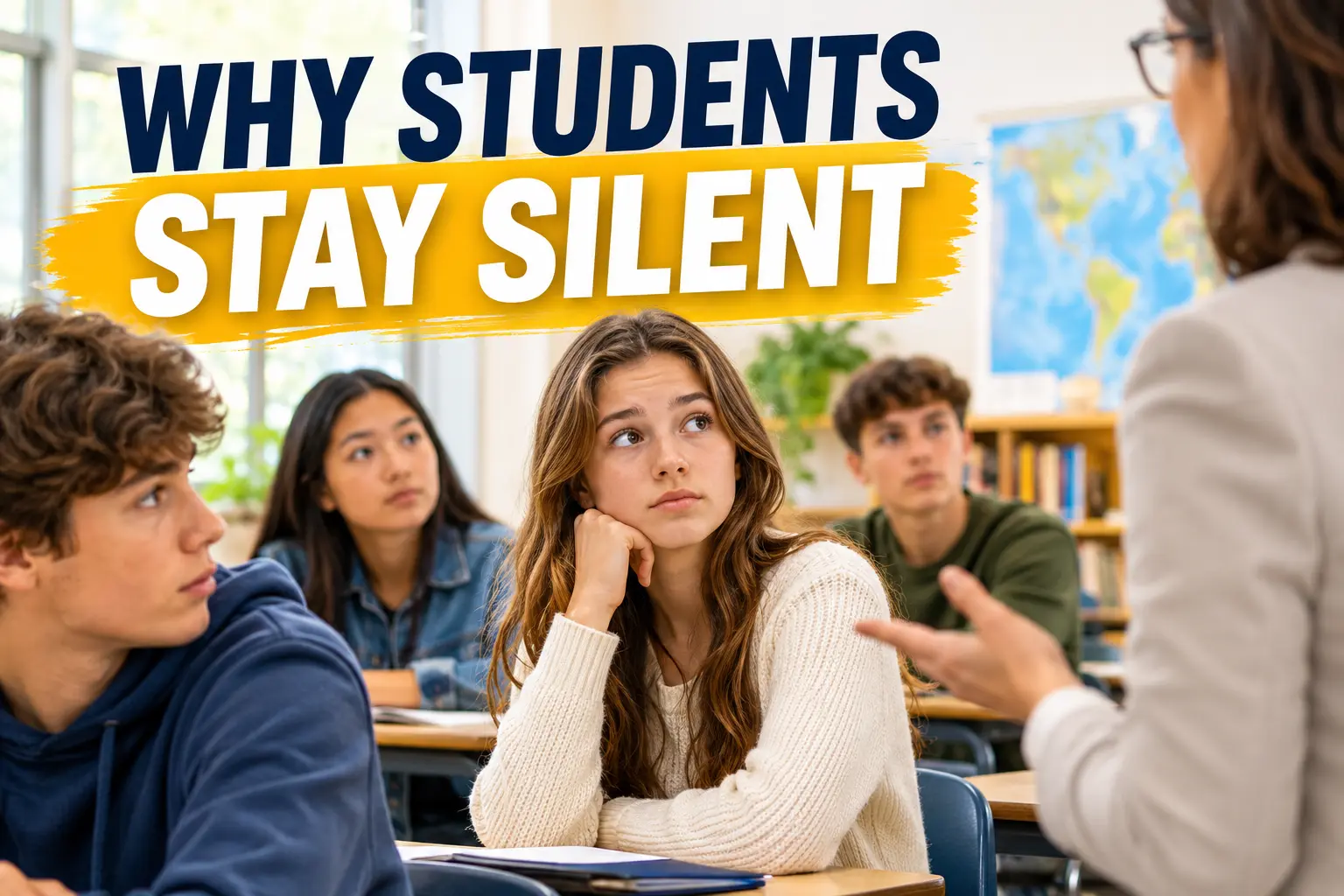
A teacher finishes explaining a lesson and asks the class a familiar question:
“Does anyone have anything they would like to ask?”
Nobody raises a hand.
The classroom remains quiet. The teacher moves on, assuming the students have understood.
But after the lesson, a few students approach their classmates. They ask about instructions they did not understand, concepts they found confusing, or examples they were too hesitant to discuss in front of everyone.
This raises an important question: If students have questions, why do so many hesitate to ask them during class?
Asking questions helps students understand lessons and clarify what they do not know. It helps students clarify difficult ideas, recognise gaps in their understanding, and become more actively involved in their education.
Yet a quiet classroom does not necessarily mean students understand what is being taught.
A student’s decision to speak often reflects more than personal confidence; it can also depend on classroom expectations, teaching approaches, and the fear of being judged.
Understanding these barriers is an important step toward creating classrooms where curiosity is encouraged rather than discouraged.
1. Fear of Giving the Wrong Answer
Some students hesitate to ask questions because they fear making a mistake in front of their classmates.
They may worry that others will laugh, that the teacher will become impatient, or that their question will make them appear less intelligent.
Students may want to understand a lesson but hesitate to ask questions because they fear revealing what they do not know.
Research published in PLOS ONE examined why university students voluntarily ask or answer questions in large science classes. The researchers identified anxiety and fear of negative evaluation as important barriers to participation.
In that study, 72.3% of students who rarely asked questions reported feeling anxious, while 62% expressed concern about being judged by others.
These figures describe the study participants, not students everywhere. These experiences highlight how fear of judgment and peer reactions can become barriers to classroom participation.
Students need to understand that mistakes are not evidence of failure.
They are part of the learning process. A classroom should make it possible to ask for clarification without feeling embarrassed.
2. Some Students Feel Uncomfortable Speaking in Front of Others
Not every student is comfortable expressing ideas in front of a large group.
Some can confidently share their opinions, while others need more time to organise their thoughts before speaking.
A student may understand the lesson but still feel nervous about explaining an answer in front of the class.
Peer relationships can make this even more difficult.
Some students avoid speaking because they fear drawing attention, standing out, or being laughed at.
This does not necessarily mean they lack curiosity or interest in learning.
They may be more comfortable asking a classmate privately, writing down their questions, or discussing an idea in a smaller group.
Teachers should therefore avoid assuming that quiet students have nothing to contribute.
Silence is not always a sign of understanding, and confidence in public speaking is not the same as knowledge.
Some students need a more comfortable way to participate.
3. The Classroom May Not Encourage Questions
Students pay close attention to how teachers respond when someone asks a question.
If a teacher listens carefully, explains difficult ideas patiently, and treats mistakes respectfully, students are more likely to see questions as a normal part of learning.
The situation changes when teachers dismiss questions, treat them as interruptions, or respond with frustration.
Even one embarrassing experience can make a student think twice before speaking again.
Classroom culture develops through repeated interactions.
Students notice whether teachers value their ideas, classmates respect different opinions, and mistakes are treated as opportunities to learn.
A supportive classroom does not require teachers to know every answer immediately.
It requires them to respond constructively, acknowledge reasonable questions, and show students that asking for clarification is worthwhile.
4. Lessons May Leave Too Little Room for Discussion
In some classrooms, much of the available time is spent explaining content, copying notes, completing exercises, and preparing for assessments.
These activities can serve important purposes.
A classroom built around teacher explanations and written exercises can leave students with limited time to express ideas, discuss uncertainties, or ask for clarification.
Time pressure can make the situation worse.
Curriculum demands and tight schedules can pressure teachers to move quickly through lesson content. As a result, they may have little time to pause when students become confused.
Students may also assume that asking a question will delay the lesson or prevent the teacher from completing the planned activities.
So they remain quiet.
Effective teaching involves more than delivering information. Teachers also need opportunities to check whether students understand what is being taught.
Short discussion periods, clarification breaks, and opportunities to raise concerns can help reveal misunderstandings before the class moves forward.
5. Some Students Do Not Know How to Formulate Their Questions
A student may know something is unclear but still struggle to put that confusion into words.
Sometimes, students know they are struggling with a lesson but cannot pinpoint where they became confused.
When students encounter unfamiliar terms or complicated ideas, they may struggle to identify exactly what confuses them and put their questions into words.
Consider a mathematics lesson.
A student may understand the first few steps of a solution but become confused when several ideas are combined.
The student knows something is wrong but cannot explain where the difficulty began.
Teachers can give students time to think and help them pinpoint what they do not understand.
Instead of asking only, “Does everyone understand?”, teachers can use more specific prompts:
- Which step would you like me to explain again?
- What part of this example seems confusing?
- Can you explain where you started having difficulty?
- Is there another way you would like to see this problem solved?
Students can learn how to ask better questions with practice.
Students should have opportunities to practise it rather than being expected to do it naturally.
6. Students May Believe Their Questions Are Not Important
Some learners remain silent because they assume their questions are too simple, irrelevant, or already answered.
They may think everyone else understands the lesson and that they are the only ones struggling.
Others may decide that a classmate will eventually ask the same question.
Research on university science students has also found that some learners avoid asking questions because they can seek help from classmates, search for answers independently, or approach their instructor outside class.
This shows that silence can have different explanations. It does not always indicate fear or a lack of interest.
However, relying on guesses or incomplete explanations can allow misunderstandings to continue.
Teachers can help students speak up by making it clear that asking questions is always acceptable.
They can also invite anonymous questions, use short written reflections, or ask students to identify confusing points before moving to a new topic.
Sometimes, the simplest questions lead to the most important learning moments.
Sometimes, asking about a basic concept is exactly what helps a student understand everything that follows.
7. How Teachers Can Encourage Students to Ask More Questions
Creating a classroom where students feel comfortable asking questions requires consistent effort.
Simply telling students to “speak up” is unlikely to change participation if they still fear embarrassment or feel that their questions are unwelcome.
Teachers can begin with practical changes.
Respond respectfully to questions.
Avoid sarcasm, public criticism, or comments that make students feel foolish for asking. A respectful response encourages students to participate again.
Allow students time to think.
Not everyone can formulate an answer immediately. Giving students a few moments to organise their thoughts can make participation less intimidating.
Use smaller discussions.
Let students discuss a question with a partner or small group before sharing their ideas with the entire class.
Provide different ways to participate.
Written submissions, anonymous question channels, and digital discussion platforms can reduce the pressure of speaking publicly while supporting student participation.
Treat mistakes as part of learning.
An incorrect answer can allow the class to examine an idea more carefully. Students should see that mistakes can lead to better understanding.
Invite questions throughout the lesson.
Do not wait until the final minutes to ask whether anyone needs clarification. Give students opportunities to raise questions as the lesson develops.
These practices cannot guarantee that every student will participate.
Students have different personalities, experiences, and learning needs. However, they can reduce unnecessary barriers and create more opportunities for meaningful classroom interaction.
8. Why Student Questions Matter Beyond the Classroom
Learning should not be limited to receiving information and repeating what a teacher has explained.
Students also need to develop the ability to examine ideas, identify uncertainty, seek evidence, and challenge explanations when something does not make sense.
Asking questions helps them practise these habits.
This connects to a broader concern in education: whether students are being encouraged to understand ideas or are mainly expected to remember information.
In Are Schools Teaching Students to Memorize Instead of Truly Understand?, the discussion examines why meaningful learning requires more than recalling facts.
Asking questions helps students understand unfamiliar ideas, see how different concepts relate, and learn more effectively.
Teachers also need the professional judgment to adjust lessons when students struggle or need a different explanation.
How Teacher Autonomy Affects Student Learning explains how teachers can use their professional freedom to respond to students’ needs and adjust their teaching methods.
These connections matter because students cannot develop independent thinking if they rarely have opportunities to express uncertainty, examine ideas, or ask for clarification.
Conclusion
When students stop asking questions, it is easy to assume that they understand the lesson or have nothing to contribute.
But silence can hide confusion, uncertainty, fear of embarrassment, or a lack of confidence.
Schools should therefore pay attention not only to the answers students give but also to the questions they feel comfortable asking.
Teachers play an important role in creating this environment. However, the responsibility extends across the classroom community.
Students need respectful classmates, supportive teaching practices, enough time to think, and opportunities to participate in different ways.
Not every student needs to speak in every class.
The aim is to build a classroom environment where asking questions is seen as a normal part of learning rather than a source of embarrassment.
A student who feels safe enough to say “I do not understand” has already taken an important step toward understanding more.
Frequently Asked Questions (FAQs)
Some students fear giving the wrong answer, being judged by classmates, or appearing less capable. Previous negative experiences can also make them reluctant to speak.
Teachers can respond respectfully, allow thinking time, use small-group discussions, accept written or anonymous questions, and treat mistakes as normal parts of learning.
Not necessarily. Questions can show curiosity, critical thinking, or a desire to examine an idea more deeply. They can also reveal areas where students need clarification.
Not automatically. Unexpectedly calling on a student may increase anxiety, especially if the student fears public embarrassment. Teachers can offer supportive ways to participate and gradually build confidence.
Questions help students clarify information, identify misunderstandings, examine explanations, and connect new knowledge with what they already know.