

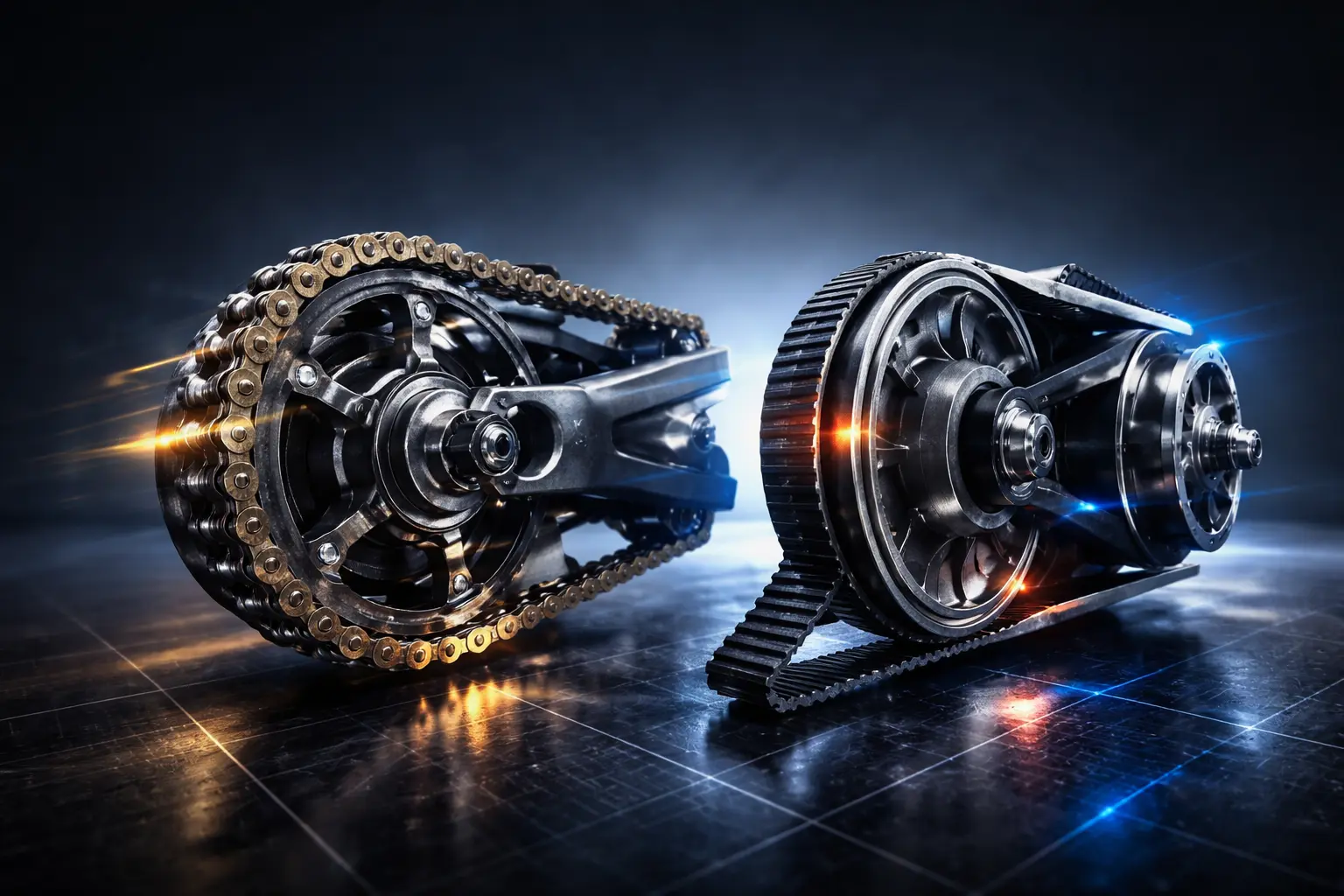
Motorcycle chains are stronger than scooter belts because they rely on metal-to-metal mechanical engagement, while scooter belts depend on friction-based power transfer.
That single difference decides everything: strength, durability, and performance limits.
How Motorcycle Chain Systems Work
A motorcycle chain drive is a direct mechanical system.
How power flows:
- The engine rotates the front sprocket.
- Steel chain transfers force link-by-link
- The rear sprocket drives the wheel.
Why is it powerful:
- Each metal link locks into the sprocket teeth.
- No slipping under high load.
- Designed for high torque and sudden acceleration
Chains perform best in:
- Sport motorcycles
- Semi-automatic bikes
- Heavy-load performance riding
How Scooter Belt Systems Work
Scooters use a CVT (Continuously Variable Transmission) with a belt.
How it works:
- The engine spins the variator pulley
- Belt transfers power via friction
- The rear pulley automatically regulates the speed ratio.
What makes it different:
- No mechanical locking
- Power depends on grip (friction)
- Designed for smoothness, not extreme force
The Real Engineering Difference
1. Mechanical lock vs friction
- Chain = physical engagement (locked connection)
- Belt = friction-based contact
It is the biggest strength difference.
2. Torque handling capability
Motorcycles generate higher stress during:
- Acceleration
- Uphill riding
- Heavy load conditions
Chains handle this easily.
Belts begin to:
- Slip under heavy load
- Heat up easily
- Wear faster
- Possible snap
3. Heat resistance
- Chains: metal, high heat tolerance
- Belts: rubber/composite, degrades under heat
Heat is one of the fastest destroyers of belt systems.
4. Power response
- Chains: instant torque delivery
- Belts: smoother but slightly delayed response
That’s why motorcycles feel more “direct” and aggressive.
| Feature | Motorcycle Chain Drive | Scooter CVT Belt |
|---|---|---|
| Power Transfer | Mechanical locking (sprockets) | Friction-based pulley system |
| Torque Handling | Very high | Moderate |
| Durability | High (metal-based) | Medium (wears faster) |
| Heat Resistance | Excellent | Limited |
| Riding Feel | Direct and responsive | Smooth and gradual |
Why Scooters Still Use Belts (Even If They’re Weaker)
Belts are not “bad” — they serve a different functional purpose:
- Smooth acceleration in traffic
- Low maintenance complexity
- Lightweight design
- Affordable production cost
Scooters prioritize comfort and simplicity, not maximum performance.
Insight
Chains are optimized to carry high loads with precise control.
Engineers design belts to deliver smooth operation with minimal complexity.
That is why both systems exist—and why neither replaces the other.
Frequently Asked Questions (FAQs)
Why are motorcycle chains stronger than belts?
Chains use metal-to-metal engagement for power transfer, while belts rely on friction, which limits their torque capacity.
Can a scooter belt handle motorcycle-level power?
No. It would struggle to maintain grip, overheat, and eventually fail under high motorcycle torque.
Do chains require more maintenance than belts?
Yes. Chains need periodic maintenance, while belts are only changed when they’ve worn out.
Why do scooters use belts instead of chains?
Scooters use belts because they enable automatic transmission, smoother acceleration, and lower maintenance needs.
Are belt systems ever used in motorcycles?
Yes, but mostly in specific cruiser-style motorcycles designed for comfort rather than performance.
Which is stronger, a motorcycle chain or a scooter belt?
Motorcycle chains are significantly stronger and handle much higher torque loads than scooter belts.
Do chains last longer than belts?
Yes, chains generally last longer under high-load conditions, but they require regular maintenance to achieve maximum lifespan.
Is a belt drive faster than a chain drive?
Not necessarily. Chain drives are typically more efficient for high-speed and high-power applications.
Which is cheaper to maintain?
Belts are easier to live with for everyday use, while chains are more budget-friendly and repairable.
Which system is better for city riding?
Belts are generally better suited for city riding due to their smooth operation and low maintenance requirements.
Why do sport bikes avoid belts?
Sport bikes demand maximum torque transfer efficiency and heat resistance, where chains outperform belts.
Which is better for uphill and downhill riding: a motorcycle chain or a scooter belt?
For uphill riding, a chain is better because it is stronger and doesn’t slip under heavy loads, making climbs easier. For downhill riding, it improves control by increasing engine braking, ensuring safer and smoother deceleration.
- Why Cars Don’t Use Scooter-Style Belts to Move Wheels
- Honda ADV 160 vs. Yamaha NMAX: Which Maxi-Scooter Is Better for Daily Riding?


