

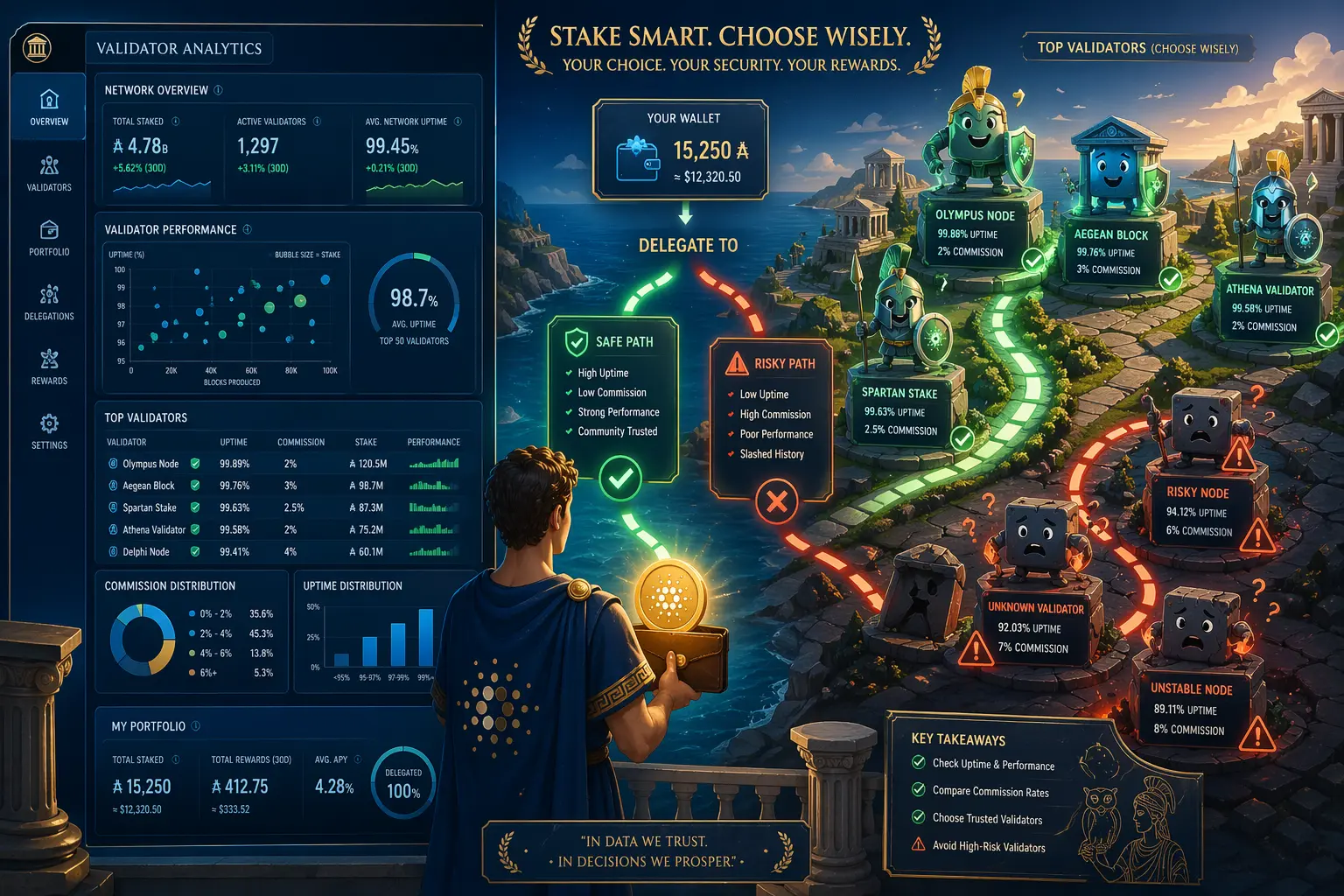
In Cosmos staking, your returns depend less on headline APR—and more on who you delegate to.
Validators are not interchangeable. Their performance, reliability, and behavior directly affect:
- Your rewards
- Your risk exposure
- Your long-term outcomes
This guide delivers a clear, decision-focused framework for selecting safe validators across the Cosmos ecosystem—helping you build a staking strategy grounded in stability rather than guesswork.
How to Identify Reliable Validators and Avoid Hidden Staking Risks
1. What Validators Actually Do
When you stake Cosmos (ATOM) or other Cosmos coins:
- You delegate tokens to a validator
- Validators propose and validate blocks
- They earn rewards and share them with delegators.
Core implication:
2. The 5 Core Metrics That Define a Safe Validator
1. Uptime (Reliability)
- Measures how consistently a validator signs blocks
- Low availability = missed rewards
What to look for:
- Near 100% uptime
- No frequent downtime events
2. Commission Rate (Fee Structure)
- Percentage of rewards taken by validator
Guidelines:
- Too high → reduces your returns
- Too low → may be unsustainable long-term
👉 Balance is essential (not just “lowest fee wins”)
3. Slashing History (Risk Signal)
Slashing occurs when a validator:
- Goes offline for extended periods
- Double-signs blocks
Why it matters:
- You can lose a portion of your stake.
What to check:
- Clean slashing record
- Transparent incident history
4. Validator Size (Decentralization Factor)
- Large validators dominate the stake
- Small validators support decentralization
Risk trade-off:
- Very large → centralization risk
- Very small → operational risk
👉 Aim for mid-sized, reliable validators
5. Reputation & Transparency
Look for validators that:
- Publish updates
- Communicate clearly
- Maintain public presence (website, docs)
3. The Validator Risk Spectrum
| Validator Type | Risk Level | Reward Stability | Notes |
|---|---|---|---|
| Top-tier (very large) | Unknown/new | High | Reliable but centralized |
| Mid-tier (balanced) | Low | High | Best balance |
| Small validators | Medium–High | Variable | Supports decentralization, but riskier |
| Unknown / new | High | Uncertain | Limited track record |
For a broader comparison of reliability and reward trade-offs, see this guide on the best Cosmos validators ranked (safe vs. high-yield).
4. The Diversification Rule (Critical)
Why:
- Reduces slashing impact
- Protects against downtime
- Improves reward consistency
Practical approach:
- Split stake across 2–4 validators
- Mix reliability + decentralization
5. Auto-Compounding and Validator Compatibility
If you are using tools like Restake.app:
- Not all validators support auto-compounding
- Some require manual reward claiming.
What to check:
- Restake compatibility
- Compounding frequency
- Validator configuration
For the full strategy, see your guide on cosmos staking and auto-compounding.
If you are using tools like Restake.app, validator compatibility becomes even more important. Not all validators support auto-compounding, and compounding frequency can vary. For a full breakdown of how this affects long-term returns, see this guide on cosmos staking and auto-compounding, which explains how rewards grow over time and how to structure a more efficient staking strategy.
6. Common Mistakes to Avoid
1. Choosing the highest APR uncritically
High APR can signal:
- Inflation-heavy tokens
- Riskier networks
2. Ignoring validator history
Past behavior often predicts future reliability.
3. Overconcentration
Single-validator exposure increases risk significantly.
4. Choosing validators based only on low fees
Sustainability matters more than short-term savings.
7. Validator Selection Checklist (Quick Use)
Before delegating, confirm:
- ✔ Uptime is consistently high
- ✔ Commission is reasonable
- ✔ No slashing incidents
- ✔ Validator size is balanced
- ✔ Supports auto-compounding (if needed)
- ✔ Transparent communication
8. How Validator Choice Affects Real Returns
Your real yield depends on:
- Validator uptime
- Fee structure
- Compounding efficiency
- Market conditions
9. Staking vs Other Risk Models
Validator risk is fundamentally different from DeFi risks like impermanent loss in crypto, which occurs in liquidity pools—not staking. Understanding this distinction is essential when comparing passive income strategies across different crypto systems.
Staking risks are:
- Operational
- Validator-based
- Network-dependent
10. Building a Safe Cosmos Staking Setup
Step-by-step:
- Choose 2–4 reliable validators
- Allocate stake proportionally
- Enable auto-compounding where possible
- Monitor performance periodically
- Rebalance if validator performance declines
Frequently Asked Questions (FAQs)
How many validators should I use?
Typically 2–4 for balanced risk and diversification.
Can a validator steal my funds?
No. Validators cannot access your tokens—but they can affect rewards and the risk of slashing.
What happens if a validator goes offline?
You may lose rewards, and prolonged downtime can lead to slashing.
Is a lower Commission always better?
No. Extremely low Commission can signal unsustainable operations.
Should I redelegate often?
Only when necessary. Frequent changes can reduce efficiency.