

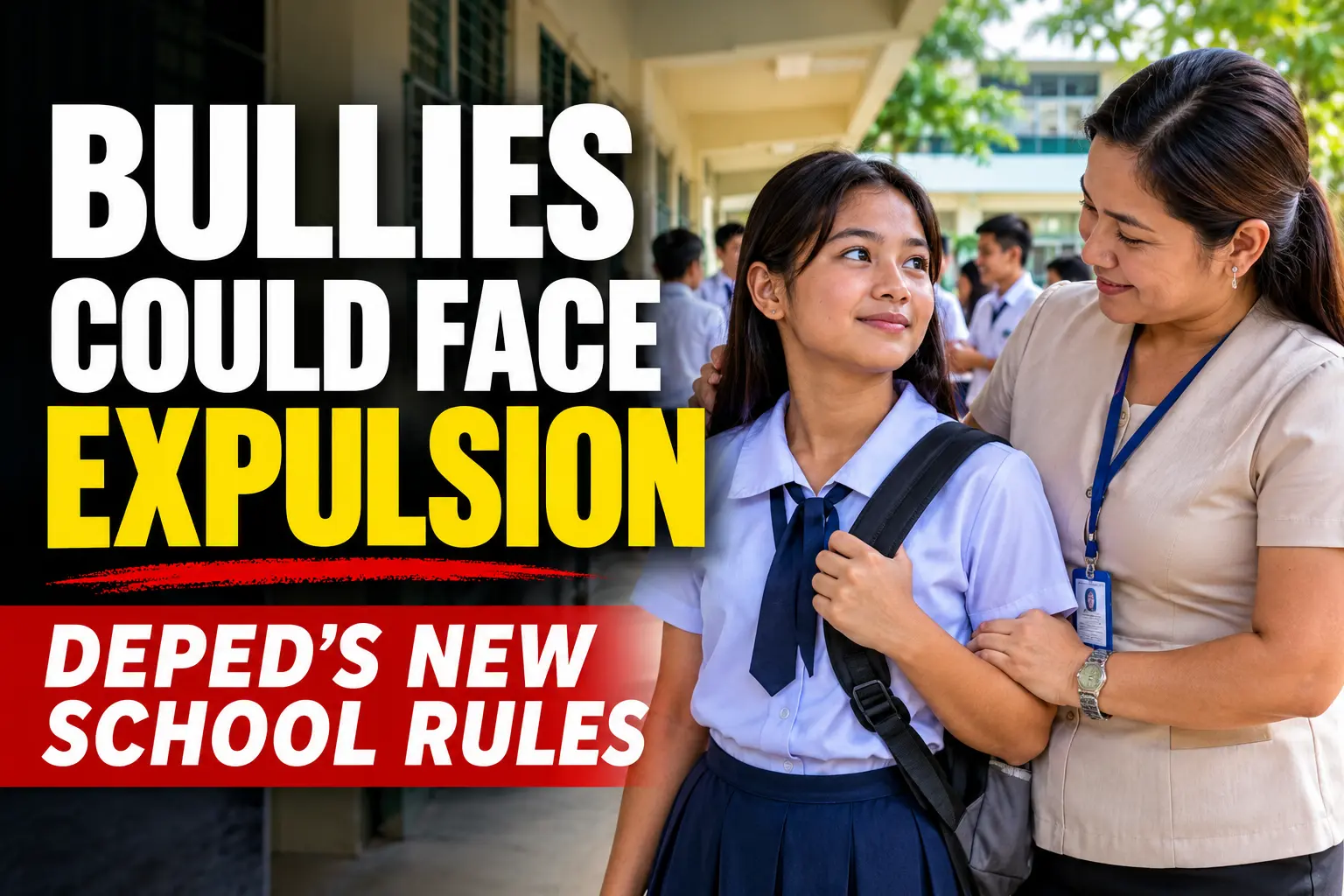
The Department of Education (DepEd) is strengthening its response to bullying in Philippine schools, warning that students found responsible for serious acts of bullying could face severe disciplinary consequences, including expulsion.
The announcement has drawn further attention to school safety after reports emerged of an alleged assault involving a Grade 9 student and six male classmates in Aklan.
The case has raised questions about how schools respond to bullying, how victims are protected, and whether existing disciplinary measures are enough to prevent violence among students.
Under DepEd Order No. 006, s. 2026, known as the Guidelines on Ensuring a Safe and Motivating Learning Environment (ESMLE), Schools must implement consistent procedures to prevent bullying, handle reports, investigate incidents, and take appropriate action against all forms of violence.
The policy sets disciplinary measures according to the nature and severity of each offense. Depending on the circumstances and the number of offenses, students may face suspension, non-readmission, or exclusion from school.
But what exactly do the new DepEd rules mean for students and parents? How will schools handle bullying complaints, and what happens when a student repeatedly harms classmates?
What Happened in the Aklan School Bullying Incident?
The latest discussion about stricter anti-bullying measures followed an incident reported at Ciriaco L. Icamina Sr. National High School in Malinao, Aklan.
According to reports published on November 21 and 22, 2026, a Grade 9 female student was allegedly assaulted by six male classmates on November 17.
The Council for the Welfare of Children (CWC) condemned the incident, reporting that the student suffered several injuries, dizziness, and blurred vision.
The council also raised concerns that verbal insults and other forms of bullying may escalate into physical violence when warning signs are ignored.
Education Secretary Sonny Angara reiterated that students found guilty of bullying could face expulsion under DepEd Order No. 006, s. 2026.
However, he also urged the public not to spread unverified information, photographs, or videos involving the children while the investigation was ongoing.
The incident underscores the need for schools to respond promptly to bullying complaints and take steps to prevent further harm.
Schools must ensure that every allegation is properly investigated and that disciplinary decisions are based on established findings.
What Is DepEd Order No. 006, s. 2026?
DepEd Order No. 006, s. 2026, was issued on March 24, 2026. It introduces guidelines for creating a safe and motivating learning environment.
The policy brings together existing learner protection guidelines and provides a more coordinated approach to addressing bullying, gender-based violence, physical abuse, harassment, and other incidents that threaten student safety.
It covers prevention, incident reporting, investigation, disciplinary action, and mental health and psychosocial support.
The order applies to public schools and community learning centers. Private schools, state and local universities and colleges, and Philippine schools overseas are encouraged to adopt its provisions.
The policy moves beyond ordinary classroom discipline by establishing procedures that involve teachers, school administrators, parents, guidance personnel, and other relevant authorities.
The goal is to create a learning environment where students can participate without fear of harassment, intimidation, or violence.
What Punishments Can Students Who Bully Others Face?
The strengthened DepEd policy introduces a graduated disciplinary framework.
The consequences depend on the nature, seriousness, and repetition of the bullying behavior.
Not every bullying incident leads to expulsion. The policy distinguishes between minor bullying acts, serious bullying acts, and more severe incidents that require intervention at the highest disciplinary level.
1. Minor Bullying Acts
Minor bullying acts may include:
- Uttering profanities or swear words against another learner.
- Disruptive behavior or pranks directed at another student.
- Taking or grabbing another learner’s belongings without permission.
- Punching or pinching another learner without causing physical injuries.
- Fighting that does not result in physical injuries.
The bullying-specific disciplinary schedule provides the following consequences:
| Offense | Possible disciplinary action |
|---|---|
| First offense | Written reprimand and parent notification |
| Second offense | Suspension for three days |
| Third or subsequent offense | Suspension for five days |
These measures aim to address inappropriate behavior before it escalates into more serious misconduct or repeated harassment.
2. Serious Bullying Acts
Serious bullying acts involve severe or repeated behavior that requires formal intervention by the Learner Formation Officer or other appropriate school authorities.
Examples include:
- Stalking another student.
- Catcalling and persistent unwanted sexual or discriminatory comments.
- Using misogynistic, homophobic, transphobic, or sexist slurs.
- Assaulting another learner or causing slight physical injuries.
- Stealing another student’s belongings.
- Intimidating or threatening a classmate.
Under the bullying-specific disciplinary schedule, the consequences are:
| Offense | Possible disciplinary action |
|---|---|
| First offense | Suspension for five days, parent notification, and referral to the Social Welfare Development Office |
| Second offense | Non-readmission |
| Third or subsequent offense | Exclusion |
These measures show that repeated serious bullying can lead to a student losing the opportunity to continue studying at the same school.
3. Severe Bullying Acts
Some incidents are too serious to be handled through ordinary classroom discipline or initial interventions by the Learner Formation Officer.
DepEd identifies severe bullying acts that may warrant the highest level of disciplinary intervention.
Examples include:
- Inflicting physical injuries that leave a student incapacitated or require medical intervention for at least 10 days.
- Sexualized physical acts intended to demean, harass, threaten, or intimidate another learner.
- Uploading or sharing recorded videos that degrade, shame, or humiliate other students.
- Sharing sexual videos, photographs, or recordings involving students through social media or other channels for financial gain.
For these third-level bullying acts, the policy provides exclusion even for a first offense, subject to investigation and due process.
This is an important distinction. A single serious bullying incident may warrant the highest level of disciplinary action, depending on the circumstances.
What Is the Difference Between Non-Readmission and Exclusion?
Parents should understand these two terms because they involve different consequences for a student’s education.
Non-readmission
A student who receives this sanction may complete the current school year but will not be allowed to enroll in the same school for the following school year.
Exclusion
Exclusion immediately removes the student from the school’s active class list. The learner may continue education through appropriate alternative educational interventions in another educational setting, based on an assessment of the learner’s needs and circumstances.
These are serious disciplinary measures, but they do not automatically mean that a student must lose access to education.
DepEd’s policy recognizes both school safety and the need to maintain educational continuity.
Can a Student Be Suspended While an Investigation Is Ongoing?
Yes, under certain circumstances.
The ESMLE policy allows a school head to impose preventive suspension of up to 30 days in cases involving a possible expulsion penalty.
The school head may consider this measure if the available evidence is strong and keeping the student on campus during the investigation could create safety concerns or disrupt school activities.
A student placed under preventive suspension has not necessarily been found responsible for the alleged misconduct.
Its purpose is to address immediate safety concerns while the school investigates the reported incident.
This distinction matters because schools must protect students without treating an allegation as proof of guilt.
What Rights Do Students Have During a Bullying Investigation?
Stricter disciplinary rules must also protect the rights of students accused of bullying.
DepEd’s policy requires schools to follow due process before imposing disciplinary penalties.
The minimum requirements include:
- Written notice: The student and their parents or guardians must receive written information about the complaint and supporting evidence.
- Opportunity to respond: The student must be given five school days to submit a written answer, with assistance from a parent or guardian.
- Written decision: The disciplining authority must issue a written decision explaining the facts and reasons for its ruling.
- Right to appeal: The decision may be appealed through the procedures established by DepEd.
These safeguards help ensure that disciplinary action is based on evidence and a fair investigation.
They also protect schools from making decisions based solely on rumors, social media posts, or unverified accusations.
A strong anti-bullying policy must protect victims while ensuring that every student receives fair treatment.
What Must Schools Do When Bullying Is Reported?
Everyone in the school community shares responsibility for preventing bullying.
Schools have a primary responsibility to protect learners from violence and harassment.
The policy requires schools to follow clear procedures for reporting bullying, investigating complaints, protecting affected students, and providing appropriate support.
Teachers, Learner Formation Officers, school heads, and Child Protection Committees have different responsibilities depending on the seriousness of the reported incident.
For minor bullying behaviors, teachers provide initial intervention and address the behavior.
When incidents become serious, the Learner Formation Officer takes a more direct role and may recommend appropriate disciplinary action to the school head.
Serious cases require the school head to intervene and may involve coordination with relevant government agencies.
Schools must also maintain appropriate incident records and monitor the effectiveness of their learner protection measures.
The policy recognizes that bullying can happen both inside and outside physical classrooms, including through online platforms and other virtual environments covered by the guidelines.
How Does DepEd Protect Students Who Experience Bullying?
Punishing students responsible for bullying is only one part of the policy.
Victims also need protection, support, and opportunities to recover from the experience.
DepEd’s guidelines include mental health and psychosocial support, psychological first aid, guidance counseling, and other appropriate interventions.
Schools may also coordinate with the Department of Social Welfare and Development (DSWD), local government units, the Philippine National Police (PNP), and other relevant agencies when necessary.
These measures are important because bullying can affect more than a student’s physical safety.
Students who experience repeated harassment may become afraid to attend school, lose confidence, struggle to concentrate, or withdraw from classroom activities.
Some may also become reluctant to report further incidents because they fear retaliation or believe that adults will not take their complaints seriously.
Schools must therefore make reporting systems accessible, protect students from further harm, and provide support throughout the response process.
A disciplinary decision alone cannot address every consequence of bullying.
Why Do Stronger Anti-Bullying Rules Matter?
Bullying can interfere with the basic purpose of education.
Students attend school to acquire knowledge, develop skills, build relationships, and prepare for their future. Every student should be able to attend school without fearing intimidation, humiliation, or violence from classmates.
A meaningful education should also develop students’ ability to think critically and understand what they learn, rather than focus only on memorizing information. This is another important issue explored in Are Schools Teaching Students to Memorize Instead of Truly Understand?.
When bullying continues without an effective response, the consequences can extend beyond the students directly involved.
Other learners may become afraid to participate in class, witnesses may remain silent, and parents may lose confidence in the school’s ability to protect their children.
The consequences can also affect teachers, who must manage classroom behavior while ensuring that students feel safe and respected.
This is why anti-bullying policies should not be treated as administrative paperwork. They form an important foundation for effective teaching and learning.
Schools cannot create a healthy learning environment when students feel unsafe around their classmates.
Will Harsher Punishments Actually Stop Bullying?
Consistently enforcing disciplinary measures shows that schools will not tolerate serious misconduct.
However, tougher punishments alone will not eliminate bullying.
What matters most is whether schools consistently apply the policy and take meaningful action when bullying occurs.
Several challenges deserve attention.
1. Schools Must Investigate Complaints Consistently
Students and parents need assurance that schools will respond appropriately to all reported incidents.
If schools investigate some complaints but ignore others, students may stop trusting the reporting process.
When schools follow established procedures, they are better positioned to treat similar cases fairly and avoid arbitrary decisions.
2. Victims Must Be Protected From Retaliation
Reporting bullying can be difficult, particularly when the students involved attend the same classes or share the same social circles.
Schools must establish safeguards to protect affected students from further intimidation, harassment, or retaliation throughout the investigation process.
Students should feel safe reporting misconduct, not fear that speaking up will make their situation worse.
3. Teachers and School Administrators Need Support
Teachers are often among the first adults to recognize signs of bullying.
However, they cannot manage every serious incident without appropriate guidance, training, and administrative support.
Schools need clear reporting procedures, trained personnel, and sufficient resources to investigate complaints and support affected students.
4. Schools Must Address the Causes of Bullying
Disciplinary action can stop certain behaviors, but preventing future incidents also requires understanding why students engage in bullying.
Some students may imitate aggressive behavior, struggle to manage emotions, seek social dominance, or have difficulty understanding the consequences of their actions.
These circumstances do not excuse harmful behavior.
However, identifying contributing factors can help schools design appropriate interventions that reduce the likelihood of repeated misconduct.
5. Rules Must Apply to Everyone
Anti-bullying policies should protect all students regardless of their academic performance, family background, social influence, or relationships with school personnel.
A student should not receive special treatment simply because their family has influence or because they perform well academically.
Fair and consistent enforcement is essential to building trust in the policy.
Should Schools Focus Only on Punishing Bullies?
No. An effective school response must protect affected students, impose appropriate consequences, and provide interventions that address harmful behavior.
DepEd’s policy includes counseling, positive discipline, life skills training, and mental health and psychosocial interventions.
Preventing bullying also requires teaching students how to make responsible decisions, understand the consequences of their actions, and consider how their behavior affects others. Schools should give children opportunities to practise these skills in everyday situations, not just punish them for harmful choices. These skills also support safer and more responsible school communities, as explained in How Schools Can Teach Children to Make Better Decisions in Real Life.
Preparing students for responsible adulthood also means teaching practical life skills, including managing money, making informed financial decisions, and avoiding financial risks. Read more in Should Schools Teach Financial Literacy as a Core Subject?.
These measures can involve victims, students responsible for bullying, bystanders, parents, guardians, and school personnel.
However, rehabilitation must never replace necessary disciplinary action.
When a student commits a serious offense, schools must still impose the appropriate consequences. Counseling should help students change harmful behavior, not replace accountability for the harm they cause.
Giving students a chance to change should never come at the expense of protecting those affected by their actions.
What Should Parents Do If Their Child Is Being Bullied?
Parents should take every bullying report seriously, even when the incident seems minor at first.
Some students may not immediately explain what happened because they feel embarrassed, frightened, or worried about making the situation worse.
Parents can take several practical steps:
- Listen carefully: Allow the child to explain what happened without blaming or dismissing their concerns.
- Record important details: Keep track of dates, locations, witnesses, messages, and other relevant evidence.
- Report the incident: Contact the teacher, school head, or designated Child Protection Committee.
- Request appropriate protection: Ask what steps the school will take to prevent further harassment or retaliation.
- Follow up: Monitor the school’s response and document any additional incidents.
- Seek professional support when necessary: Consider appropriate medical, psychological, or counseling assistance if the child experiences physical or emotional harm.
Parents should also avoid publicly sharing photographs, videos, or identifying details of children involved in an incident.
Protecting one child should not cause further harm to another or compromise a fair investigation.
Are DepEd’s New Rules Enough to Make Philippine Schools Safer?
DepEd Order No. 006, s. 2026 provides a more structured approach to addressing bullying and other threats to student safety.
It establishes clearer disciplinary consequences, strengthens reporting and investigation procedures, and recognizes the need for support services for affected learners.
Evaluating the policy requires looking beyond disciplinary sanctions to consider how effectively schools prevent and address bullying.
Effective implementation requires schools to conduct impartial investigations, safeguard affected students, ensure fair disciplinary procedures, and provide appropriate interventions.
Parents must also be able to trust that school administrators will respond when children report threats or harassment.
The government, meanwhile, must ensure that schools have the personnel, training, and resources needed to implement the policy effectively.
The real measure of success will not simply be how many students are suspended or excluded.
It will be whether fewer children experience bullying, more students feel safe reporting incidents, and schools become places where respect and accountability are part of everyday life.
Frequently Asked Questions (FAQs)
Yes. DepEd Order No. 006, s. 2026 includes exclusion as a disciplinary sanction for serious and severe bullying acts. Certain severe bullying acts may warrant exclusion even for a first offense, subject to investigation and due process.
No. The consequences depend on the nature, severity, and repetition of the behavior. Minor bullying may result in a written reprimand or suspension, while serious and severe incidents can lead to non-readmission or exclusion.
Even behavior initially classified as minor can lead to suspension when it becomes a repeated offense. Repeated serious bullying can result in non-readmission or exclusion, depending on the number of offenses and the applicable disciplinary provisions.
A school head may impose preventive suspension of up to 30 days in qualifying cases involving a possible expulsion penalty, provided the conditions specified in the policy are met. This is a temporary safety measure, not a final finding of guilt.
Yes. The ESMLE policy addresses incidents in physical and virtual environments. Online harassment, threats, intimidation, and other prohibited acts may result in disciplinary action depending on their nature and severity.
Parents should document the incident, report it to the school, request appropriate protection, and follow up on the investigation. They should also seek medical or psychological support when necessary.
The order directly applies to public schools and community learning centers. Private schools, state and local universities and colleges, and Philippine schools overseas are highly encouraged to adopt its provisions.
Schools Must Be Safe Places to Learn
Every child deserves an opportunity to attend school without fear of being threatened, humiliated, or physically harmed.
DepEd’s strengthened rules send a clear message that serious bullying and violence will have consequences. They recognize that effective student protection requires measures beyond disciplinary action.
Schools must respond to complaints, support victims, investigate incidents fairly, and help prevent harmful behavior from happening again.
Parents and teachers also have important roles in teaching children respect, empathy, responsibility, and self-control.
Academic achievement should never be the only measure of a school’s success. The way students treat one another and the safety of the learning environment matter just as much.
Ultimately, schools should prepare children not only to pass examinations and pursue careers but also to become responsible individuals who respect the rights and dignity of others.
References
- Department of Education (DepEd). (2026). DepEd Order No. 006, s. 2026: Guidelines on Ensuring a Safe and Motivating Learning Environment (ESMLE).
- Philippine Information Agency. (2026, September 3). DepEd tightens measures to curb violence, bullying in schools.
- GMA News. (2026, November). CWC condemns assault of Grade 9 student by six classmates in Aklan.
- The Philippine Star. (2026, November 22). Bullies face expulsion under new rules, says DepEd chief.