
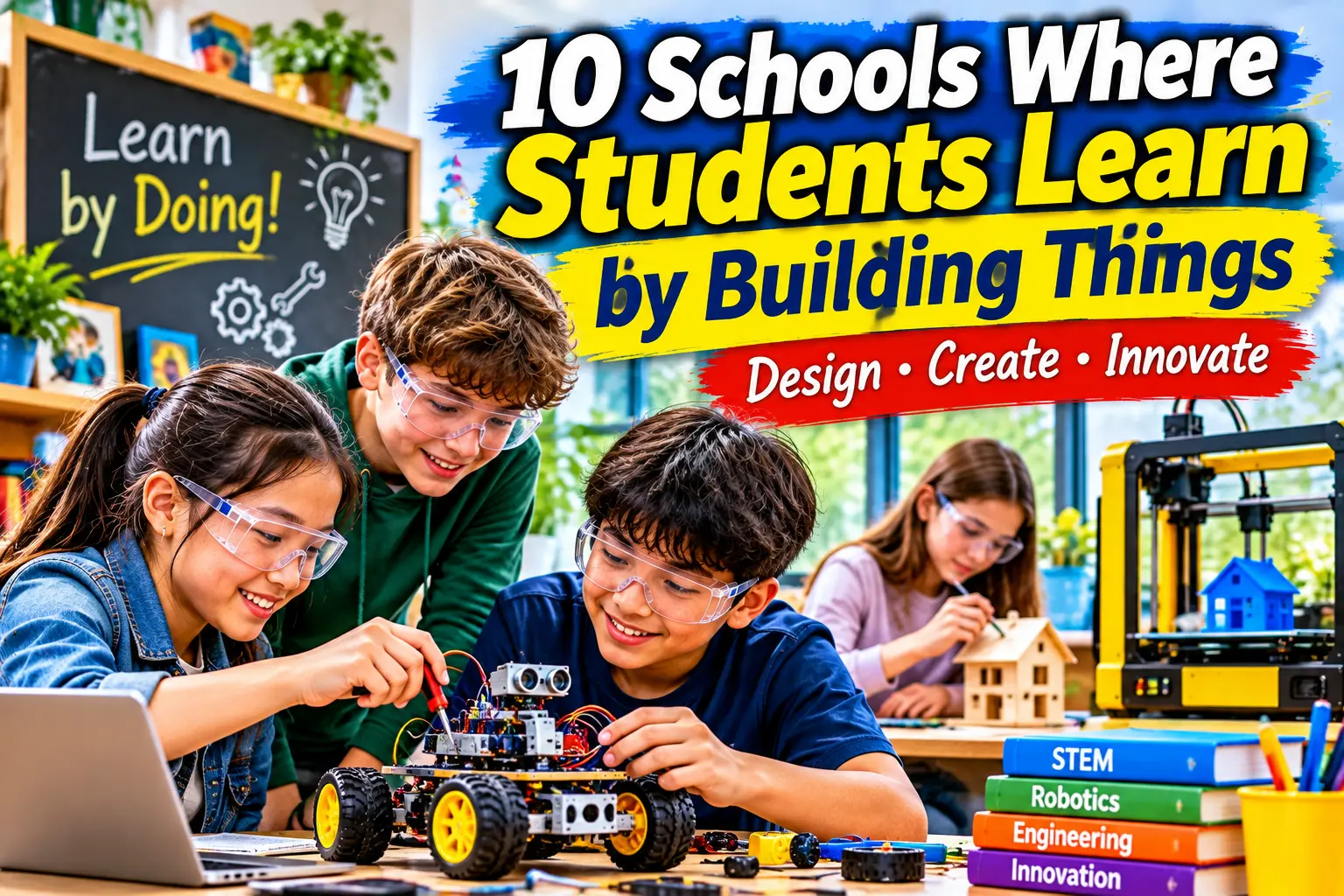
In many schools, students learn about ideas through textbooks, lectures, and written assignments. But some schools take a different approach. They give students opportunities to turn what they learn into something they can actually make.
An engineering lesson might involve designing and building a working machine. A study of architecture could become a model building. A science project might involve designing, testing, and improving a prototype.
This approach is often associated with maker education, design-based learning, and hands-on project-based learning. However, these terms do not all mean the same thing. Some schools build making into their everyday curriculum, while others use dedicated studios, workshops, or specialized programs.
The following ten schools illustrate how hands-on creation is incorporated into education, from the projects students produce to the learning processes behind them.
1. NuVu High School – Cambridge, Massachusetts, USA
NuVu High School is built around a studio-based learning model. Instead of following a conventional schedule dominated by textbooks and lectures, students work on interdisciplinary design challenges that require research, experimentation, and physical creation.
Students participate in intensive design studios where they develop ideas into tangible outcomes. These may include prototypes, installations, products, films, and other creative projects.
One example is its soft robotics studio, where students explored ways to develop assistive devices using flexible materials, 3D printing, silicone casting, electronics, and other fabrication techniques.
The process involves more than making something that looks impressive. Students research a challenge, develop possible solutions, test their designs, receive feedback, and make improvements.
NuVu demonstrates how a high school can organize much of its academic experience around designing and creating rather than simply studying information.
What students build: Prototypes, robotic devices, installations, products, and creative solutions.
Age group: High school students.
Source: NuVu High School
2. Brightworks – San Francisco, California, USA
Brightworks is an independent K–12 school where students develop their knowledge and skills through hands-on projects. Its approach encourages students to investigate questions, develop ideas, create physical work, and share their results with others.
The school organizes learning through a project framework called the Arc. Students explore a topic from different perspectives before developing individual or collaborative projects.
The work can involve building models, creating artworks, developing inventions, or designing solutions to challenges. Students are encouraged to experiment, make mistakes, revise their work, and explain what they have learned.
Brightworks also connects students with artists, scientists, makers, and organizations in the wider community.
Its approach challenges the idea that making belongs exclusively in engineering classes, showing how hands-on creation can support learning across disciplines. Making can connect science, mathematics, art, language, and other subjects.
What students build: Models, inventions, artwork, creative installations, and collaborative projects.
Age group: Kindergarten through Grade 12, with programs serving different developmental stages.
Source: Brightworks
3. Design Tech High School (d.tech) – Redwood City, California, USA
Design thinking and technology guide the way students learn at Design Tech High School.
One of its most distinctive facilities is the Design Realization Garage, an extensive fabrication space equipped with 3D printers, laser cutters, woodworking tools, soldering stations, and other equipment.
All ninth-grade students receive an introduction to the facility through workshops and practical activities. They learn how to use tools, develop maker skills, and create prototypes that help them understand academic concepts.
Students also use the space for design projects, robotics, independent work, and assignments connected to other subjects.
Rather than treating fabrication as an activity reserved for students interested in engineering, d.tech gives learners opportunities to use making as another way to express ideas and demonstrate understanding.
What students build: Prototypes, robotic projects, physical models, and fabricated designs.
Age group: High school students, particularly Grades 9–12.
Source: Design Tech High School
4. High Tech High – San Diego, California, USA
High Tech High is widely associated with project-based learning. Its educational approach combines academic subjects with meaningful projects that require students to use both their hands and their minds.
Students work on projects that involve research, collaboration, design, and the creation of finished products. These may include physical models, prototypes, exhibitions, publications, and other forms of work.
The school emphasizes meaningful work that allows students to demonstrate their understanding through what they create, rather than simply completing assignments for grades.
Teachers also design projects that connect different subjects. A project might combine science, mathematics, writing, and design, requiring students to apply several areas of knowledge to create a final product.
High Tech High shows how hands-on creation can be integrated into a broad academic program without making technical training the school’s sole focus.
What students build: Models, prototypes, exhibitions, publications, and interdisciplinary project outcomes.
Age group: Elementary through high school, depending on the specific High Tech High campus.
Source: High Tech High
5. Bank Street School for Children – New York City, USA
Bank Street School for Children takes a hands-on approach to education through its STEAM Lab, where students work with engineering, design thinking, coding, robotics, and fabrication.
The facility gives students access to tools such as 3D printers and laser cutters. They can also experiment with motors, sensors, and other components to create objects that move or respond to their surroundings.
What makes this approach interesting is how the school connects making with its wider academic curriculum.
Students do not simply visit the lab to complete unrelated technology activities. The STEAM program reinforces and expands learning across subjects such as science, mathematics, social studies, and the arts.
For example, students can use fabrication tools to create prototypes that demonstrate an idea or apply engineering concepts to a practical challenge.
What students build: 3D-printed objects, prototypes, robotic creations, and projects involving sensors and motors.
Age group: Elementary and middle school students.
Source: Bank Street School for Children
6. The Nueva School – California, USA
The Nueva School integrates design thinking and engineering throughout its PreK–12 educational program.
The school provides dedicated Innovation Labs, called I-Labs, where students can turn their ideas into practical projects and test what works.
The process encourages students to identify needs, develop possible solutions, create prototypes, and improve their designs. Instead of expecting a perfect result immediately, students learn to treat mistakes and feedback as part of the development process.
In the upper school, students can take courses such as Design Engineering for Social Good and Engineering and Fabrication Workshop.
These opportunities help students move beyond theory and apply what they learn through practical projects.
Nueva demonstrates how design and making can evolve as students progress through different stages of education.
What students build: Engineering prototypes, designed products, models, and projects addressing real-world challenges.
Age group: Preschool through Grade 12.
Source: The Nueva School
7. Canadian International School – Singapore
Canadian International School incorporates making into its STEAM education through dedicated makerspaces and robotics facilities.
Students can explore activities such as woodworking, textile design, engineering, construction, 3D printing, and laser cutting.
The school also provides robotics equipment that allows students to build and program machines. These activities require learners to combine physical construction with coding and logical thinking.
A robotics project requires students to understand how physical components, sensors, and programming work together to control the machine’s movement.
The process encourages students to test their creations, identify problems, and make adjustments.
The makerspace reflects a broader understanding of creative construction, encompassing projects that extend beyond electronics. Students can work with different materials and techniques depending on the project.
What students build: Robots, engineering models, 3D-printed objects, and creative designs.
Age group: Preschool through Grade 12, with activities suited to different age levels.
Source: Canadian International School
8. RTPM-Dumaguete Science High School – Dumaguete City, Philippines
Students do not need to attend an expensive international school to experience maker education. A public school in the Philippines is also developing opportunities for students to learn through digital fabrication.
In December 2024, RTPM-Dumaguete Science High School inaugurated a makerspace through a partnership involving the Department of Science and Technology Region 7, the Dumaguete City Division of DepEd, and other educational and research institutions.
The initiative introduced additive manufacturing education, including 3D printing, into the public senior high school curriculum.
Students learn to turn digital designs into real objects by modeling, making, and testing them.
The project was also intended to serve as a starting point for expanding makerspace opportunities to other public senior high schools in Dumaguete.
This example is particularly relevant because it demonstrates how schools can introduce maker education into public education through partnerships with government agencies and research institutions.
What students build: Digitally designed and 3D-printed objects and prototypes.
Age group: Senior high school students.
Source: RTPM-Dumaguete Science High School
9. Dwight School Hanoi – Hanoi, Vietnam
Dwight School Hanoi gives students opportunities to explore design and fabrication through its Spark Lab.
The makerspace is equipped with tools for different types of projects, from 3D printing and laser cutting to woodworking and robotics. Students can use these facilities to develop ideas and turn them into physical prototypes.
The facility supports different stages of the International Baccalaureate Middle Years Programme and Diploma Programme.
The Middle Years Programme introduces students to the design process, from analyzing challenges and developing solutions to testing prototypes. Older students can explore topics such as product design, materials, sustainability, manufacturing, and user-centered design.
This progression helps students understand that building a product involves more than assembling materials. It requires planning, research, technical knowledge, and careful evaluation.
What students build: Product prototypes, 3D models, fabricated designs, and robotics projects.
Age group: Middle and high school students, particularly Grades 6–12.
Source: Dwight School Hanoi
10. Chinese American International School (CAIS) – San Francisco, California, USA
Chinese American International School uses its Phanachet Design Lab to help students explore engineering, architecture, coding, and creative construction.
The program is particularly notable because students create more than just technology-related projects. They also use the design lab to support learning in other subjects.
For example, students can create scale models of monuments while studying history and culture. During science lessons on aerodynamics, students can design different wing shapes, test prototypes, collect data, and analyze the results.
Middle school students also undertake longer product-design investigations. These projects can involve sketching, prototyping, developing, packaging, and presenting a product intended to help someone.
This approach connects physical construction with academic understanding. Students learn to explain not only what they made but also why they made it and how they tested their ideas.
What students build: Robots, furniture, games, architectural models, prototypes, and experimental designs.
Age group: Preschool through Grade 8, with more advanced design projects in middle school.
Source: Chinese American International School
What Do Students Actually Learn by Building Things?
Building something involves more than following instructions or assembling materials. It requires students to understand a challenge, make decisions, apply knowledge, and evaluate whether their work achieves its purpose.
This is one reason building-based education is closely connected to problem-solving. Some schools take this approach further by giving students opportunities to tackle practical challenges that affect people and communities. 10 Schools That Teach Children How to Solve Real-World Problems explores these examples.
Different projects develop different skills.
| Skill | How students develop it |
|---|---|
| Critical thinking | Analyzing challenges and choosing suitable approaches |
| Problem-solving | Identifying why a design does not work and finding improvements |
| Creativity | Turning ideas into original objects or solutions |
| Mathematics | Measuring dimensions, calculating quantities, and working with proportions |
| Science | Testing materials, forces, movement, and other physical principles |
| Collaboration | Sharing responsibilities and working toward a common result |
| Communication | Explaining designs, presenting projects, and responding to feedback |
| Persistence | Revising unsuccessful designs and trying different approaches |
These skills can develop together during a single project. For example, students designing a small robot may need to calculate measurements, understand electrical circuits, write code, assemble components, and troubleshoot technical problems.
Students can also develop these skills by working with classmates of different ages and learning from one another’s experiences. Some schools make this part of their educational approach, as shown in 10 Schools Where Children of Different Ages Learn Together.
The learning happens throughout the process, not only when the finished robot works.
Does Learning by Building Mean Students Spend Less Time Studying?
Not necessarily.
A common misunderstanding is that hands-on learning replaces academic instruction with practical activities. In reality, successful maker education often requires students to understand academic concepts before they can apply them effectively.
A student designing a bridge model needs to understand measurements, materials, forces, and structural stability. Someone creating a working electronic device may need knowledge of mathematics, physics, and programming.
The difference is how students encounter and apply that knowledge.
Building-based learning is one of several approaches that allow schools to broaden the learning experience beyond conventional classroom instruction. Other schools use different educational models, environments, and teaching methods to change how children experience learning, as shown in 10 Schools Designed to Make Children Learn Differently.
Instead of learning a concept only through explanation, they can use it to complete a practical task. Teachers still provide instruction, guidance, and assessment, but students also have opportunities to demonstrate understanding through their creations.
This approach does not eliminate the need for textbooks, lessons, or written work. It gives students another way to connect academic knowledge with practical experience.
What Can Other Schools Learn From These Examples?
These schools show that meaningful maker education does not always require an expensive laboratory filled with advanced equipment.
Some schools have sophisticated fabrication facilities with 3D printers, laser cutters, and robotics tools. Others can begin with simpler materials such as cardboard, wood, recycled objects, paper, and basic construction kits.
The most important element is not the equipment itself. It is the learning process.
Students should have opportunities to:
- Start with a question, challenge, or idea.
- Research and plan before building.
- Choose materials and tools appropriate to the project.
- Create an initial model or prototype.
- Test their work and identify weaknesses.
- Improve their designs based on observations and feedback.
- Present their finished work and explain what they learned.
Schools can also connect projects to different academic subjects rather than treating making as an isolated activity.
Learning opportunities can also extend beyond the classroom itself. Some schools take students outside the classroom to learn in communities, workplaces, and natural settings. See 10 Schools Where Students Learn Outside School for more examples.
A cardboard model can teach geometry and structural design. A simple motorized vehicle can introduce physics and engineering. A student-designed product can combine mathematics, writing, art, and entrepreneurship.
The goal is not to make every student an engineer or inventor. It helps children see how they can use what they learn to make things, test their ideas, and improve their designs.
Conclusion
Some of the most valuable learning experiences emerge when students can develop their ideas into tangible creations. By designing, building, testing, and improving their work, they can connect academic knowledge with practical experience.
These schools show how making can become part of education across different age groups and subject areas. Some use advanced fabrication equipment, while others rely on simple materials and creative projects.
The important lesson is that students should not only learn how the world works. They should also have opportunities to experiment, create, and understand how they can contribute to it.
Frequently Asked Questions (FAQs)
Maker education encourages students to learn by designing, building, experimenting, and creating physical or digital projects. It often combines science, technology, engineering, art, and mathematics.
A makerspace is a dedicated area where students can use tools, materials, and technology to create projects. Depending on the school, it may include 3D printers, woodworking equipment, electronics, robotics kits, and other fabrication tools.
Yes. Younger children can begin with age-appropriate activities such as building with blocks, creating simple models, exploring materials, and constructing basic machines. More advanced projects can be introduced as their skills develop.
No. Making can connect many subjects, including mathematics, art, history, language, and social studies. Students can build models, create visual presentations, design products, and develop projects that demonstrate their understanding of different topics.
No. Schools can begin with affordable materials such as cardboard, recycled objects, paper, wood, and simple construction kits. Advanced equipment can expand the range of projects, but meaningful learning depends more on the quality of the activities and guidance than on expensive tools.