
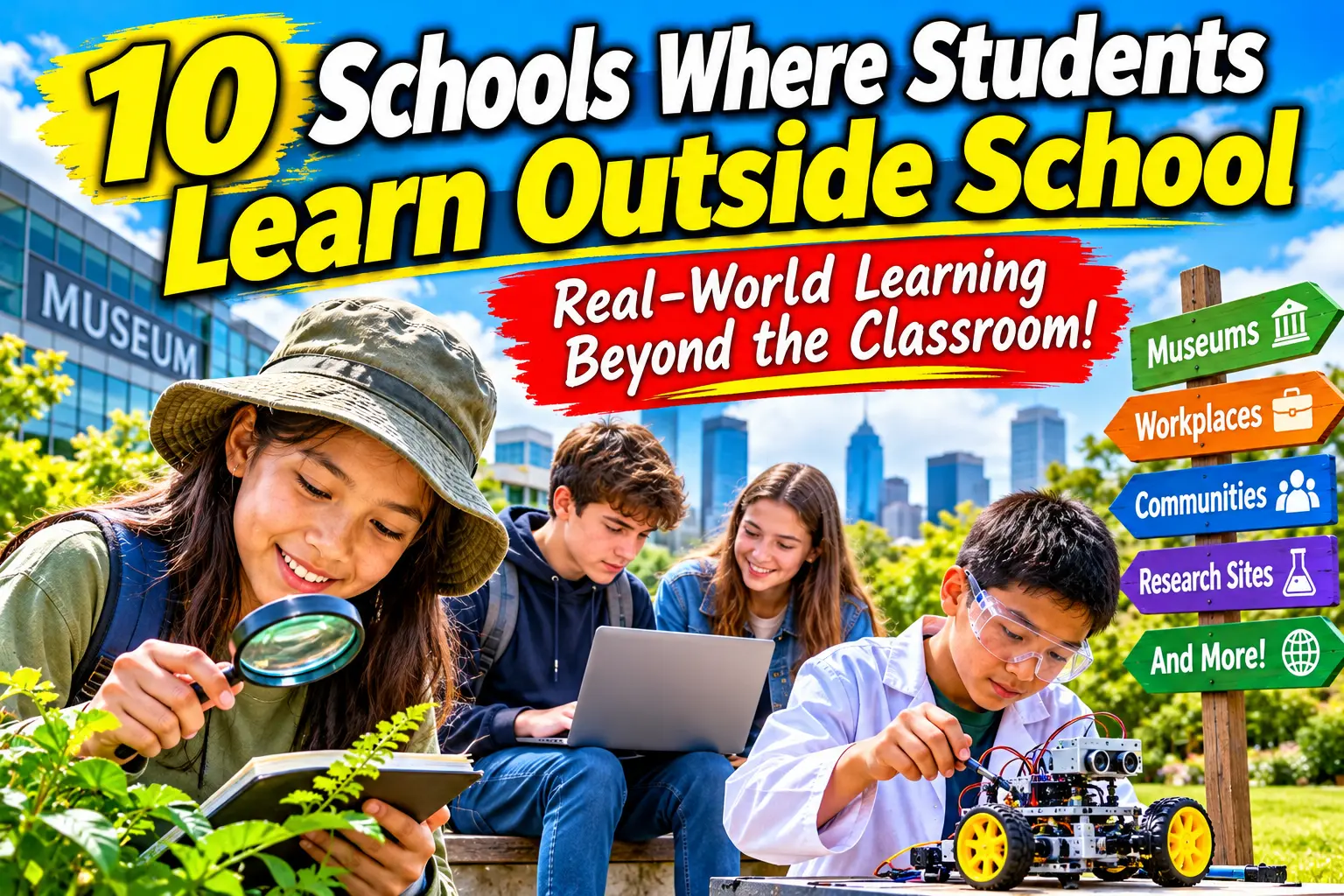
Most children spend much of their education inside school buildings. They attend lessons, complete assignments, read textbooks, and take examinations. Still, some lessons are difficult to grasp without opportunities to experience them firsthand.
Students can learn about business by working with professionals, understand history by visiting important places, and study science by collecting data in the field.
These experiences also help students develop communication and problem-solving skills by working with people outside their usual school environment.
Some schools have made these experiences a regular part of their educational approach. Rather than treating outdoor activities and workplace visits as occasional field trips, the school integrates them into academic subjects, research, projects, and practical assignments.
In these schools, the classroom is only one part of the learning environment. Museums, workplaces, communities, research sites, and even different countries become places where students develop knowledge and skills.
Here are 10 schools and educational programs that show how learning can extend far beyond the traditional classroom.
1. City-As-School — New York City, USA
City-As-School in New York City connects academic learning with real-world experiences, giving students opportunities to earn credit beyond the traditional classroom.
The public high school uses internships as an important part of its educational approach. Students participate in external learning placements at businesses, community organizations, hospitals, political offices, parks, museums, and other locations.
These experiences help students see how what they learn connects to the world around them.
A student interested in healthcare might learn from professionals in a medical setting, while another interested in government could gain experience with a political organization.
The school connects these placements with academic requirements. Students work with licensed teachers and complete assignments related to their experiences rather than simply spending time off campus without a learning purpose.
This approach turns New York City into an extended learning environment. Students can explore different fields, build relationships with mentors, and understand how academic knowledge applies to everyday work.
Official source: City-As-School – Learning Outside the Classroom
2. High Tech High — San Diego, California, USA
High Tech High in San Diego connects classroom education with professional workplaces through its internship program.
All juniors are required to complete an off-campus internship with a professional organization. During the four-week experience, students work full-time at their placement and receive guidance from a workplace mentor.
The experience involves more than observing employees or performing simple tasks. Each student works with a mentor to develop a substantial project that contributes to the organization.
Past internship projects have included website development, marketing support, technology assistance, recruitment activities, and public relations work.
Students also document their experiences through journals, portfolios, interviews, and other assignments. After completing the internship, they present what they learned to their mentors, teachers, and fellow students.
The program allows teenagers to experience professional environments before graduating from high school.
Students also learn how to communicate, take responsibility, use technical skills, and work with others outside school.
Official source: High Tech High – Internships
3. The Met High School — Rhode Island, USA
The Met integrates internships into its educational model, making them a planned component of students’ learning.
They are an essential part of the school’s learning model.
The program calls these experiences Learning Through Interest, or LTI. Each week, students learn alongside professionals at workplaces and organizations across Rhode Island.
Each placement is connected to the student’s interests, goals, and curiosity. By exploring fields such as healthcare, engineering, technology, business, education, law, and the arts, students can discover areas that match their interests.
The experience also connects workplace activities with academic learning. Students reflect on their experiences, conduct research, and complete projects related to what they encounter outside school.
The Met’s approach recognizes that students can learn important lessons by working with people who use professional knowledge every day.
Conversations with mentors, new responsibilities, and practical challenges can introduce students to ideas that textbooks alone may not fully convey.
Official source: The Met – Internships and Learning Through Interest
4. THINK Global School — International
THINK Global School takes learning outside the classroom to an unusual level. It is a traveling high school where students live and study in different countries throughout their final two years of secondary education.
Each academic year, students in Grades 11 and 12 travel with their educators and spend time in four countries.
The places they visit become part of their curriculum. Students learn about academic topics by experiencing different places, cultures, and communities, not just by reading books or joining classroom discussions.
For example, students might study literature while exploring locations connected to a historical story or investigate marine life through experiences in coastal environments.
The school combines project-based learning, independent work, collaborative activities, and firsthand exploration.
Its traveling model gives students opportunities to experience different cultures and examine global issues from multiple perspectives.
THINK Global School demonstrates how the world itself can become a learning environment when education is deliberately connected to place, culture, and firsthand experience.
Official source: THINK Global School
5. The Island School — Eleuthera, The Bahamas
The Island School offers high school students a semester-based educational program on Eleuthera in The Bahamas.
Its curriculum links academic subjects with the island’s natural surroundings and cultural heritage.
Students study ecological science, mathematics, history, English literature, and other subjects while participating in field-based research, cultural immersion, and service learning.
Scientific research also plays an important role in the program. Students can investigate subjects such as fisheries, sustainable energy, food production, and local environmental conditions.
These collaborations help students understand local issues by learning directly from researchers and the people who experience them.
The program includes outdoor education and physical activities, but its purpose goes beyond adventure. Students are expected to connect their experiences with academic research and develop a deeper understanding of the place where they are studying.
The Island School shows how an entire academic program can be organized around a particular location, allowing students to learn directly from the environment and community around them.
Official source: The Island School – Semester Program
6. Promontory School of Expeditionary Learning — Perry, Utah, USA
At Promontory School of Expeditionary Learning, students take part in fieldwork that connects classroom lessons with real-world experiences.
The school organizes learning expeditions around important questions and topics. Students explore these subjects through research, conversations with experts, community activities, and structured fieldwork.
The difference between a traditional field trip and the school’s approach is important.
A typical field trip may involve visiting a location, listening to a guide, and returning to school. At Promontory, learning involves exploring questions, gathering relevant information, and putting new knowledge into practice.
They may work with scientists, historians, artists, and other professionals to understand a subject from different perspectives.
Each expedition has clear learning goals and usually ends with students presenting their work to families and community members.
This approach gives students opportunities to develop research skills while understanding how academic knowledge can be used outside school.
Official source: Promontory School – Fieldwork
7. Casco Bay High School — Portland, Maine, USA
Casco Bay High School in Portland, Maine, organizes much of its curriculum around learning expeditions.
These are long-term studies that connect academic subjects with important social, environmental, and community issues.
Students do more than study topics through reading and written examinations. They investigate questions, conduct fieldwork, gather information, and create projects for real audiences.
For example, students have studied climate change and global migration. Some have worked with scientific partners to investigate environmental issues, while others have researched public policy and presented their findings to local experts.
The school also gives students opportunities to study different subjects through longer fieldwork activities.
These activities help students build knowledge and meet academic requirements while learning in different environments.
Casco Bay demonstrates how schools can use communities and real-world challenges as part of a structured academic curriculum.
Official source: Casco Bay High School – School Profile
8. Watershed School — Colorado, USA
Watershed School in Boulder, Colorado, emphasizes experiential learning for students in Grades 6 through 12.
Its academic program combines skills-based courses with expedition courses that allow students to apply what they learn to real-world questions.
Fieldwork, community projects, and travel are regular parts of the educational experience.
The school also organizes extended fieldwork periods during which students spend several days investigating subjects connected to their academic courses.
These experiences can include collecting scientific data, interviewing community members, examining environmental issues, and participating in service projects.
For example, students may study animal migration by conducting bird surveys or investigate water quality by collecting and analyzing freshwater samples.
The purpose is to help students understand academic subjects through direct experience rather than relying entirely on classroom explanations.
Watershed’s approach also encourages students to work with community partners and experts, helping them connect their studies with people and challenges beyond school.
Official source: Watershed School – Extended Fieldwork
9. School of Environmental Studies — Minnesota, USA
Located in Apple Valley, Minnesota, the School of Environmental Studies is commonly known as the Zoo School, a name linked to its partnership with the Minnesota Zoo.
The public magnet school serves high school juniors and seniors and focuses on environmental education and authentic learning experiences.
Instead of learning about certain subjects only in the classroom, students can explore them in the environment around the school.
Students can work with professionals and investigate environmental topics through research and practical activities. They study issues involving ecosystems, wildlife, conservation, and the relationships between people and their surroundings.
The school’s approach encourages students to become active investigators rather than simply receiving information from teachers.
For example, students may conduct environmental research, examine local ecological problems, and work on projects that have practical applications.
The partnership with the Minnesota Zoo gives students opportunities to connect classroom lessons with animal behavior, marine biology, and other environmental topics.
The school demonstrates how professional partnerships can broaden the learning environment and enrich students’ overall educational experience.
Official source: School of Environmental Studies – About SES
10. Shawnigan Lake School — British Columbia, Canada
Shawnigan Lake School on Vancouver Island provides students with opportunities to connect academic learning with experiences beyond the classroom.
Its educational approach includes the SOUL Seeking program, which gives students opportunities to undertake long-term independent projects.
Students choose subjects they want to investigate and develop projects that can involve research, practical activities, and collaboration.
Students document their projects in journals and present their work at the end, explaining their discoveries and reflecting on what they have learned.
The school also provides opportunities for students to participate in activities and experiences that connect their learning with the wider community.
SOUL Seeking is not simply a traditional fieldwork program. It is included here because it encourages students to take their learning beyond ordinary classroom assignments and develop independent investigations.
The experience shows that learning outside school does not always require extensive travel. It can also bring academic interests to life through firsthand experiences, independent research, and practical work.
Official source: Shawnigan Lake School – SOUL Seeking
What Students Can Learn Beyond the Classroom
These schools show that education does not have to be limited to textbooks, classrooms, and examinations.
When students visit workplaces, conduct research, investigate community issues, and learn from professionals, they encounter situations that require them to use knowledge in different ways.
Students can deepen their understanding of science by gathering information and making observations in the field. Students exploring business can experience professional expectations firsthand while learning to communicate effectively and take responsibility for their work.
These experiences can also help students develop skills that lectures alone may not fully teach, such as collaboration, adaptability, observation, and independent thinking.
Hands-on projects bring practical learning into the school. Students design, build, and test creations based on what they learn in class. See 10 Schools Where Students Learn by Building Things for examples of how this approach works.
This connects with the ideas explored in 10 Schools That Teach Children How to Solve Real-World Problems, where students use academic knowledge to investigate practical challenges.
Does Learning Outside School Mean Less Classroom Time?
Not necessarily.
The examples in this article show that learning beyond school does not require abandoning traditional academic subjects.
Students still need teachers, structured lessons, reading, writing, mathematics, and opportunities to develop foundational knowledge.
The distinction lies in how each school links academic learning to the world beyond its campus.
Investigating a local ecosystem allows students to connect environmental science concepts with firsthand observations. Students can learn how businesses operate by gaining experience with professional organizations.
Some schools organize these experiences through internships, while others use fieldwork, research projects, community partnerships, or international travel.
The best approach depends on the students, the subject being studied, and the resources available.
For another perspective on how schools give students greater control over their education, see 10 Schools Where Children Can Follow Their Own Interests.
Conclusion
Some of the most meaningful learning experiences happen beyond school buildings. Students can develop knowledge by working with professionals, investigating local communities, conducting research, and experiencing different cultures firsthand.
These schools show that students can learn outside traditional classrooms. By connecting practical experiences to academic goals, the program helps students see how classroom lessons apply to everyday life.
School buildings provide structure, teachers offer guidance, and textbooks introduce essential concepts. But the world beyond those walls can give students opportunities to test what they know, ask better questions, and see their education from a wider perspective.
Frequently Asked Questions (FAQs)
Learning outside the classroom is an educational approach that uses places beyond school buildings as learning environments. These may include workplaces, museums, communities, research sites, public spaces, and other locations connected to academic subjects.
No. A field trip is often a short visit to a particular location. Learning outside school can involve longer activities such as internships, research projects, community investigations, and practical assignments connected to the curriculum.
It can help students apply academic knowledge to real-world situations, strengthen communication and collaboration skills, gain practical experience, and explore subjects from different perspectives.
Yes. Classroom instruction remains important for developing foundational knowledge and academic skills. Learning outside school works best when it complements structured teaching rather than replacing it entirely.
Almost any academic subject can connect with experiences outside the classroom. Science can involve field investigations, history can be explored through visits to historical sites, mathematics can be applied in workplaces, and language skills can be practiced through interviews, presentations, and community projects.