

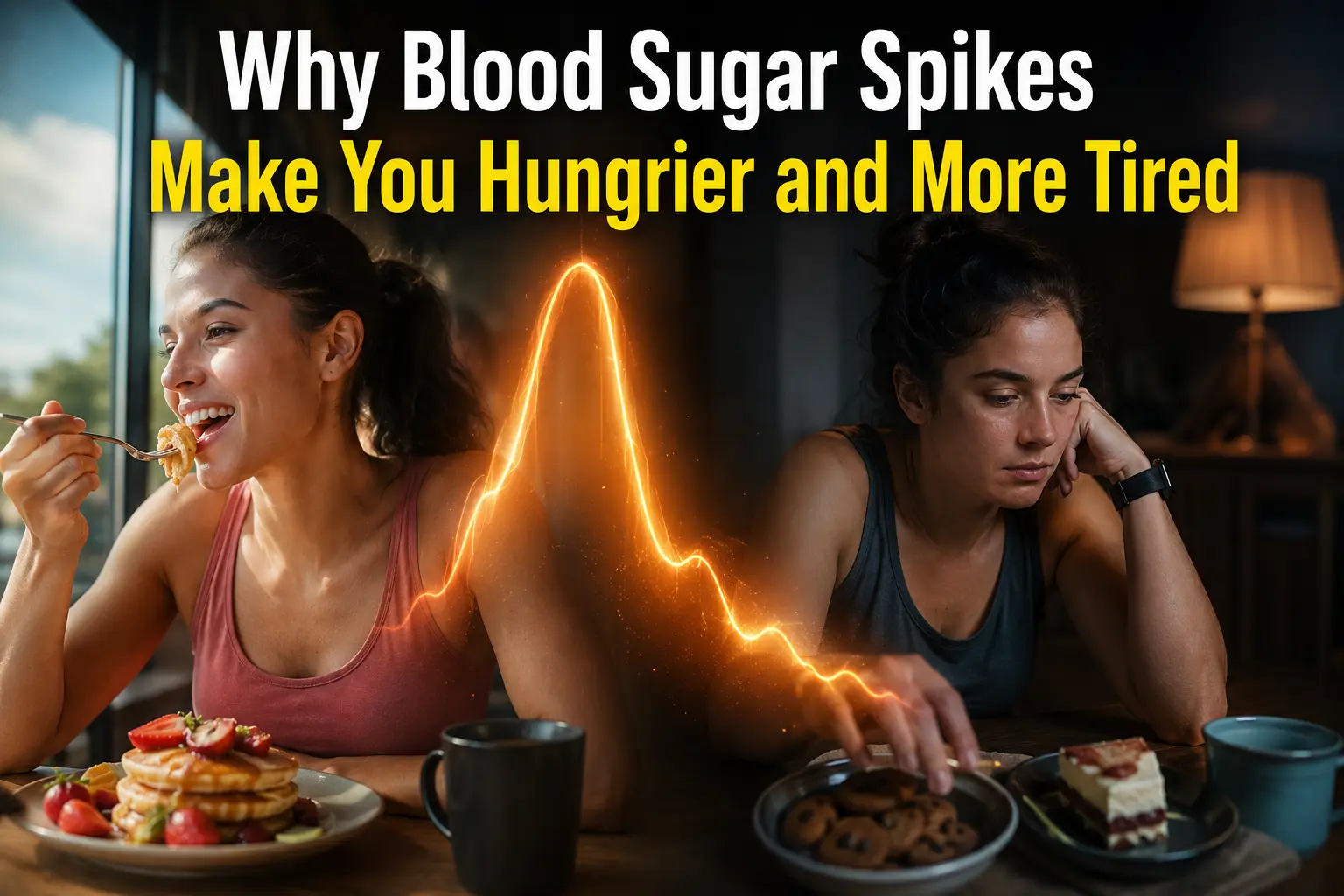
You eat something.
At first, you feel fine.
Maybe even energized.
Then, a few hours later…
It hits you.
You feel tired.
You feel hungry again.
And suddenly, you crave something sweet or heavy.
And it doesn’t make sense.
Because you already ate.
So why are you hungry again so fast?
The answer is not willpower.
It’s blood sugar.
Quick Truth
What Happens When Blood Sugar Spikes
When you eat high-carb or high-sugar foods:
- Blood sugar rises quickly
- Insulin is released to bring it down
- Energy is pushed into cells.
At first:
You feel a burst of energy.
But what comes next matters more.
The Crash Phase (Where Hunger Starts Again)
If blood sugar drops too fast:
- Energy levels fall sharply
- Brain signals fatigue
- Hunger signals increase
- Cravings for quick energy appear.
So your body says:
“We need food again.”
Even if you just ate.
Why This Leads to Constant Eating
This cycle repeats:
spike → crash → hunger → eating → spike → crash
Over time, it creates:
- Frequent snacking
- Sugar cravings
- Energy instability
- Overeating patterns
Why Your Brain Confuses This With Hunger
Your brain doesn’t measure glucose directly.
It responds to:
- Energy availability
- Fatigue signals
- Hormonal responses
So a crash feels like:
“I’m hungry again.”
But it’s actually:
“My energy just dropped.”
The Hidden Problem Most People Miss
Many people think:
- “I didn’t eat enough.”
- “My metabolism is fast.”
- “I need more food.”
But the real issue is often:
unstable blood sugar regulation
Stable vs Unstable Blood Sugar Response
| Stable Blood Sugar | Unstable Blood Sugar |
|---|---|
| Steady energy | Energy spikes and crashes |
| Longer fullness | Quick return of hunger |
| Low cravings | Frequent sugar cravings |
| Balanced mood | Irritability and fatigue |
The Energy Crash Loop
blood sugar spike → insulin response → crash → hunger → cravings → eating again
This loop silently drives:
- Fatigue eating
- Sugar dependency
- Late-night cravings
- Overeating cycles
Insight
This article completes your full behavioral + metabolic framework:
→ Sleep cluster
Why Lack of Sleep Makes You Gain Weight Over Time
→ Craving cluster
Why You Crave Sugar at Night
→ Stress cluster
Why Stress Makes You Eat More Even When You’re Not Hungry
→ Overeating cluster
Why You Can’t Stop Eating Even When You’re Full
Frequently Asked Questions (FAQs)
Because sugar spikes and crashes your blood glucose.
It is usually an energy crash response, not true Hunger.
Yes. Frequent spikes and crashes can increase calorie intake and cravings.
Because insulin response and glucose shifts can affect energy stability.
By reducing rapid sugar spikes and eating more balanced meals.