
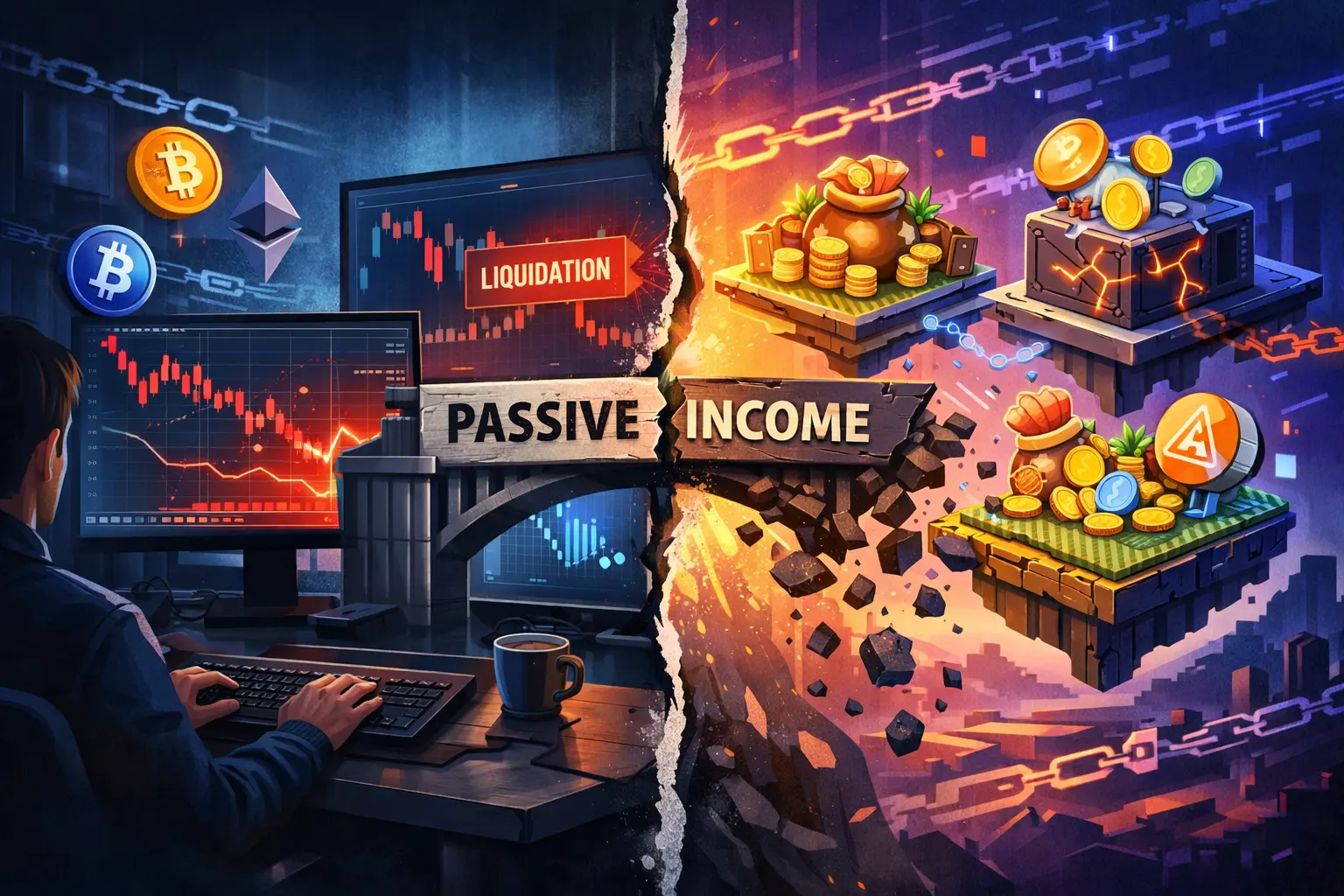
Crypto passive income has become one of the most aggressively marketed narratives in digital finance. Staking rewards, DeFi yields, and lending returns promise effortless income streams in exchange for holding assets.
These systems are not truly passive; they carry financial risk and operate in unstable, lightly regulated markets.
Understanding these risks is not optional. It is the difference between sustainable yield generation and irreversible capital loss.
Many of these risks become clearer when understanding how DeFi Yield Farming: Complete Risk vs Reward Guide.
A Clear Breakdown of Where Crypto Passive Income Really Breaks Down
1. What Crypto Passive Income Actually Means
Crypto passive income refers to earning returns from holding or deploying crypto assets without active trading.
Common mechanisms include:
- Staking (locking tokens to secure networks)
- Lending (providing liquidity to borrowers)
- Yield farming (liquidity provisioning in DeFi protocols)
- Airdrop farming/incentive programs
While structurally different, all share one core reality:
You are exchanging liquidity and control for yield.
2. Core Risk Categories in Crypto Passive Income
Crypto income risks do not exist in isolation; they are interconnected and layered across multiple levels.
2.1 Market Risk (Price Volatility)
Even if yields are stable, the underlying asset value is not.
Key issue:
- Token price drops can outweigh earned rewards.
Example:
- 15% APY on a token that drops 40% = net loss
It is the most underestimated risk among beginners.
2.2 Smart Contract Risk (Code Failure)
DeFi protocols run on smart contracts—self-executing code.
Risks include:
- Bugs in contract logic
- Exploits and hacks
- Flash loan attacks
- Poorly audited protocols
Once exploited, funds are often irrecoverable.
2.3 Platform Custody Risk (Centralized Failure)
Centralized yield platforms (CeFi lending and exchanges) introduce counterparty risk.
Possible failures:
- Insolvency or bankruptcy
- Mismanagement of user funds
- Withdrawal freezes
- Regulatory shutdowns
Users often lose access to assets without warning.
2.4 Liquidity Risk (Exit Restrictions)
Liquidity risk occurs when you cannot easily exit positions.
Common causes:
- Locked staking periods
- Illiquid DeFi pools
- Market stress events
- Withdrawal caps
This risk becomes critical during market crashes.
2.5 Impermanent Loss (DeFi Liquidity Pools)
As token prices diverge within a liquidity pool, providers may suffer impermanent loss, meaning their pooled assets can be worth less than a simple buy-and-hold position.
Mechanism:
- You add two tokens into a liquidity pool.
- Price imbalance occurs
- Withdrawal value is lower than the value of holding the assets separately.
It is “impermanent” only if conditions revert—often they do not.
2.6 Regulatory Risk
Crypto yield systems often operate in unclear legal frameworks.
Risks include:
- Sudden bans or restrictions
- Tax reclassification of rewards
- Platform delistings
- Geo-blocking of services
Regulatory pressure is increasing globally.
2.7 Token Inflation Risk
Many high-yield platforms fund rewards via token emissions.
It creates:
- Continuous dilution
- Downward price pressure
- Unsustainable APY models
High yields often signal hidden inflation mechanics, not real profit.
2.8 Stablecoin Depeg Risk
Stablecoin-based yield strategies assume price stability.
Risks:
- Depegging events (e.g., $1 → $0.90 or lower)
- Reserve transparency issues
- Algorithmic failure
A stable yield becomes meaningless if the principal value collapses.
3. Risk Comparison Table (By Income Type)
| Income Type | Main Risk Exposure | Risk Level | Key Weak Point |
|---|---|---|---|
| Staking | Market + Lock-up risk | Medium | Price volatility during lock period |
| CeFi Lending | Custody + regulatory risk | High | Platform insolvency |
| DeFi Yield Farming | Smart contract + impermanent loss | Very High | Protocol exploits |
| Stablecoin Yield | Depeg + issuer risk | Medium-High | Stablecoin collapse |
4. Hidden Structural Risks Most Investors Miss
Beyond obvious risks, crypto passive income contains deeper systemic vulnerabilities:
4.1 Yield Sustainability Illusion
High APYs are often:
- Subsidized by token emissions
- Temporary incentive programs
- Liquidity acquisition strategies
Once incentives stop, yields collapse.
Different strategies carry different levels of risk—see this crypto staking vs yield farming comparison to understand which approach is safer.
4.2 Composability Risk (DeFi Cascade Failure)
DeFi protocols are interconnected.
A failure in one protocol can:
- Trigger liquidation cascades
- Collapse dependent platforms
- Amplify systemic losses
It creates a “domino risk” structure.
4.3 Behavioral Risk (Overexposure)
Human behavior amplifies losses:
- Yield chasing
- Over-leveraging
- Ignoring token fundamentals
- Reinvesting unrealized gains
It is often the final layer of failure.
5. Risk Reduction Strategies (Practical Framework)
Risk is unavoidable, but it can be structured effectively:
- Diversify across income types (staking, lending, DeFi)
- Prioritize audited protocols only
- Avoid excessive APY chasing (>20–30% unsustainable range)
- Limit exposure to locked assets
- Prefer overcollateralized lending systems
- Monitor token emission schedules
- Use stablecoin diversification strategies.
The objective is not maximum yield—it is risk-adjusted yield stability.
Platform selection plays a major role in exposure to liquidity and counterparty risks, which vary widely across the best DeFi platforms for passive income
Frequently Asked Questions (FAQs)
Is crypto passive income safe?
No. It is structurally risk-bearing and depends heavily on platform integrity, market conditions, and protocol security.
What is the biggest risk in crypto staking?
Price volatility of the staked asset, combined with lock-up restrictions.
Can DeFi yield farming lead to total loss?
Yes. A smart contract vulnerability or liquidity collapse can wipe out capital entirely.
Are stablecoin yields risk-free?
No. It carries depeg, issuer, and regulatory risks.
Why are crypto yields so high compared to banks?
High yields often reflect higher risk, token inflation, or unsustainable incentive models.