
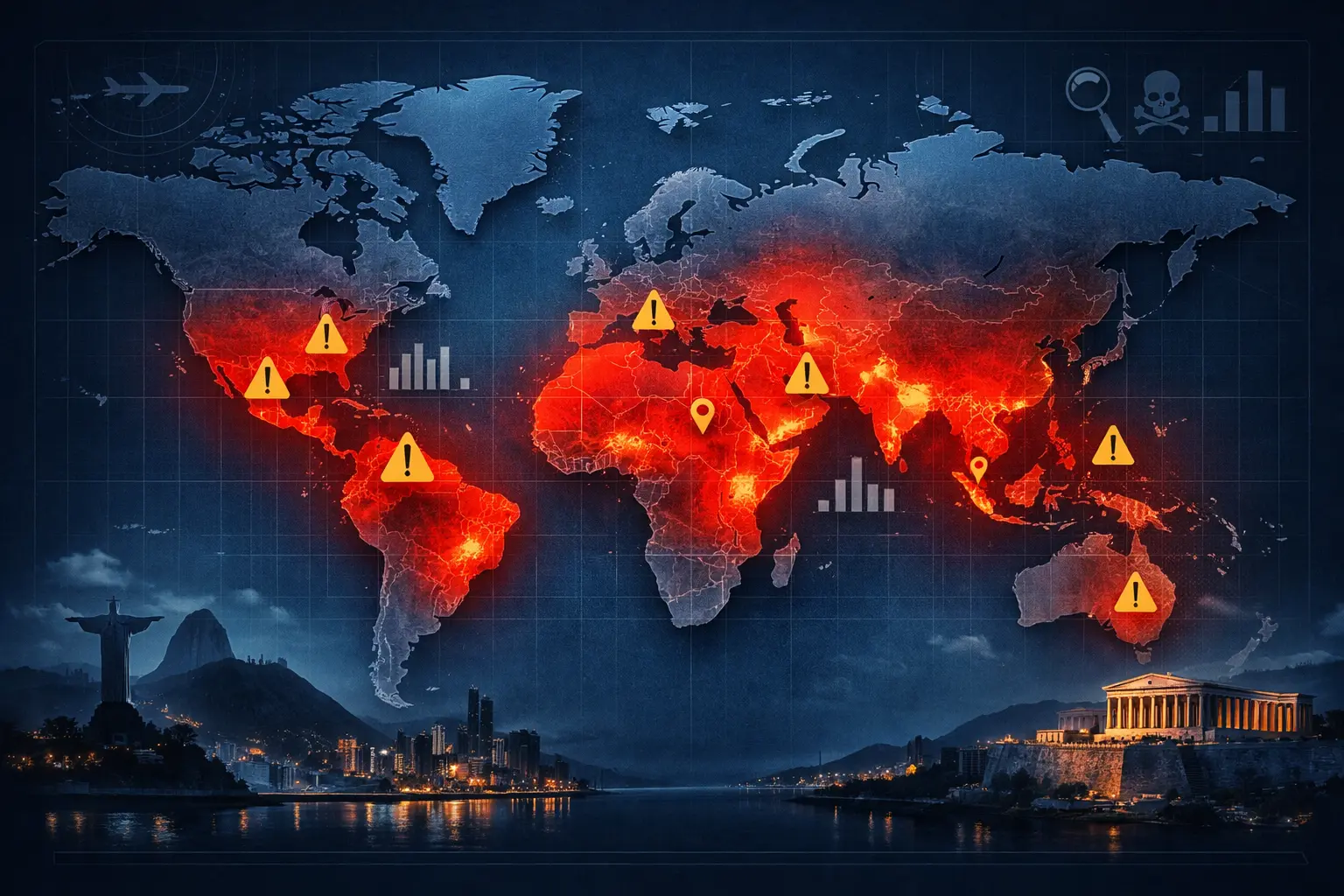
Crime varies widely across the world.
But certain countries consistently rank higher due to systemic challenges, weak institutions, or economic pressure.
Below is a data-informed global snapshot, based on aggregated indicators from public datasets (crime indices, homicide rates, and international reports)
| Rank | Country | Crime Index* | Primary Drivers |
|---|---|---|---|
| 1 | Venezuela | 83–85 | Economic collapse, organized crime |
| 2 | Papua New Guinea | 80–82 | Weak policing, tribal conflict |
| 3 | Afghanistan | 78–80 | Conflict, instability |
| 4 | South Africa | 75–78 | Violent crime, inequality |
| 5 | Honduras | 74–76 | Gangs, drug trafficking |
| 6 | Trinidad and Tobago | 72–74 | Firearm violence, gangs |
| 7 | Guyana | 70–72 | Robbery, violent crime |
| 8 | El Salvador | 68–70 | Gang legacy, security transition |
| 9 | Brazil | 65–68 | Urban violence, organized crime |
| 10 | Peru | 63–66 | Street crime, drug trade |
*Crime Index is a composite estimate based on crowd-sourced data (e.g., Numbeo) and comparative indicators. It reflects perceived and reported crime levels, not exact official crime counts.
What Drives High Crime Rates Globally
Crime is rarely random.
It tends to follow patterns shaped by structural conditions.
Economic Pressure and Inequality
High unemployment and inflation increase survival-driven crimes.
Large wealth gaps often correlate with higher violent crime rates.Weak Institutions and Corruption
If law enforcement has limited capacity or low public trust, crime rates tend to increase.
Corruption weakens deterrence mechanisms and creates conditions that allow organized networks to form, expand, and operate with reduced risk of enforcement.Organized Crime Ecosystems
Drug trafficking routes and gang systems amplify violence.
These networks often operate across borders, making them harder to control.Political Instability and Conflict
Fragile governments struggle to maintain order.
Conflict zones create environments where crime and violence overlap.
How to Interpret These Rankings
Some countries on this list are improving.
For example, El Salvador has seen notable declines in homicide rates in recent years.
Data Limitations
Crime data is complex.
Numbeo and the United Nations Office on Drugs and Crime (UNODC) both provide useful data, though differences in methodology mean their results are not always directly comparable.
Crime Reflects Deeper Systems
High crime rates are often symptoms, not root causes.
They reflect deeper issues—economic stress, governance gaps, and social inequality.
Frequently Asked Questions (FAQs)
Which country shows the highest crime rates based on available global data?
Venezuela frequently ranks at the top due to economic collapse and widespread organized crime.
Are these countries unsafe for travelers?
Not entirely. Risk levels vary by region, with many areas remaining safe and under effective control.
Which source provides the most reliable crime data?
Organizations like UNODC provide official data, while platforms like Numbeo offer real-time perception-based insights.
Is global crime increasing?
It depends on the region. Some countries are improving, while others face rising pressures due to economic and political instability.
- The Ultimate Guide to Cost of Living Around the World
- Top 10 Best Countries Where Your Money Goes the Farthest
- Top 10 Countries with the Cleanest Air in the World