
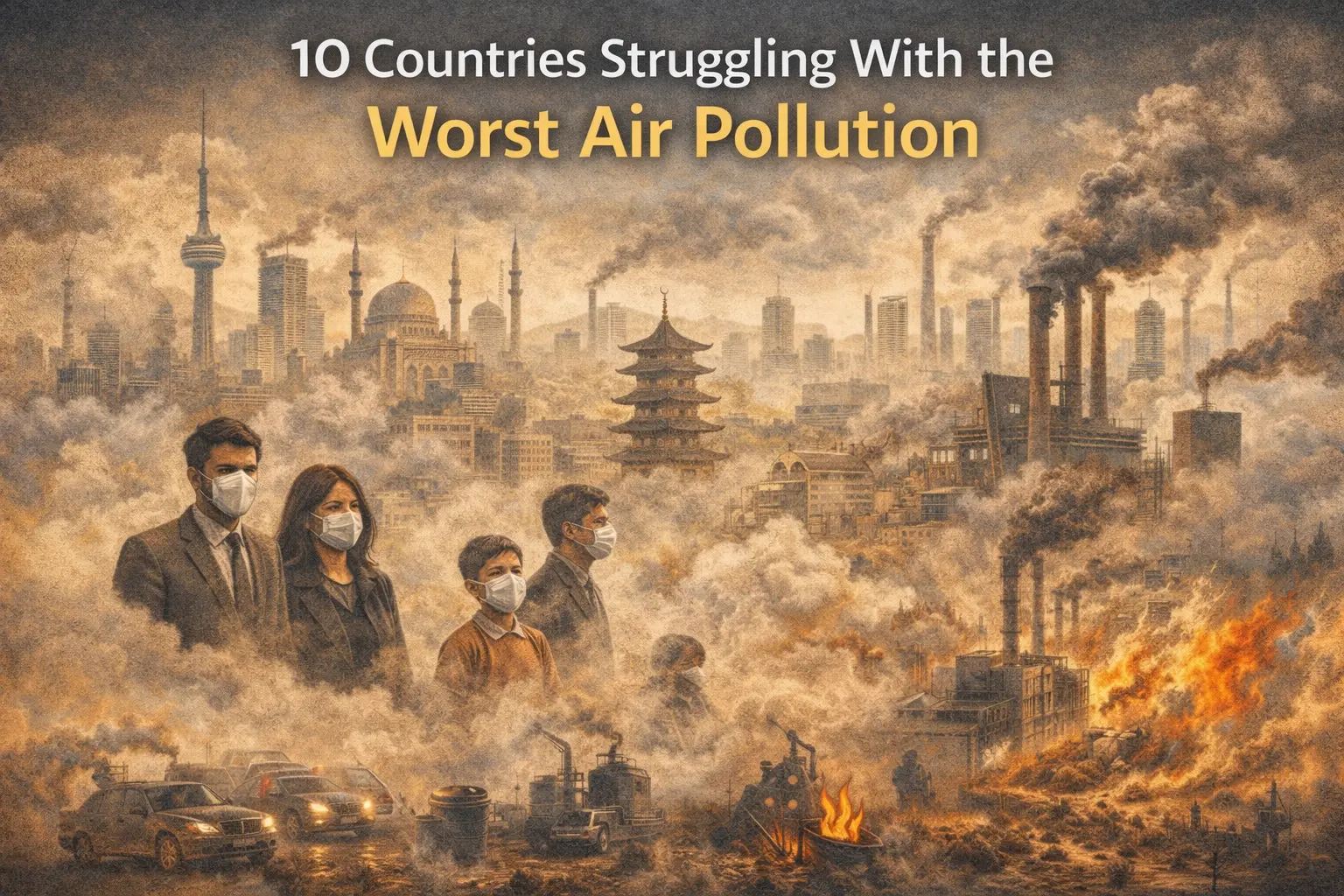
Air pollution is now one of the most serious environmental and public health challenges of the modern era. Microscopic particles from vehicle emissions, coal power plants, industrial activity, and construction dust accumulate in the atmosphere, creating dangerous levels of pollution in many cities.
According to the World Health Organization, air pollution contributes to millions of premature deaths every year, increasing the risk of respiratory disease, heart conditions, and stroke.
In fast-growing urban economies, population growth, industrial activity, and weak environmental regulation often aggravate the problem.
Global monitoring data and environmental assessments indicate that the countries below rank among the world’s most polluted.
The severity of the problem differs between cities in these countries.
But national patterns show persistent air quality challenges that affect millions of people daily.
Countries With the Worst Air Pollution
1. Bangladesh
Bangladesh consistently ranks among the most polluted countries in global air quality reports.
Major drivers include:
- Brick kilns surrounding cities
- Traffic congestion
- Construction dust
- Industrial emissions
The capital, Dhaka, frequently records extremely high PM2.5 levels, particularly during the dry season.
2. Pakistan
Pakistan faces severe winter smog, particularly in the Punjab region.
The city of Lahore often records hazardous air quality due to:
- Crop burning
- Industrial emissions
- Vehicle pollution
- Weather conditions that trap smog
These episodes can disrupt schools, transportation, and public life.
3. India
Indian cities frequently rank among the highest in global pollution levels.
The capital, New Delhi, frequently experiences dangerous air quality during the winter months due to:
- Agricultural burning
- Traffic emissions
- Construction dust
- Coal-fired power plants
Air pollution has become a major public health issue across northern India.
4. China
China once faced some of the worst air pollution levels in the world during rapid industrialization.
Cities such as Beijing were notorious for heavy smog in the early 2010s.
Government policies have since improved air quality in many regions, but pollution remains a challenge in industrial areas.
5. Iran
Air pollution is a major issue in several Iranian cities.
The capital, Tehran, experiences smog caused by:
- Heavy traffic
- Industrial pollution
- Geographic conditions that trap polluted air
Seasonal temperature inversions often worsen the situation.
6. Mongolia
Winter air pollution in Ulaanbaatar can reach extreme levels.
The primary cause is the burning of coal in household stoves used for heating during long, harsh winters.
Cold temperatures and valley geography trap smoke close to the ground.
7. Afghanistan
Urban air quality in Kabul has deteriorated significantly due to:
- Vehicle emissions
- Low-quality fuel
- Waste burning
- Unregulated construction
Air pollution has become a growing health concern in the city.
8. Indonesia
Indonesia faces periodic air pollution crises caused by forest and peatland fires.
These fires produce thick haze that spreads across Southeast Asia and affects cities such as Jakarta.
Transboundary haze events have repeatedly affected neighboring countries.
9. Nepal
Air pollution in Kathmandu has increased due to:
- Rapid urban growth
- Vehicle emissions
- Construction dust
- Limited environmental regulation
The city’s valley geography also traps polluted air.
10. Egypt
The capital, Cairo, has long struggled with severe air pollution.
Major contributors include:
- Traffic congestion
- Industrial activity
- Agricultural burning
- Dust from the surrounding deserts
These factors combine to produce persistent smog conditions.
| Source | Primary Pollutants | Impact |
|---|---|---|
| Vehicle emissions | PM2.5, nitrogen oxides | Urban smog and respiratory disease |
| Coal power plants | Sulfur dioxide, particulate matter | Regional pollution and acid rain |
| Industrial activity | Heavy metals and toxic gases | Long-term environmental damage |
| Agricultural burning | Fine particulate matter | Seasonal smog events |
| Construction dust | PM10 particles | Urban air quality deterioration |
| Country | Major Source | Affected Cities |
|---|---|---|
| Bangladesh | Brick kilns and traffic | Dhaka |
| Pakistan | Crop burning and industry | Lahore |
| India | Agricultural burning and traffic | New Delhi |
| China | Industrial emissions | Beijing |
| Indonesia | Forest fires | Jakarta |
Policy Responses and Environmental Efforts
Many countries are working to reduce pollution with new policies and environmental initiatives.
Key strategies include:
Clean energy transitions
Many governments are investing in renewable energy to reduce reliance on coal power.
Vehicle emission regulations
Stricter standards aim to reduce pollution from transportation.
Urban air monitoring systems
Real-time air quality monitoring informs citizens and guides environmental policy.
Global organizations such as the United Nations Environment Programme and the World Health Organization continue to support international efforts to improve air quality worldwide.
Frequently Asked Questions (FAQs)
What causes the worst air pollution in the world?
The most common causes include vehicle emissions, coal power plants, industrial activity, agricultural burning, and construction dust.
Which region has the worst air pollution?
South Asia consistently records some of the world’s highest pollution levels, especially in cities across India, Pakistan, and Bangladesh.
Why are winter pollution levels often worse?
Cold weather can trap polluted air near the ground through a phenomenon known as temperature inversion.
How does air pollution affect health?
Air pollution increases the risk of asthma, lung disease, heart disease, stroke, and premature death.
What is PM2.5?
PM2.5 refers to fine particulate matter smaller than 2.5 micrometers, which can penetrate deep into the lungs and bloodstream.
Can governments reduce air pollution?
Yes. Policies such as renewable energy adoption, stricter emissions standards, and improved public transportation can significantly reduce pollution.
Is air pollution getting worse globally?
Some countries have successfully reduced pollution through policy measures, yet developing cities experiencing rapid growth face increasing environmental challenges.
What organizations track global air pollution?
Groups including the World Health Organization and the United Nations Environment Programme oversee international monitoring of environmental conditions.
- The Growing Global Threat of Antibiotic Resistance
- 10 Countries With the Most Severe Youth Unemployment Crisis
- 10 Countries Most Vulnerable to Climate Change