

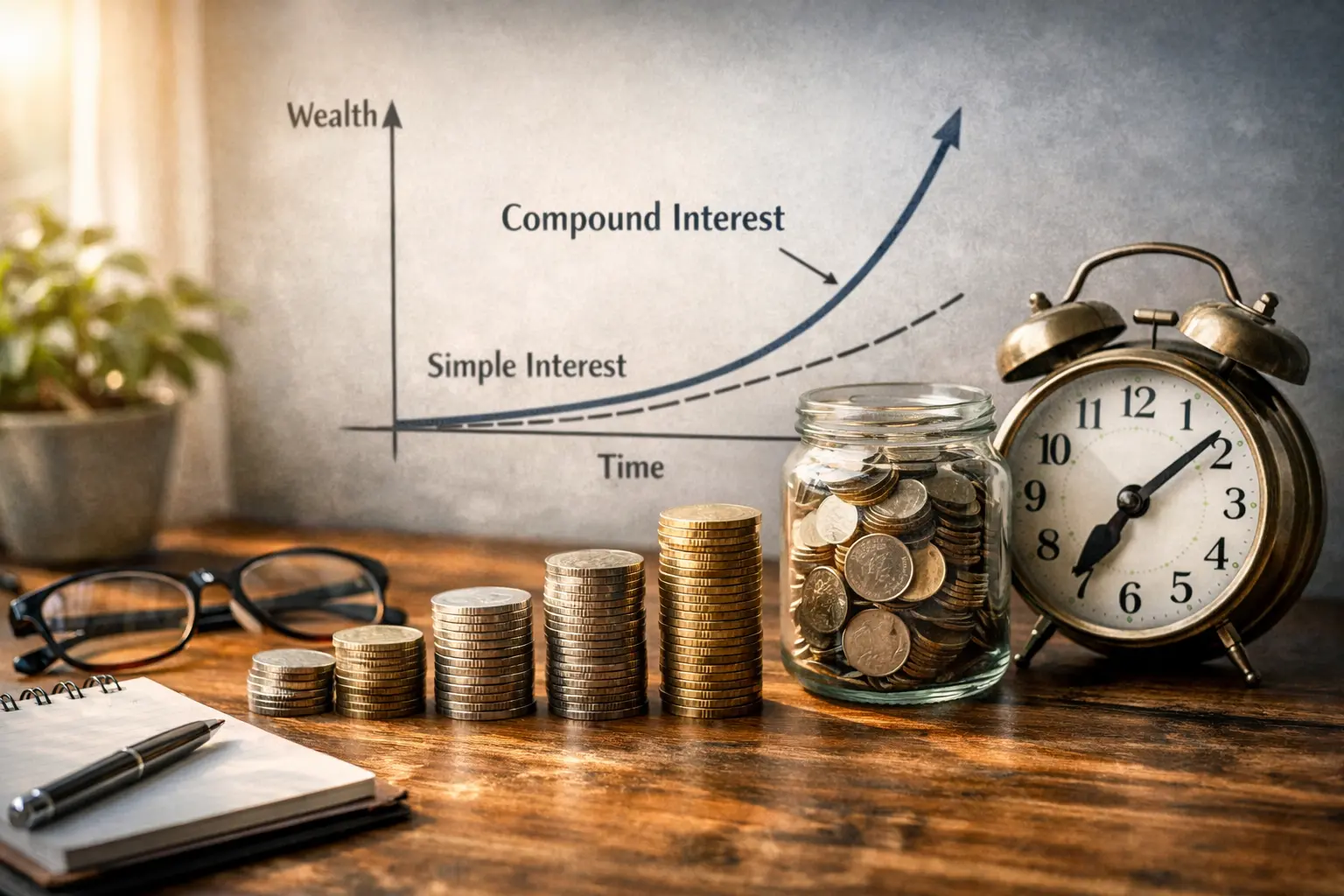
Compound interest is not just “interest earning interest.”
It is exponential growth applied to money.
Unlike simple interest — where returns are calculated only on your original principal — compound interest adds previous gains to the base. Future returns are calculated based on an increasing total balance.
That growth curve is not linear.
It bends upward.
The Formula Behind Compounding
The compound interest formula:
𝐴 = 𝑃 (1 + 𝑟 / 𝑛)𝑛𝑡Where:
- P = principal (starting amount)
- r = annual interest rate
- n = number of compounding periods per year
- t = number of years
- A = final amount
The most powerful variable in this equation is not the rate.
It is time.
Simple Interest vs Compound Interest
| Type | How It Grows | Long-Term Effect |
|---|---|---|
| Simple Interest | Earns on principal only | Linear growth |
| Compound Interest | Earns on principal + past gains | Exponential growth |
Over short periods, the difference is small.
Over the decades, the difference is massive.
A Real Example: Starting Early vs Starting Late
Assume:
- $200/month invested
- 8% annual return
- Compounded annually
Investor A
Starts at 25 and invests until 65.
Investor B
Starts at 35 and invests until 65.
| Investor | Years Invested | Total Contributed | Final Value |
|---|---|---|---|
| A | 40 | $96,000 | ~$622,000 |
| B | 30 | $72,000 | ~$298,000 |
Investor A contributes only $24,000 more.
But ends with more than double.
This is the time advantage effect — often demonstrated in long-term investing strategies endorsed by investors like Warren Buffett, whose wealth was built largely through decades of compounding rather than short-term speculation.
Why Time Outperforms Contribution Size
Most individuals concentrate on the amount rather than the strategy.
But compounding rewards:
- Early start dates
- Consistency
- Patience
- Reinvestment
Mathematically, the later years produce the majority of growth.
In long-term projections:
- The first 10 years build momentum.
- The final 10 years generate the largest gains.
This is exponential acceleration.
The Three Drivers of Compound Growth
Time Horizon
The longer money remains invested, the steeper the growth curve.Rate of Return
Higher returns amplify growth — but volatility increases risk.Reinvestment
Reinvest dividends and interest to let compounding work.
The Psychological Barrier to Compounding
Compounding feels slow in the beginning.
- Year 1: Minimal visible growth.
- Year 5: Noticeable.
- Year 20: Significant.
- Year 30+: Transformational.
Most people give up before the growth curve starts to rise.
Studies in behavioral finance, such as those by Daniel Kahneman, reveal that humans tend to choose immediate rewards over delayed, larger gains.
Compounding requires resisting that bias.
What Disrupts Compounding?
- Withdrawing early
- Interrupting contributions
- Paying high fees
- Taking excessive short-term risk
- Panic selling during downturns
Market volatility slows short-term growth, but historically diversified long-term investing has demonstrated recovery patterns over extended periods.
The Role of Inflation
Compound interest builds nominal wealth.
But inflation reduces purchasing power.
Real wealth growth = Return – Inflation rate.
Long-term investors typically go for diversified stocks rather than just low-interest savings.
Where Compound Interest Applies
It works in:
- Savings accounts
- Bonds
- Retirement accounts
- Dividend reinvestment plans
- Index funds
It also applies conceptually to:
- Business reinvestment
- Skill development
- Health habits
- Knowledge accumulation
Compounding is a universal growth principle.
How to Apply Compound Interest Strategically
- Begin immediately — even with small contributions.
- Automate contributions.
- Reinvest dividends.
- Avoid high-fee investment products.
- Extend your time horizon.
- Stay consistent through market cycles.
Consistency + time > intensity.
Frequently Asked Questions (FAQs)
How often should interest compound?
More frequent compounding increases returns slightly, but time horizon matters far more.
Is compound interest guaranteed?
Savings accounts earn a steady interest, whereas investment returns are unpredictable.
Can you lose money while compounding?
Yes, in market-based investments, short-term losses occur. Long-term discipline reduces risk impact.
What is the best rate of return?
Higher returns increase growth, but risk tolerance must align with strategy.
Is it too late to start at 40 or 50?
No. Compounding still works — but contribution size becomes more important as time shortens.
- Why Most People Struggle to Save Money
- How to Build an Emergency Fund When Money Is Tight
- Early Investing Mistakes That Destroy Compounding Power