

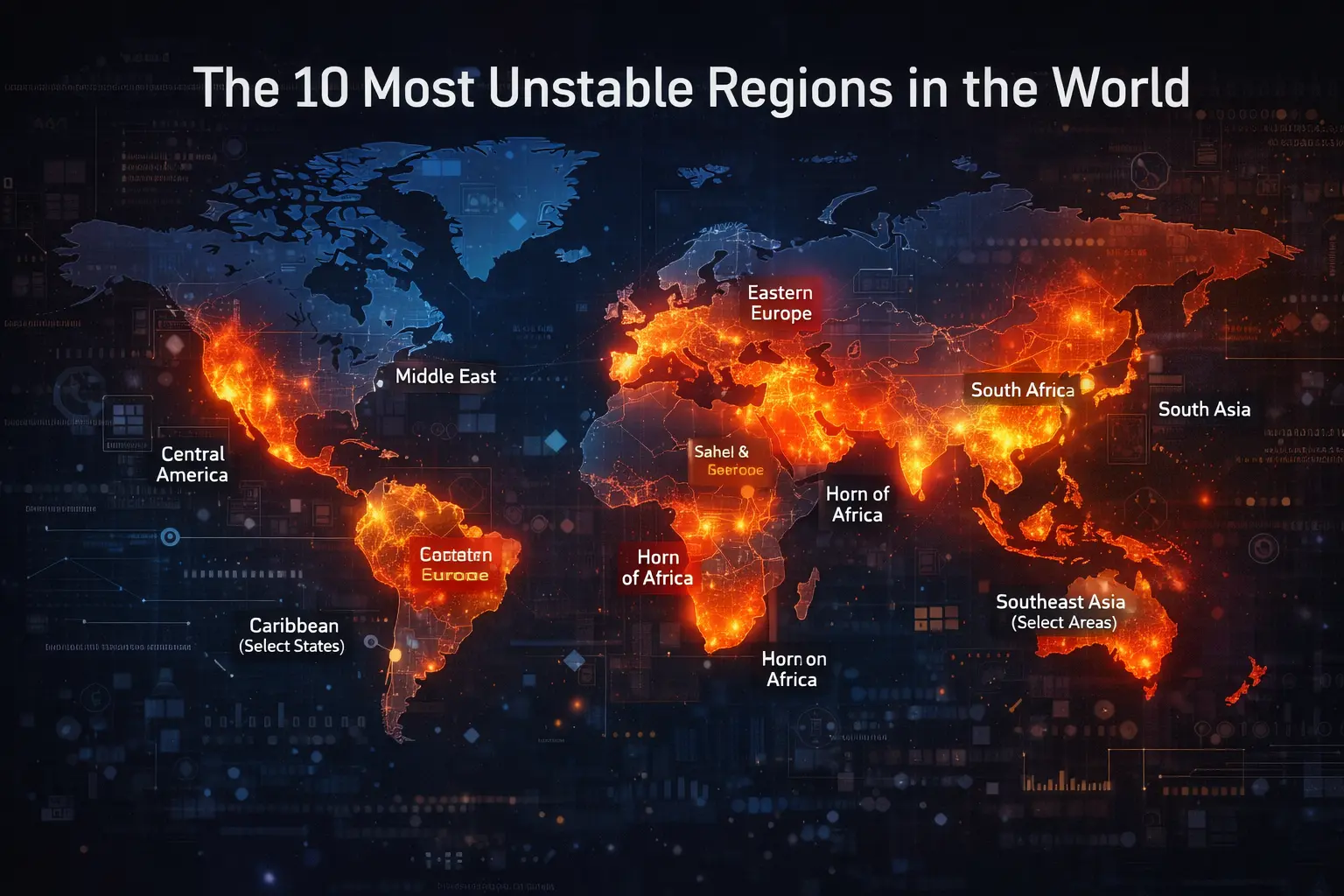
Global instability now extends far beyond isolated conflict zones.
Economic pressure, political fragmentation, climate stress, and security threats are reshaping entire regions—often with consequences that extend far beyond national borders.
Understanding where instability is most concentrated helps explain global migration patterns, energy risk, market volatility, and long-term geopolitical shifts.
Below are the 10 most unstable regions in the world, based on persistent structural risk rather than short-term headlines.
-
The Middle East
The Middle East remains among the world’s most volatile regions.
Long-standing conflicts, proxy wars, and sectarian divisions continue to destabilize large parts of the region.
Energy security, regional rivalries, and unresolved political transitions keep tensions high. Eastern Europe
Eastern Europe faces ongoing instability driven by war, security realignments, and economic pressure.
Military conflict, sanctions, and shifting alliances have altered regional stability and trade flows.
The region’s proximity to major global powers amplifies its geopolitical significance.The Sahel (West and Central Africa)
The Sahel is experiencing a deepening crisis.
Military coups, insurgency, food insecurity, and weak governance have created chronic instability across multiple countries.
Climate change further intensifies resource competition and displacement.Horn of Africa
This region struggles with overlapping crises.
Civil conflict, drought, famine risk, and fragile political systems undermine long-term stability.
Humanitarian emergencies remain persistent and under-resolved.South Asia
High population density in South Asia intensifies political and economic pressures.
Border tensions, internal unrest, and uneven development pose significant challenges to stability.
Climate vulnerability adds another layer of long-term risk.Central America
Central America faces instability rooted in violence and weak institutions.
Organized crime, corruption, and limited economic opportunity drive migration and social strain.
The region’s instability directly threatens North America and regional security.The Caucasus
The Caucasus remains fragile due to unresolved territorial disputes.
Political fragmentation and competing regional influences keep tensions unresolved.
Small escalations can quickly trigger wider regional consequences.Parts of Southeast Asia
Despite strong economic growth, parts of Southeast Asia face rising instability risks.
Ethnic conflict, political unrest, and governance challenges persist in specific areas.
Strategic competition among major powers adds pressure.The Caribbean (Select States)
Some Caribbean nations struggle with structural instability.
High debt, crime, and vulnerability to climate disasters weaken resilience.
Global shocks disproportionately impact smaller economies.Northern South America
Northern South America experiences political and economic strain.
Institutional erosion, inflation, and migration pressures destabilize parts of the region.
Cross-border impacts continue to affect neighboring states.
Why Regional Instability Matters Globally
Regional instability does not remain local.
It affects:
- Global energy and commodity markets
- Migration and refugee flows
- Trade routes and supply chains
- Financial market volatility
- International security and diplomacy
In an interconnected world, regional instability spreads fast.
Frequently Asked Questions (FAQs)
What defines an unstable region?
Long-term stability remains elusive in regions facing sustained political, economic, security, or humanitarian challenges.
Are unstable regions always at war?
No. Governance breakdowns, economic collapse, and environmental stress have destabilized many regions despite the absence of war.
Can instability improve over time?
Yes, but recovery often requires institutional reform, investment, and sustained political stability.
How does instability affect global markets?
It increases risk premiums, disrupts supply chains, and fuels uncertainty in energy and financial markets.
Is instability increasing worldwide?
Many indicators suggest instability is becoming more widespread and interconnected rather than isolated.
Do unstable regions affect migration trends?
Yes. Most large migration flows originate from unstable or high-risk regions.
Can global cooperation reduce instability?
Targeted diplomacy, development aid, and conflict prevention can help—but results vary widely.
Do unstable regions affect migration trends?
Yes. Most large migration flows originate from unstable or high-risk regions.
Can global cooperation reduce instability?
Targeted diplomacy, development aid, and conflict prevention can help—but results vary widely.
- The 10 Biggest Problems in Argentina Today
- The Most Influential Countries Shaping Global Politics Today
- The 10 Biggest Problems in Egypt Today