
Crypto Is Built on Trust—But Not Every Cryptocurrency Deserves It
One of the biggest risks in cryptocurrency isn’t always market volatility.
Sometimes, it’s the people behind the project.
Over the past decade, the crypto industry has witnessed remarkable innovation alongside spectacular failures. While blockchain technology was created to reduce reliance on centralized institutions, many newer cryptocurrencies remain heavily influenced by founders, venture capital firms, or small groups of insiders.
Large token allocations.
Private investor unlocks.
Developer-controlled treasuries.
Admin keys that can change the rules.
These features are common across thousands of projects, yet many investors overlook them until problems emerge.
History has shown that excessive insider control can create significant risks. Large token unlocks may place downward pressure on prices, concentrated ownership can reduce decentralization, and governance controlled by only a handful of participants may not always align with the interests of the broader community.
By contrast, a smaller group of cryptocurrencies was designed with a different philosophy.
Some launched without venture capital funding.
Others distributed coins through public mining rather than private sales.
Several projects operate without founder allocations, pre-mining, or any central authority empowered to alter monetary policy.
These characteristics do not guarantee investment success.
Nor do they make a cryptocurrency immune to market manipulation or price volatility.
However, they can reduce one important source of risk: manipulation by founders or insiders.
Investors who want to understand why founder control matters should also look at real-world examples. Our article, 10 Crypto Projects Involved in Founder Manipulation Scandals, examines several high-profile cases where insider actions, misleading practices, or founder misconduct contributed to major losses and regulatory investigations. It highlights why evaluating a project’s governance and token distribution can be just as important as analyzing its technology.
For long-term investors, understanding who controls a network can be just as important as understanding its technology.
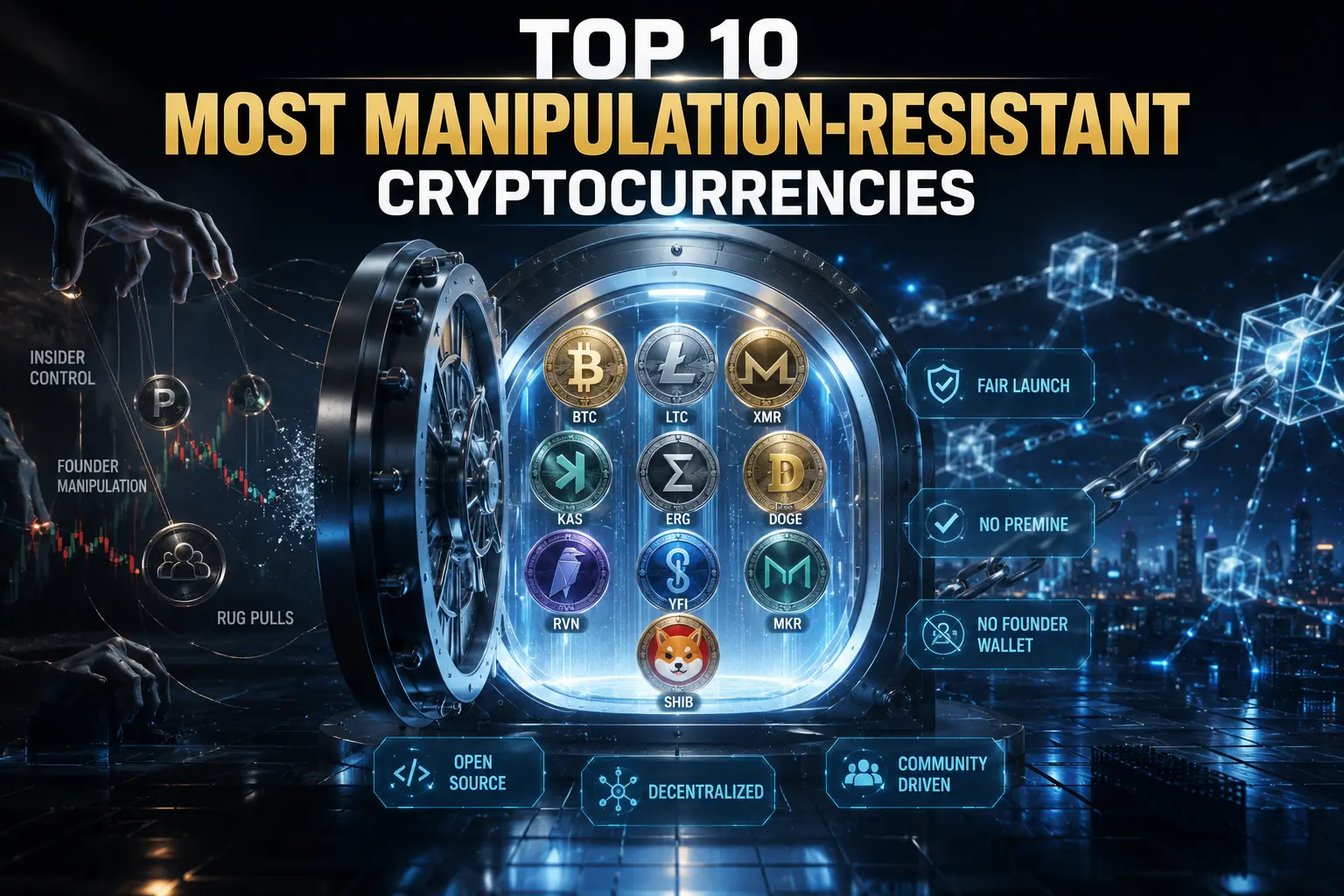
This article explores ten cryptocurrencies that are widely regarded as among the cleanest in terms of launch structure, token distribution, and decentralization. While each project has its own strengths and trade-offs, all were selected because they demonstrate characteristics that make them comparatively more resistant to insider influence than many newer crypto assets.
What Makes a Cryptocurrency More Resistant to Manipulation?
No cryptocurrency is completely impossible to manipulate.
Large investors—often called whales—can influence prices through substantial buying or selling. News events, macroeconomic conditions, leveraged trading, and investor sentiment can also produce dramatic price swings.
When we refer to manipulation-resistant cryptocurrencies, we are discussing something different.
The focus is on whether a project’s founders, early investors, or governing organization possesses disproportionate control over the network or its token supply.
Several characteristics generally indicate a healthier and more transparent ecosystem.
Fair Launch
A fair launch means that the public had the same opportunity to acquire the cryptocurrency as everyone else.
Rather than distributing large portions of the supply to insiders before launch, fair-launch projects typically release coins through public mining or open participation.
This reduces the likelihood that a small group controls a significant percentage of the total supply from the outset.
No Pre-Mine
Some blockchain projects allocate millions—or even billions—of tokens before opening participation to the public.
These pre-mined allocations are often reserved for founders, private investors, foundations, or development teams.
While not inherently problematic, large pre-mines increase the possibility that insiders could influence the market by selling substantial holdings.
Projects without a pre-mine avoid this concern because every coin enters circulation according to publicly defined rules.
Limited Founder Ownership
Founder incentives can help fund development.
However, when founders retain a large percentage of the total supply, investors assume additional risk.
The concentration of billions of dollars’ worth of tokens in a single wallet may increase its potential to influence market sentiment or liquidity.
Many of the projects featured in this list intentionally minimized—or eliminated—founder allocations.
Transparent Monetary Policy
Predictability matters.
Investors should know how many coins exist today, how many will exist tomorrow, and under what conditions new coins are created.
Transparent issuance policies help reduce uncertainty while increasing confidence in the long-term integrity of a cryptocurrency.
Decentralized Governance
Healthy blockchain ecosystems distribute decision-making across their communities.
When protocol upgrades require broad consensus among developers, validators, miners, or token holders, the network becomes less dependent on any single organization.
Although governance models vary across projects, decentralization generally reduces the ability of any single group to make unilateral decisions.
Open-Source Development
Transparency extends beyond token distribution.
Most of the strongest blockchain projects publish their source code openly, allowing independent developers, researchers, and security experts to review improvements and identify potential vulnerabilities.
Open-source software encourages accountability while strengthening trust across the ecosystem.
How We Ranked These Cryptocurrencies
There is no universal standard for measuring a cryptocurrency’s resistance to manipulation.
Instead of relying on short-term price performance or popularity, this ranking evaluates the structural characteristics that contribute to long-term transparency and decentralization.
Each project was assessed using several key factors:
- Fairness of launch
- Founder token allocation
- Presence or absence of a pre-mine
- Venture capital involvement
- Transparency of tokenomics
- Degree of decentralization
- Governance structure
- Predictability of supply issuance
- Long-term community independence
It’s important to note that being highly manipulation-resistant does not necessarily make a cryptocurrency a better investment.
Some projects on this list have experienced significant price volatility.
Others have smaller developer communities or slower adoption.
Likewise, several successful cryptocurrencies not included here may have strong technology but retain larger founder allocations or greater institutional influence.
The purpose of this ranking is not to predict future returns.
Rather, it is to highlight projects whose design principles place a strong emphasis on fairness, transparency, and decentralized ownership.
10. Ravencoin (RVN)
Community Ownership Inspired by Bitcoin
Ravencoin was introduced in 2018 with a simple objective: create a blockchain optimized for issuing and transferring digital assets while preserving Bitcoin’s philosophy of openness and fairness.
Unlike many blockchain projects launched during the ICO boom, Ravencoin avoided private fundraising entirely.
There was no initial coin offering.
No venture capital allocation.
No founder pre-mine.
No developer rewards are hidden within the protocol.
Instead, every RVN entered circulation through public mining, allowing anyone with compatible hardware to participate from the very beginning.
Ravencoin’s fair-launch methodology remains among its most compelling competitive advantages.
By distributing coins through mining rather than insider allocations, the network reduced the ownership concentration often seen in newer blockchain projects.
Its open-source development model also encourages community participation, with contributors helping improve the protocol without relying on centralized corporate control.
Although Ravencoin has a smaller ecosystem than many leading Layer 1 blockchains, its launch structure continues to earn respect among long-term crypto enthusiasts who value decentralization over aggressive fundraising.
Why Ravencoin ranks here
✅ Fair public launch
✅ No ICO
✅ No pre-mine
✅ No founder allocation
✅ Community-driven development
9. Maker (MKR)
Governance Designed Around Protocol Rules
Maker occupies a unique position on this list.
Unlike Bitcoin or Monero, Maker is not a mineable cryptocurrency.
Instead, it functions as the governance token behind the decentralized stablecoin DAI.
What distinguishes Maker is that many of its critical economic mechanisms operate according to transparent, on-chain rules rather than discretionary decisions.
For example, if the DAI system becomes undercollateralized, protocol-defined mechanisms can create and sell new MKR tokens to recapitalize the system. These actions are governed by the protocol and community governance rather than unilateral founder decisions.
Although Maker operates under a different governance model than proof-of-work projects, it highlights the role of transparent rules and decentralized governance in reducing reliance on central authorities.
Its long-term integrity depends less on individual leaders and more on the protocol itself.
8. Dogecoin (DOGE)
A Community-Driven Network That Outgrew Its Founders
Dogecoin began as a joke in 2013.
Few expected the meme-inspired cryptocurrency to become one of the world’s largest digital assets.
Ironically, one reason Dogecoin remains relatively resistant to founder manipulation is that its creators largely stepped away from the project years ago.
Neither founder retains control of the network or a substantial token treasury that could materially influence market dynamics.
Instead, Dogecoin has evolved into a community-driven cryptocurrency maintained by independent developers and supported by miners.
Unlike many newer projects, there is no dominant founding company directing every major decision.
Dogecoin does have important trade-offs.
Its supply continues to expand over time rather than remaining fixed, while its price has often reflected shifts in social media sentiment and celebrity influence.
However, those factors differ from founder control.
From a structural perspective, Dogecoin no longer depends on insiders holding massive token allocations.
Why Dogecoin ranks here
✅ Founders no longer control the project
✅ No founder treasury
✅ Open-source development
✅ Large decentralized community
⚠️ Unlimited supply
7. Ergo (ERG)
Transparent Funding Without Venture Capital
Ergo combines modern smart contract capabilities with a launch philosophy strongly influenced by Bitcoin.
The project avoided venture capital funding, private token sales, and insider allocations that have become common across the blockchain industry.
Instead, Ergo launched through public mining.
One characteristic that separates Ergo from completely founder-free projects is its protocol-defined treasury.
Approximately 4.4% of the total supply was allocated through immutable code to support long-term ecosystem development.
Importantly, this allocation was transparent from the beginning and follows a predetermined emission schedule rather than allowing discretionary token sales.
This structure differs significantly from projects where founders retain unrestricted access to large token reserves.
The protocol-level embedding of treasury distribution allows investors to evaluate long-term implications with markedly improved certainty.
For investors who value transparency, predictable funding mechanisms are generally preferable to opaque insider allocations.
Why Ergo ranks here
✅ Public mining launch
✅ No private VC allocation
✅ Transparent development treasury
✅ Predictable emission schedule
✅ Open-source ecosystem
7. Yearn.finance (YFI)
One of DeFi’s Fairest Token Launches
Few cryptocurrency launches have become as legendary as Yearn Finance.
When developer Andre Cronje introduced YFI in 2020, he made an unusual decision.
Rather than reserving tokens for himself or early investors, he distributed the entire initial supply to users participating in the protocol.
He famously described YFI as having “no financial value” during its launch.
Whether that statement proved accurate is less important than the launch structure itself.
There were:
- No founder allocation
- No venture capital allocation
- No pre-mine
- No insider token sale
This approach immediately distinguished Yearn from many other DeFi projects.
Although governance has evolved, Yearn remains one of the clearest examples of a genuinely community-first token distribution.
Its fair launch continues to be cited as one of the most transparent in decentralized finance.
Why Yearn ranks here
✅ Zero founder allocation
✅ No VC funding
✅ Community distribution
✅ Governance-led development
✅ Transparent launch
5. Kaspa (KAS)
Modern Blockchain Performance Without Insider Advantages
Kaspa has become one of the fastest-growing Proof-of-Work blockchains in recent years.
While many investors focus on its BlockDAG architecture and high transaction throughput, another feature deserves equal attention:
Its launch.
Kaspa followed a remarkably clean distribution model.
There was:
- No pre-mine
- No ICO
- No venture capital allocation
- No founder token reserve
Every KAS entered circulation through public mining.
Even the project’s creators had to acquire coins under the same economic conditions as everyone else.
That approach closely mirrors the philosophy established by Bitcoin.
Kaspa diverged from the common practice of insider token allocations, instead relying on mining to achieve a more organic distribution model.
For long-term investors, this significantly reduces concerns about large founder wallets entering the market unexpectedly.
While its long-term success will depend on adoption, developer activity, and ecosystem growth, its token distribution stands out as one of the cleanest among modern Layer 1 networks.
For readers interested in Kaspa’s long-term outlook, our in-depth analysis explores why its technology and fair launch continue attracting investor attention:
→ Why a Growing Segment of Crypto Investors Still Views Kaspa (KAS) as Early
Why Kaspa ranks here
✅ No pre-mine
✅ No ICO
✅ No founder allocation
✅ Public mining only
✅ Strong decentralization philosophy
4. Monero (XMR)
Privacy Built on Community Ownership
Monero has spent more than a decade building one of the most respected privacy ecosystems in cryptocurrency.
Equally important is how the project began.
Unlike many blockchain networks, Monero launched without:
- Founder rewards
- Venture capital funding
- Private allocations
- Pre-mined tokens
Every XMR entered circulation through public mining.
Development has been funded largely through community contributions rather than centralized corporate ownership.
This decentralized governance model reflects Monero’s broader philosophy:
Privacy, financial sovereignty, and community control.
Because no central organization controls a dominant share of the token supply, Monero remains one of the clearest examples of a cryptocurrency designed around decentralization rather than founder influence.
Its privacy technology often receives the most attention, but its launch structure is equally important when evaluating long-term integrity.
Readers who want to understand Monero in greater depth can explore our complete guide:
→ What Is Monero (XMR)? The Most Untraceable Cryptocurrency in the World
Why Monero ranks here
✅ No pre-mine
✅ No founder allocation
✅ No VC funding
✅ Community-funded development
✅ Decentralized Proof-of-Work network
3. Litecoin (LTC)
One of Crypto’s Fairest Long-Term Success Stories
If Bitcoin established the blueprint for decentralized digital money, Litecoin refined it.
Created in 2011 by Charlie Lee, Litecoin was designed to provide faster transaction confirmations while preserving Bitcoin’s open, decentralized philosophy.
Perhaps the most remarkable aspect of Litecoin’s history came years after its launch.
In 2017, Charlie Lee announced that he had sold or donated nearly all of his Litecoin holdings to eliminate concerns that his personal financial interests could influence the project.
Although the decision generated debate, it also removed one of the largest sources of potential founder influence.
Today, Litecoin continues to operate as an open-source cryptocurrency maintained by a global developer community rather than a founder-controlled organization.
Like Bitcoin, it has:
- No pre-mine
- No ICO
- No venture capital allocation
- No founder treasury
More than a decade after launch, Litecoin remains one of the cleanest examples of a fair-launch cryptocurrency.
Why Litecoin ranks here
✅ Fair public launch
✅ No founder treasury
✅ No VC allocation
✅ Open-source development
✅ Long operating history
9. Bitcoin (BTC)
The Gold Standard of Decentralization
Few technologies have changed finance as profoundly as Bitcoin.
When the anonymous creator Satoshi Nakamoto introduced Bitcoin in 2009, there were no venture capital firms, no private investors, and no token sale.
Every bitcoin entered circulation through mining according to rules embedded in the protocol.
Perhaps even more extraordinary is what happened afterward.
Satoshi disappeared.
The roughly one million BTC believed to belong to Satoshi have remained untouched for more than fifteen years.
Whether those coins are permanently inaccessible or simply dormant remains unknown.
Either way, no founder has exercised influence over the network through large token sales or centralized decision-making.
Bitcoin’s monetary policy is also among the most predictable in the financial world.
Its supply is permanently capped at 21 million coins, with issuance following a transparent schedule enforced by thousands of independent nodes worldwide.
No individual can vote to create more Bitcoin.
Changing the protocol would require an overwhelming consensus across the global network.
This combination of decentralization, predictable issuance, and founder independence has made Bitcoin the benchmark against which nearly every other cryptocurrency is measured.
Why Bitcoin ranks here
✅ No CEO
✅ No controlling organization
✅ Fixed 21 million supply
✅ Public mining launch
✅ Strongest decentralization in crypto
10. Monero (XMR)
The Cleanest Complete Package for Long-Term Decentralization
Bitcoin remains the industry’s benchmark for decentralization.
However, when evaluating overall resistance to founder manipulation, Monero arguably offers the cleanest, most complete package.
Its launch featured:
- No pre-mine
- No founder allocation
- No venture capital funding
- No ICO
- Community-funded development
- Open-source governance
Unlike many modern blockchain projects, Monero has never depended on large insider treasuries or private investment rounds.
Its development has been sustained through a decentralized community that contributes voluntarily to improve the protocol.
Monero also addresses another important aspect of decentralization:
Financial privacy.
By allowing users to protect transaction details, Monero extends decentralization beyond network ownership to the control of financial information itself.
Whether privacy-focused cryptocurrencies achieve widespread adoption remains uncertain.
From a structural perspective, Monero remains one of the clearest examples of a blockchain built around community ownership rather than founder influence.
That combination earns it the top position in this ranking.
Comparison Table
| Cryptocurrency | Fair Launch | Founder Allocation | VC Funding | Supply Cap | Overall Resistance to Founder Manipulation |
|---|---|---|---|---|---|
| Bitcoin | ✅ | None | None | 21 Million | ⭐⭐⭐⭐⭐ |
| Monero | ✅ | None | None | Tail emission | ⭐⭐⭐⭐⭐ |
| Litecoin | ✅ | None | None | 84 Million | ⭐⭐⭐⭐⭐ |
| Kaspa | ✅ | None | None | Fixed emission schedule | ⭐⭐⭐⭐☆ |
| Yearn Finance | ✅ | None | None | Fixed | ⭐⭐⭐⭐☆ |
| Ergo | ✅ | Minimal protocol treasury | None | Fixed emission | ⭐⭐⭐⭐☆ |
| Dogecoin | Fair mining | Founders exited | None | Inflationary | ⭐⭐⭐⭐☆ |
| Maker | Governance-based | Limited | Early ecosystem funding | Variable | ⭐⭐⭐☆☆ |
| Ravencoin | ✅ | None | None | Fixed emission | ⭐⭐⭐⭐☆ |
How to Evaluate a Cryptocurrency Yourself
Every new cryptocurrency claims to be decentralized.
Not all of them are.
Before investing, consider asking the following questions.
Does the project have a pre-mine?
Large pre-mines often indicate concentrated ownership before public participation begins.
How much do founders own?
A project where founders control a substantial percentage of the supply may expose investors to additional concentration risk.
Was there a private VC sale?
Private funding is not inherently negative.
However, investors should understand token unlock schedules and insider ownership.
Is the monetary policy transparent?
Can anyone independently verify how new coins enter circulation?
Predictable issuance generally inspires greater confidence than discretionary changes.
Is governance decentralized?
Can one company or foundation make major protocol decisions independently?
Or must changes receive a broad community consensus?
Is the code open source?
Transparent development allows independent experts to review security, propose improvements, and identify vulnerabilities.
Clean Launch Doesn’t Guarantee Success
One important point deserves emphasis.
A fair launch alone does not guarantee superior investment returns.
Technology matters.
Developer activity matters.
User adoption matters.
Real-world utility matters.
Network effects matter.
For example, newer projects exploring artificial intelligence and decentralized computing may have different token structures while still offering compelling long-term potential.
Our analysis of Bittensor examines how building a decentralized AI infrastructure differentiates its investment thesis from that of traditional fair-launch cryptocurrencies.
→ Can Bittensor (TAO) Become the Decentralized AI Network of the Future? What Investors Should Know
Ultimately, investors should evaluate both project quality and token distribution, rather than relying on either factor alone.
Final Thoughts
Cryptocurrency was originally built around the idea of removing unnecessary intermediaries.
Yet over time, many projects have reintroduced new forms of centralization through insider allocations, venture capital funding, and concentrated ownership.
The projects featured in this article stand apart because they generally emphasize openness, transparency, and community participation.
None is perfect.
Each carries its own technical, economic, and adoption risks.
However, all demonstrate characteristics that reduce reliance on founder control and strengthen long-term decentralization.
For investors seeking projects built on transparent principles rather than concentrated ownership, these cryptocurrencies represent some of the cleanest foundations in the industry.
As always, structural integrity should be viewed as one factor in an investment decision—not the only one.
Frequently Asked Questions (FAQs)
Bitcoin is widely regarded as the most decentralized cryptocurrency because of its global network of miners and nodes, predictable monetary policy, and the absence of active founder control.
A fair-launch cryptocurrency distributes coins publicly rather than allocating large portions to founders, private investors, or venture capital firms before launch.
No.
A fair launch reduces founder-related concentration risk, but long-term price performance still depends on adoption, utility, developer activity, and overall market demand.
Large founder allocations may create potential conflicts of interest or concentrated selling pressure. Understanding token distribution helps investors evaluate governance and long-term incentives.
Yes.
Even highly decentralized cryptocurrencies can experience price volatility caused by whales, leverage, market sentiment, or macroeconomic events. Decentralization primarily reduces the risk of founder or insider manipulation, not market fluctuations.