

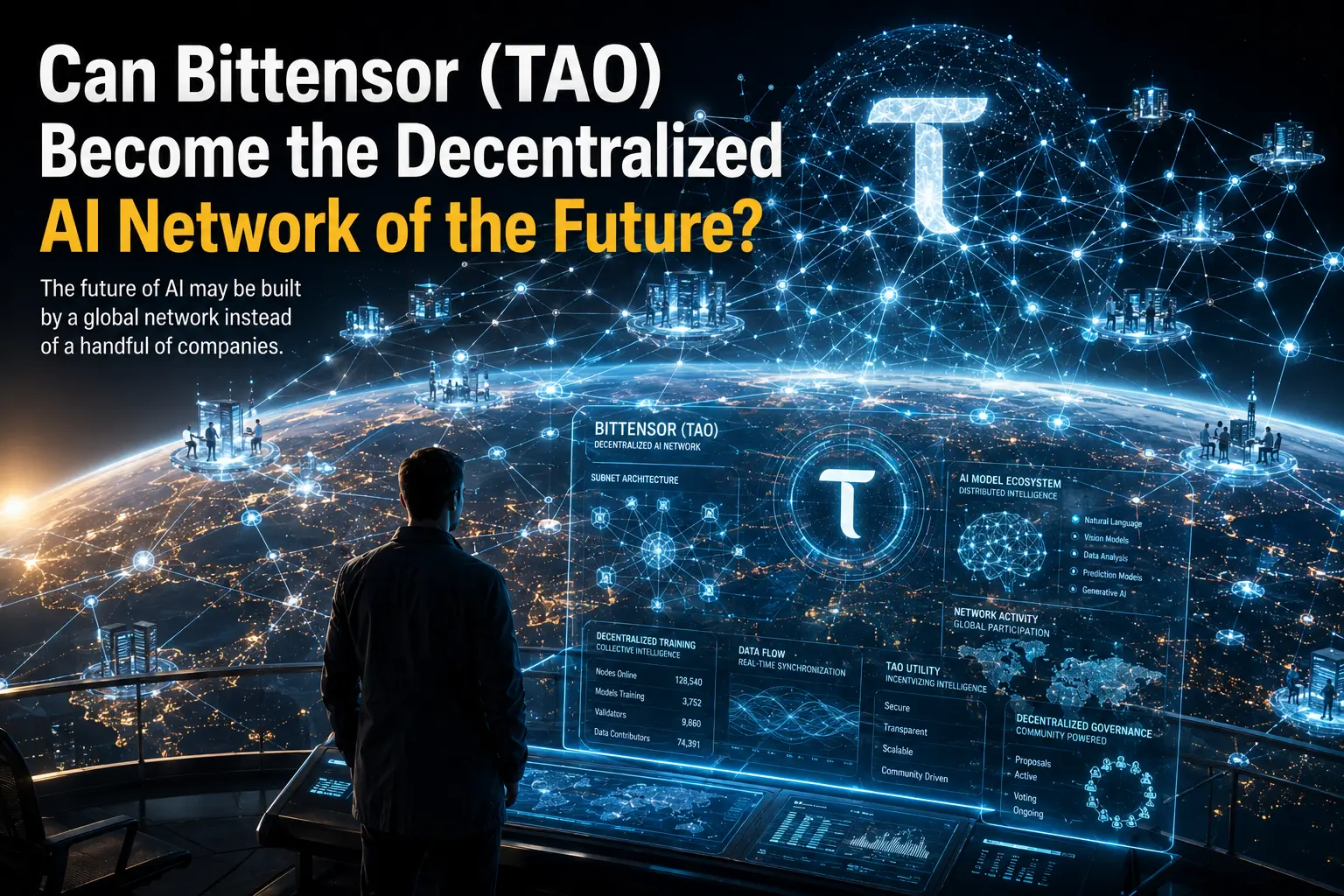
Artificial intelligence is emerging as one of the defining technologies of the 21st century.
From intelligent assistants and image generators to scientific research and software development, AI is beginning to influence how people work, learn, create, and communicate.
Yet despite its transformative potential, today’s AI industry is largely dominated by a relatively small number of technology companies.
Training cutting-edge models requires enormous computing resources, specialized expertise, and access to vast amounts of data. As a result, the development of advanced AI has become increasingly concentrated within a handful of organizations.
This concentration raises important questions.
Who should control artificial intelligence?
Who should benefit economically from creating useful AI models?
Can AI Innovation Stay Open if a Few Companies Control the Technology?
These questions have given rise to a growing movement toward decentralized AI—an approach that seeks to distribute both the development and the rewards of artificial intelligence across a global network rather than concentrating them within a few centralized platforms.
One of the most ambitious projects pursuing this vision is Bittensor (TAO).
Instead of building a single AI application, Bittensor aims to create an open marketplace where AI models compete, collaborate, and earn rewards based on the value they provide to the network.
If successful, it could represent an entirely new way of developing artificial intelligence—one where incentives, rather than centralized control, drive continuous improvement.
The question is no longer simply whether AI will reshape the future.
It is whether decentralized networks can help shape the future of AI itself.
Why AI Has Become One of Crypto’s Biggest Long-Term Narratives
Blockchain technology and artificial intelligence are often discussed separately.
In reality, they may become increasingly interconnected.
Artificial intelligence excels at generating knowledge, solving complex problems, and automating decision-making.
Blockchain, meanwhile, provides mechanisms for decentralized ownership, transparent incentives, and trust without relying on a central authority.
Together, these technologies could enable entirely new digital economies.
This broader convergence is one reason AI has emerged as one of crypto’s most significant long-term narratives. As discussed in The 5 Crypto Narratives That Could Define the Next Decade, blockchain is evolving from a payment technology into a foundational infrastructure for decentralized finance, Web3, privacy, scalability, and artificial intelligence.
Rather than replacing one another, AI and blockchain may solve complementary problems.
AI can create intelligence.
Blockchain can coordinate and reward it.
That combination has attracted growing attention from developers, researchers, and investors seeking technologies that extend beyond traditional cryptocurrency use cases.
Among the projects exploring this intersection, Bittensor has emerged as one of the most distinctive.
What Is Bittensor?
Bittensor is an open-source, decentralized network designed to create a global marketplace for artificial intelligence.
Instead of relying on a single company to develop increasingly capable AI systems, Bittensor enables participants worldwide to contribute machine learning models to a shared network.
Those models compete to produce valuable outputs.
The network then evaluates participant performance and distributes TAO, Bittensor’s native cryptocurrency, as rewards.
In simple terms, Bittensor aims to make useful AI a valuable digital resource.
Instead of mining Bitcoin or validating financial transactions, participants contribute knowledge and computational capabilities.
The better their contributions, the greater their potential rewards.
This transforms AI development into an open market where incentives encourage continuous improvement.
The concept differs significantly from most blockchain projects.
Many cryptocurrencies focus on payments, decentralized finance, or smart contracts.
Bittensor focuses on creating a decentralized economy centered on artificial intelligence itself.
A Different Vision for Artificial Intelligence
Most leading AI systems today operate through centralized platforms.
Organizations develop proprietary models, control access to those models, and determine how they can be used.
While this approach has accelerated technological progress, it also concentrates significant influence within a relatively small number of organizations.
Bittensor proposes a different model.
Instead of one organization building the world’s most capable AI, thousands of independent participants contribute specialized intelligence to a decentralized network.
Economic incentives encourage contributors to improve their models because higher-quality outputs receive greater rewards.
The network evolves through competition, collaboration, and market-based incentives rather than centralized planning.
This approach mirrors one of blockchain’s foundational ideas.
Bitcoin demonstrated that digital money could operate without a central bank.
Ethereum demonstrated that decentralized applications could function without centralized servers controlling every interaction.
Bittensor extends that philosophy to artificial intelligence by asking whether intelligence itself can become a decentralized network.
Rather than concentrating AI development within a few organizations, it seeks to distribute both participation and rewards across a global community.
Why Decentralized AI Matters
Artificial intelligence is becoming increasingly important across nearly every industry.
Healthcare.
Finance.
Education.
Scientific research.
Software engineering.
Manufacturing.
Media.
As AI capabilities continue advancing, the infrastructure supporting those systems may become just as important as the models themselves.
This raises several long-term questions.
Should access to advanced AI depend primarily on a handful of corporations?
Can researchers around the world contribute meaningfully without joining one of those organizations?
How can innovation remain open while still rewarding those who build valuable technology?
Decentralized AI attempts to address these challenges by creating an environment where participation is not limited to a small number of companies.
Instead, contributors from different countries, organizations, and backgrounds can help improve the network while sharing in its economic incentives.
Supporters argue that this approach could encourage broader innovation by allowing ideas to compete on their quality rather than on the size of the organization behind them.
Whether this vision ultimately succeeds remains uncertain.
However, it reflects one of the broader themes shaping the future of blockchain technology.
As discussed in Is Monad the Next Ethereum? What Investors Should Know: Many next-generation blockchain projects are no longer focused solely on increasing transaction speeds or lowering fees. Increasingly, they are competing to provide the infrastructure for entirely new digital economies.
Bittensor represents that same shift, but in the field of artificial intelligence.
Instead of building better financial infrastructure, it seeks to build infrastructure for decentralized intelligence.
How Bittensor Works
Unlike traditional blockchain networks that primarily process financial transactions, Bittensor is designed to coordinate artificial intelligence.
Instead of asking computers to verify payments or execute smart contracts, the network encourages participants to produce valuable machine intelligence.
In simple terms, Bittensor functions as an open marketplace for AI.
Developers contribute machine learning models to the network.
Those models perform specialized tasks, compete with one another, and are continuously evaluated based on the quality of their outputs.
Participants who provide more useful intelligence receive greater rewards in the form of TAO tokens.
This creates an incentive system where contributors are rewarded for making the network smarter over time.
Rather than relying on a single organization to improve an AI model, Bittensor distributes innovation across a global community of developers.
The better the collective intelligence becomes, the stronger the network may become.
Understanding Miners, Validators, and Subnets
At first glance, Bittensor’s architecture can appear complex.
However, breaking the system down into its core components and their functions makes it much easier to understand.
Miners
Despite the name, Bittensor miners do not mine cryptocurrency in the traditional sense.
Instead, they contribute machine learning models or AI services to the network.
These models might specialize in tasks such as:
- Natural language processing
- Image generation
- Code generation
- Data analysis
- Prediction models
- Other AI-related capabilities
Their objective is straightforward:
Produce useful intelligence.
Validators
Validators evaluate the quality of the intelligence produced by miners.
Rather than measuring raw computing power alone, they assess which AI models generate the most valuable outputs.
Models that consistently provide better results receive higher rankings.
Those rankings influence how TAO rewards are distributed across the network.
In effect, validators help ensure that incentives favor quality rather than simply computational resources.
Subnets
One of Bittensor’s most innovative developments is its subnet architecture.
Instead of forcing every participant to compete within a single AI system, Bittensor allows specialized networks—known as subnets—to focus on different areas of artificial intelligence.
For example, one subnet may concentrate on language models.
Another may specialize in image generation.
Others may focus on scientific computation, robotics, data indexing, or entirely new AI applications.
This modular approach allows innovation to occur simultaneously across multiple fields.
Rather than building one massive AI model to solve every problem, Bittensor enables specialized AI ecosystems to evolve independently while remaining connected through a shared network.
Many supporters view this expanding subnet ecosystem as one of Bittensor’s most important long-term strengths.
Why Economic Incentives Matter
Technology alone rarely creates lasting ecosystems.
Successful platforms also require strong incentives that encourage people to contribute over many years.
This principle has shaped many of the world’s largest digital networks.
Bitcoin rewards miners for securing the network.
Ethereum rewards validators for maintaining consensus.
Hyperliquid rewards participation in decentralized financial markets.
Bittensor extends this idea into artificial intelligence.
Instead of rewarding financial transactions, it rewards the creation of useful machine intelligence.
Developers who improve the network can earn TAO tokens based on the value of their contributions.
This creates an economic feedback loop.
Better AI attracts more users.
Greater usage increases demand for valuable intelligence.
Higher demand encourages more developers to participate.
As more contributors join the ecosystem, the network’s overall capabilities may continue improving.
Whether this cycle can scale globally remains uncertain, but its incentive structure is one of Bittensor’s most distinctive innovations.
The TAO Token: Powering the Network
TAO is more than a cryptocurrency.
It serves as the economic engine of the Bittensor ecosystem.
The token is used to reward contributors, align incentives across the network, and support participation in its decentralized governance and validation processes.
As the ecosystem grows, TAO serves as the common medium of exchange among developers, validators, and subnet participants.
Unlike many blockchain projects where tokens exist primarily for speculation, TAO has a clear functional role within the network’s economy.
Its utility is directly connected to the operation and growth of decentralized AI.
This close relationship between network activity and token demand is one reason many investors view TAO differently from traditional cryptocurrencies.
TAO Tokenomics: Why Scarcity Attracts Attention
One aspect of Bittensor that has generated significant interest among long-term investors is its monetary design.
Like Bitcoin, TAO has a fixed maximum supply of 21 million tokens.
No more than 21 million TAO tokens can ever exist.
This hard cap distinguishes Bittensor from blockchain networks that allow unlimited or continually expanding token supplies.
Scarcity alone does not guarantee long-term value.
However, fixed supply can become an important economic characteristic if demand for the network continues growing.
As more developers, validators, institutions, and AI applications participate in Bittensor, competition for a finite number of TAO tokens could increase.
This combination of utility and scarcity has led some observers to describe TAO as combining elements of two influential crypto models:
- Bitcoin’s limited monetary supply.
- Ethereum’s role in supporting a broader digital ecosystem.
Although the comparison is not perfect, it illustrates why Bittensor has attracted attention from investors interested in both blockchain infrastructure and artificial intelligence.
Staking and Network Participation
Beyond rewarding contributors, TAO also supports staking.
Token holders can stake TAO to participate more actively in the network while helping align incentives among participants.
Staking encourages long-term engagement by giving participants a direct interest in the network’s continued success.
Rather than treating TAO solely as a tradable asset, staking reinforces its role within the broader decentralized AI ecosystem.
For many long-term investors, this creates an additional distinction between TAO and speculative cryptocurrencies that offer little utility beyond market trading.
As adoption grows, staking may further strengthen network security, encourage long-term participation, and reduce short-term selling pressure by rewarding continued involvement.
While staking alone cannot determine an asset’s future value, it is designed to align participants with the network’s long-term development.
Why TAO Stands Apart
Many blockchain projects seek to improve payments.
Others focus on decentralized finance, gaming, or scalable smart contracts.
Bittensor occupies a different position.
Its objective is not simply to move digital assets more efficiently.
Its goal is to create an open economic network where artificial intelligence becomes a valuable resource.
If Bitcoin demonstrated that money could be decentralized, and Ethereum demonstrated that applications could be decentralized, Bittensor is attempting to explore whether intelligence can be decentralized as well.
That ambition makes it one of the most distinctive—and closely watched—projects at the intersection of blockchain and artificial intelligence.
Bittensor’s Biggest Strengths
Like every emerging technology, Bittensor faces uncertainty.
Its long-term success is far from guaranteed.
However, several characteristics help explain why it has attracted growing attention within both the cryptocurrency and artificial intelligence communities.
1. It Targets One of the World’s Fastest-Growing Industries
Artificial intelligence is no longer a niche field.
Governments, technology companies, universities, and businesses are investing billions of dollars into AI research and development.
As AI becomes increasingly integrated into everyday life, demand for computing resources, intelligent models, and open innovation platforms may continue expanding.
Instead of focusing on payments or decentralized finance, Bittensor targets the emerging field of decentralized artificial intelligence.
If decentralized AI becomes an important part of that future, projects already building the underlying infrastructure could benefit from being early participants.
2. A Strong Incentive Model
Successful decentralized networks rarely rely on technology alone.
They succeed because participants have clear economic reasons to contribute.
Bitcoin rewards miners for securing the network.
Ethereum rewards validators for maintaining consensus.
Bittensor rewards contributors for producing useful artificial intelligence.
This incentive structure creates a marketplace where intelligence itself becomes economically valuable.
If the network continues to attract developers and researchers, these incentives may encourage continuous innovation without relying on a single organization.
3. Fixed Supply
Unlike many cryptocurrencies with expanding token supplies, TAO has a maximum supply of 21 million tokens.
This hard cap creates predictable scarcity.
Scarcity alone does not create value.
Demand must grow alongside a limited supply.
However, if adoption increases while issuance remains constrained, scarcity may become an important component of TAO’s long-term economics.
This combination of utility and limited supply distinguishes TAO from many newer blockchain projects.
4. Expanding Subnet Ecosystem
Perhaps Bittensor’s greatest long-term opportunity lies in its subnet architecture.
Rather than attempting to build one universal AI model, the network allows specialized ecosystems to emerge around different forms of machine intelligence.
As additional subnets launch, developers can explore increasingly diverse applications while remaining connected to the broader Bittensor economy.
If the ecosystem continues to grow, the network’s value may increasingly come from the collective intelligence of many independent contributors rather than a single application.
Risks and Challenges
Strong technology does not automatically translate into long-term success.
Bittensor still faces significant challenges.
Competition
Artificial intelligence has become one of the world’s most competitive industries.
Major technology companies continue investing heavily in proprietary AI systems.
At the same time, other blockchain projects are exploring decentralized AI from different perspectives.
Bittensor must demonstrate that its decentralized model can compete effectively against both traditional AI companies and emerging crypto projects.
Adoption
Network effects matter.
The value of decentralized platforms often increases as more developers, users, and applications participate.
Bittensor’s long-term success depends on continued growth across its ecosystem.
Without sustained participation, even well-designed incentive systems may struggle to achieve their full potential.
Technical Complexity
Compared with many cryptocurrencies, Bittensor can be difficult for newcomers to understand.
Concepts such as validators, miners, emissions, and subnets create a learning curve that may discourage some new users.
As with many infrastructure projects, broader adoption may depend on making the underlying technology easier to understand and use.
Regulatory Uncertainty
Artificial intelligence and cryptocurrency are each evolving within rapidly changing regulatory environments.
As governments develop new rules for digital assets, AI systems, and data governance, future regulations could influence how decentralized AI networks operate.
While these uncertainties apply broadly across the industry, they remain important considerations for long-term investors.
Can Bittensor Become the Decentralized AI Network of the Future?
This is ultimately the question that attracts many investors.
The answer is neither a simple yes nor a simple no.
Bittensor is attempting something few blockchain projects have attempted before.
It is not merely creating another cryptocurrency.
Its goal is to build an open economic network that coordinates AI through global participation.
If decentralized AI continues to gain importance, Bittensor is already aligned with that long-term trend.
However, success will depend on much more than technological innovation.
The network must continue attracting developers.
Its subnet ecosystem must expand.
Useful AI applications must emerge.
And the broader community must demonstrate that decentralized intelligence can compete alongside centralized systems.
History shows that technological leadership alone rarely guarantees long-term dominance.
Network effects, developer communities, ecosystem growth, and real-world adoption often prove equally important.
As discussed in Is Monad the Next Ethereum? What Investors Should Know, blockchain history has repeatedly shown that building superior technology is only one part of creating a successful ecosystem.
Bittensor faces a similar challenge.
Its long-term opportunity depends not only on what it builds, but also on whether developers, researchers, businesses, and users choose to build with it.
What Investors Should Consider
For long-term investors, Bittensor represents a different type of opportunity.
Rather than focusing primarily on payments, decentralized finance, or smart contracts, it offers exposure to the convergence of two rapidly evolving fields:
- Blockchain
- Artificial intelligence
This combination makes TAO difficult to compare directly with many traditional cryptocurrencies.
Instead, investors may find it more useful to evaluate Bittensor by asking broader questions:
- Can decentralized AI become an important part of the future technology landscape?
- Can economic incentives accelerate AI innovation?
- Can an open global network compete with centralized development models?
- Can Bittensor continue attracting talented developers and researchers?
The answers to these questions will likely play a greater role in TAO’s long-term trajectory than short-term market cycles alone.
For readers interested in evaluating emerging projects more broadly, our guide, How to Identify the Next Big Crypto Before Everyone Else: 7 Signals Smart Investors Watch, explores the characteristics that projects with strong long-term potential often share.
Final Thoughts
Artificial intelligence is expected to become one of the defining technologies of the coming decades.
At the same time, blockchain continues evolving beyond digital payments into a foundation for decentralized applications, financial systems, and digital ownership.
Bittensor sits at the intersection of these two powerful trends.
Its ambition extends beyond creating another cryptocurrency.
It seeks to build an open marketplace where intelligence itself becomes a decentralized, economically valuable resource.
Whether that vision ultimately succeeds remains uncertain.
Competition is intense.
Adoption will take time.
Technical challenges remain.
Yet few blockchain projects are pursuing a mission as ambitious as creating decentralized infrastructure for artificial intelligence.
For that reason alone, Bittensor has become one of the most closely watched projects in the AI crypto sector.
The future of artificial intelligence may not belong exclusively to centralized platforms.
If decentralized intelligence becomes an important part of tomorrow’s digital economy, Bittensor is one of the projects attempting to help build that future.
Frequently Asked Questions (FAQs)
Bittensor combines blockchain technology with artificial intelligence by rewarding participants who contribute valuable machine learning models and AI services. Its native cryptocurrency, TAO, powers the network’s economic incentives.
Yes. TAO has a fixed maximum supply of 21 million tokens, similar to Bitcoin. This hard cap limits the total number of tokens that can ever exist.
Rather than focusing on a single AI application, Bittensor aims to create an open marketplace where AI models compete, collaborate, and earn rewards based on the value they contribute to the network.
Developers, validators, and token holders can participate in different ways, including contributing AI models, validating network outputs, staking TAO, or supporting the ecosystem.
No. Like all emerging technologies, Bittensor involves significant opportunities as well as substantial risks. Investors should conduct their own research and consider their financial circumstances before making investment decisions.