
Crypto Is Still Searching for the Next Great Blockchain
Every crypto market cycle introduces a new generation of blockchain projects promising to solve the limitations of those that came before.
Some aim to process more transactions.
Others focus on reducing fees.
Many attempt to improve scalability, developer experience, or interoperability.
Only a small number, however, go on to reshape the industry.
Ethereum is perhaps the clearest example.
When it launched in 2015, it expanded blockchain technology beyond digital money by introducing programmable smart contracts. Developers could now build decentralized applications, financial services, games, marketplaces, and entire ecosystems on a single blockchain.
That innovation fundamentally changed crypto.
Today, Ethereum remains the largest smart contract platform by ecosystem size, developer activity, decentralized finance, and application diversity.
Its influence extends far beyond its native cryptocurrency.
The virtual machine, development tools, and standards relied upon by thousands of projects all originate from Ethereum.
Yet success has also revealed new challenges for Ethereum.
As adoption increased, so did network congestion.
Transaction fees occasionally became expensive.
Scalability emerged as one of the biggest engineering problems in blockchain.
These limitations inspired a new generation of Layer 1 blockchains seeking to improve performance without sacrificing developer flexibility.
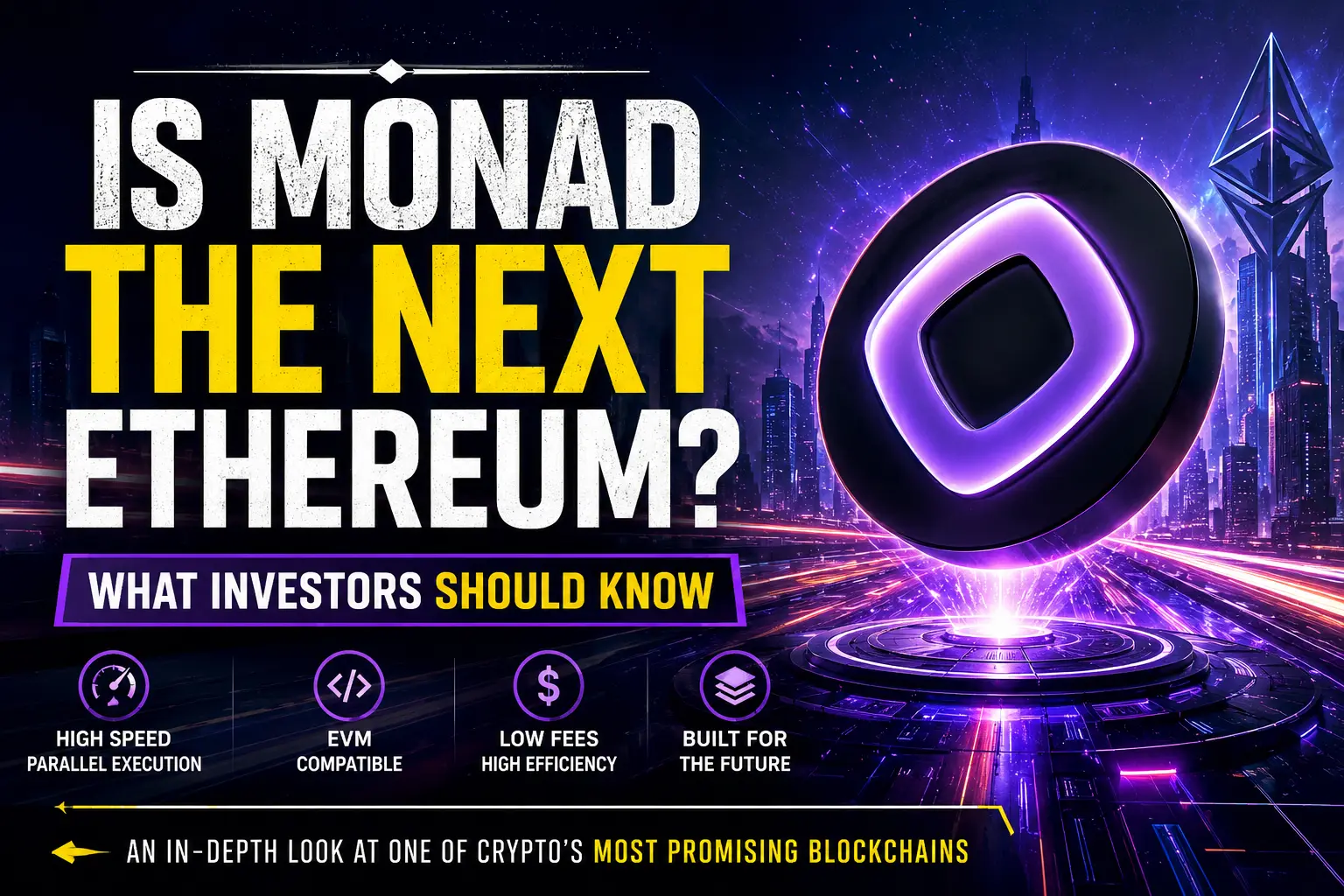
Among the newest entrants attracting significant attention is Monad.
Rather than attempting to reinvent blockchain development, Monad takes a different approach.
It seeks to remain fully compatible with Ethereum while dramatically improving execution speed and efficiency.
That combination has led many developers and investors to ask an increasingly common question:
Could Monad become the next Ethereum?
The answer is more nuanced than a simple Yes or No.
Like every emerging blockchain, Monad combines ambitious technology with meaningful execution risks.
Understanding both sides is essential before concluding.
Why Ethereum Became the Smart Contract Standard
Understanding why Ethereum became the foundation of the blockchain industry helps explain why Monad has attracted so much interest.
Before Ethereum, blockchain networks were primarily designed to transfer digital assets.
Ethereum introduced something much broader:
A decentralized computer capable of running programmable applications.
Instead of creating a separate blockchain for every idea, developers could build directly on Ethereum using smart contracts.
This dramatically lowered the barrier to innovation.
Over time, Ethereum became home to thousands of decentralized applications spanning areas such as:
- Decentralized finance (DeFi)
- Non-fungible tokens (NFTs)
- Gaming
- Stablecoins
- Decentralized autonomous organizations (DAOs)
- Tokenized assets
- Web3 infrastructure
Perhaps even more important than its technology was the ecosystem that formed around it.
Developers created tools.
Businesses built products.
Investors provided liquidity.
Users adopted applications.
Each new participant increased the value of the overall network.
This phenomenon is known as a network effect, where evolution reinforces itself by attracting additional users, developers, and activity.
Today, Ethereum benefits from one of the strongest network effects in the blockchain industry.
That advantage cannot easily be replicated.
It explains why newer blockchains rarely compete on ecosystem size alone.
Instead, they typically attempt to solve specific weaknesses while maintaining compatibility with the tools developers already know.
This is precisely the path Monad has chosen.
What Is Monad?
Monad is a next-generation Layer 1 blockchain designed to improve blockchain performance while remaining fully compatible with Ethereum’s existing ecosystem.
Instead of asking developers to learn an entirely new programming language or rebuild their applications from scratch, Monad supports the Ethereum Virtual Machine (EVM).
This means many applications designed for Ethereum can be deployed on Monad with little or no modification.
For developers, that greatly reduces the friction involved in exploring a new blockchain.
Rather than abandoning familiar tools, they can continue using many of the same development frameworks, smart contracts, and workflows.
A defining feature of Monad is full compatibility with the existing Ethereum ecosystem.
However, compatibility alone would not distinguish it from dozens of other Ethereum-compatible blockchains.
Monad was built to deliver substantially higher blockchain performance.
Its architecture is designed to process transactions more efficiently while maintaining the programming environment that has made Ethereum the industry’s dominant development platform.
The project focuses on several core goals:
- High transaction throughput
- Low transaction costs
- Fast confirmation times
- Full EVM compatibility
- Improved efficiency for decentralized applications
These enhancements could improve the performance and user experience of decentralized finance platforms, blockchain games, consumer applications, and other large-scale Web3 services.
Instead of introducing a new programming model, Monad enhances Ethereum’s speed and scalability.
What Makes Monad Different?
Many blockchain projects advertise faster transaction speeds.
Monad’s approach goes beyond increasing raw performance numbers.
Its design introduces architectural changes intended to improve how transactions are processed internally.
Several innovations distinguish the project.
Parallel Execution
Traditional blockchains generally process transactions sequentially.
One transaction finishes before the next begins.
While this approach simplifies execution, it can limit overall throughput.
Monad introduces parallel execution, allowing many independent transactions to be processed simultaneously whenever possible.
An easy analogy is a supermarket.
Imagine every customer being forced to wait in a single checkout line.
Even if several cashiers are available, only one customer can complete payment at a time.
Parallel execution instead opens multiple checkout lanes.
Independent transactions no longer need to wait unnecessarily.
The result is greater efficiency without requiring users to change how they interact with the blockchain.
Optimistic Execution
Monad also introduces a technique known as optimistic execution.
Rather than assuming universal transaction conflicts, the system optimistically processes transactions independently before resolving any actual conflicts.
Potential conflicts are checked afterward rather than preventing parallel processing from occurring in the first place.
This approach helps maximize efficiency during periods of high activity while preserving network integrity.
MonadDB
Performance is influenced not only by transaction execution but also by how blockchain data is stored and retrieved.
Monad incorporates its own database architecture, commonly referred to as MonadDB, which is designed to improve data access and reduce processing bottlenecks.
Although database architecture receives far less public attention than transaction speed, efficient data management plays an important role in maintaining overall network performance.
Lower Fees Through Greater Efficiency
High transaction fees have long been one of the most common criticisms of blockchain networks during periods of heavy demand.
Monad’s architecture aims to reduce those costs by improving the efficiency with which the network processes activity.
If successful, lower fees could make decentralized applications more practical for everyday use.
This is particularly important for consumer-facing applications where frequent transactions must remain inexpensive.
Developers often prioritize user experience as much as raw technical capability.
A blockchain capable of combining low fees with Ethereum compatibility may therefore become attractive to both builders and end users.
Familiar Tools for Ethereum Developers
Perhaps Monad’s greatest advantage is not that it introduces entirely new technology.
It attempts to improve performance without forcing developers to abandon the ecosystem they already know.
For years, Ethereum has accumulated one of the largest developer communities in blockchain.
Programming languages.
Development frameworks.
Security tools.
Smart contract libraries.
Educational resources.
Testing environments.
By maintaining EVM compatibility, Monad aims to make it easier for developers to transition their existing skills and tools into its ecosystem.
That dramatically lowers one of the biggest barriers facing every new blockchain:
Convincing developers to start over.
Instead of asking builders to learn an entirely different environment, Monad offers a familiar foundation with the promise of higher performance.
Whether that promise ultimately translates into widespread adoption remains one of the most important questions for investors.
As discussed in our pillar guide, How to Identify the Next Big Crypto Before Everyone Else: 7 Signals Smart Investors Watch, strong technology alone is rarely enough. Long-term success also depends on developer activity, ecosystem growth, network effects, and sustained real-world adoption.
Monad vs. Ethereum: Similar Foundation, Different Goals
At first glance, comparing Monad to Ethereum may seem unfair.
Ethereum has spent nearly a decade building the largest smart contract ecosystem in blockchain. It secures hundreds of billions of dollars in digital assets, supports thousands of decentralized applications, and has one of the largest developer communities in the industry.
Monad, by contrast, is still in the early stages of ecosystem development.
Yet the comparison remains relevant because Monad is not trying to replace Ethereum’s programming model.
Instead, it attempts to improve the experience of using it.
The broader blockchain landscape is also expanding beyond faster smart contract platforms. While Monad is focused on scaling Ethereum-compatible applications, other emerging projects are tackling entirely different infrastructure challenges, including decentralized artificial intelligence. We explore this growing sector in Can Bittensor (TAO): Become the Decentralized AI Network of the Future? What Investors Should Know.
The philosophy is straightforward:
Keep the tools developers already trust while making the underlying blockchain significantly faster and more efficient.
The following comparison highlights their different strengths.
| Feature | Ethereum | Monad |
|---|---|---|
| Primary Focus | Decentralized smart contract platform | High-performance EVM-compatible Layer 1 |
| Smart Contract Compatibility | Native EVM | Fully EVM Compatible |
| Transaction Processing | Sequential execution | Parallel execution architecture |
| Network Maturity | Largest blockchain ecosystem | Early-stage ecosystem |
| Developer Community | Extensive and well-established | Growing |
| Decentralized Applications | Thousands | Emerging |
| Transaction Fees | It can become expensive during congestion | Designed for consistently low fees |
| Long-Term Strength | Network effects and adoption | Performance and scalability |
The comparison illustrates an important point.
Monad is not attempting to compete with Ethereum by introducing an entirely new programming language or abandoning the EVM.
Instead, it seeks to improve one of the industry’s most widely adopted development environments.
That strategy may significantly reduce adoption barriers for developers already familiar with Ethereum.
Can Monad Really Become the Next Ethereum?
The phrase “next Ethereum” appears frequently whenever a promising Layer 1 blockchain emerges.
History shows that most projects given this label have not achieved Ethereum’s scale.
That does not necessarily reflect poor technology.
It reflects how difficult it is to build network effects.
Technology alone rarely determines long-term winners.
The strongest blockchain ecosystems combine multiple advantages:
- Excellent technology
- Active developers
- Growing applications
- Expanding liquidity
- Strong communities
- Business adoption
- Long-term execution
Ethereum possesses all of these.
Monad has demonstrated impressive technical ambition, but its long-term success will depend on whether its ecosystem grows beyond the underlying blockchain itself.
Developers must continue building.
Applications must attract users.
Liquidity must expand.
Businesses must integrate the network.
Without those elements, even exceptional engineering may struggle to achieve widespread adoption.
For that reason, a better question may not be:
“Can Monad replace Ethereum?“
Instead, investors might ask:
“Can Monad become one of the next major blockchain ecosystems alongside Ethereum?“
That distinction creates a far more realistic framework for evaluating its long-term potential.
Why Developers Are Paying Attention
Although investors often focus on price, developers frequently determine which blockchain ecosystems grow over time.
Applications do not appear automatically.
They are built.
Monad’s technical design addresses several pain points developers have encountered across previous blockchain networks.
These include:
- Greater scalability for high-demand applications
- Lower transaction costs for users
- Familiar Ethereum development tools
- Reduced migration complexity
- Improved execution efficiency
Collectively, these features may encourage experimentation by developers seeking better performance without abandoning the Ethereum ecosystem.
Developer adoption is especially important because blockchain growth often follows a predictable cycle:
Developers create applications.
Applications attract users.
Users increase network activity.
Growing activity attracts businesses.
Businesses attract additional developers.
The cycle then reinforces itself.
This is one of the most powerful competitive advantages in blockchain.
The Biggest Challenges Monad Must Overcome
Every emerging blockchain faces obstacles.
Monad is no exception.
While its technology has generated excitement, investors should also consider several important challenges.
Network Effects Cannot Be Copied.
Ethereum’s greatest advantage is not simply its technology.
It is the ecosystem that has formed around it.
Thousands of developers.
Thousands of decentralized applications.
Billions of dollars in liquidity.
Years of community growth.
These advantages cannot be recreated overnight.
Monad may achieve technical compatibility, but building the network effects of Ethereum is much harder.
Competition Is Intensifying
Monad is entering one of the most competitive sectors in blockchain.
Numerous Layer 1 ecosystems are already competing for developers, capital, and users.
Each offers its own vision of scalability and performance.
Success will depend not only on technical execution but also on attracting sustained ecosystem growth over many years.
Performance Alone Does Not Guarantee Adoption
Blockchain history contains numerous examples of technically impressive projects that struggled to build meaningful ecosystems.
Users ultimately choose applications.
Developers choose platforms.
Businesses choose networks.
Performance helps.
Adoption determines long-term success.
Tokenomics Matter
Many factors contribute to the long-term value of a blockchain beyond technology.
Investors should also understand how the native token functions within the ecosystem.
Questions worth asking include:
- Does the token provide meaningful utility?
- Is demand tied to network activity?
- Are incentives aligned between users, developers, and validators?
- Is token issuance sustainable over the long term?
Unlike Bitcoin, which has a fixed supply, Monad does not currently have a hard supply cap based on publicly available information.
That does not automatically make its tokenomics weak.
Ethereum likewise operates without a fixed maximum supply while still maintaining one of the largest crypto ecosystems.
Ultimately, long-term value depends on the balance between issuance, demand, network usage, and overall economic design—not on scarcity alone.
What Long-Term Investors Should Watch
For investors evaluating Monad over the coming years, price alone is unlikely to provide the clearest picture.
Instead, several indicators may prove more meaningful.
These include:
✅ Growth in active developers
✅ Expansion of decentralized applications
✅ Total value secured within the ecosystem
✅ User adoption
✅ Transaction activity
✅ Partnerships
✅ Ecosystem funding
✅ Community growth
Together, these indicators often reveal whether a blockchain ecosystem is becoming more valuable regardless of short-term market volatility.
Monad also aligns with one of crypto’s most significant structural trends: next-generation blockchain infrastructure. Rather than focusing solely on short-term market cycles, many investors are paying closer attention to the long-term themes shaping the industry. We explore these broader developments in The 5 Crypto Narratives That Could Define the Next Decade.
Final Perspective
Every crypto cycle introduces a new group of projects hoping to become the next major blockchain platform.
Very few succeed.
Ethereum earned its position through years of continuous development, relentless innovation, and one of the strongest network effects in technology.
Monad is still in the early stages of that journey.
Its combination of full EVM compatibility, parallel execution, and performance-focused architecture makes it one of the more technically interesting Layer 1 projects currently under development.
Whether those innovations translate into widespread adoption remains an open question.
History suggests that infrastructure projects capable of attracting developers, applications, liquidity, and businesses often create the strongest long-term ecosystems.
Monad’s future will ultimately depend on far more than transaction speed.
It will depend on execution.
Developer adoption.
Community growth.
Real-world utility.
And its ability to build lasting network effects.
For investors, the more important question is not whether Monad will replace Ethereum.
It is whether Monad can become another foundational blockchain supporting the next generation of decentralized applications.
If blockchain adoption continues to expand over the next decade, multiple ecosystems may thrive by solving different challenges rather than competing for a single winner.
That possibility makes Monad a project worth watching—not because its future is guaranteed, but because it represents one of the most ambitious attempts in industry to combine Ethereum compatibility with next-generation performance.
Readers interested in how different blockchain ecosystems may complement one another over the long term may also enjoy The Holy Trinity of Crypto: Why Zcash, Hyperliquid, and Near Could Shape the Future of Crypto Through 2035, which explores three infrastructure-focused projects addressing privacy, decentralized finance, and AI-powered Web3 from different perspectives.
Frequently Asked Questions (FAQs)
Not necessarily. Monad is designed to be fully compatible with Ethereum while improving performance through innovations such as parallel transaction execution. Its objective is to complement Ethereum by delivering greater scalability in a familiar development environment.
Monad pairs full EVM compatibility with a performance-oriented architecture built around parallel execution, optimistic execution, and MonadDB. Together, these technologies aim to increase throughput while maintaining compatibility with existing Ethereum tools.
Publicly available information indicates that Monad does not currently have a fixed hard cap like Bitcoin. Its long-term token value will depend on overall tokenomics, network adoption, and ecosystem growth rather than scarcity alone.
Developers can potentially migrate Ethereum applications with minimal changes while benefiting from lower fees and higher performance. It reduces development friction and may encourage faster ecosystem growth.
It has the technical ambition to compete with leading Layer 1 networks, but long-term success will depend on adoption, developer activity, ecosystem growth, and consistent execution—not technology alone.