

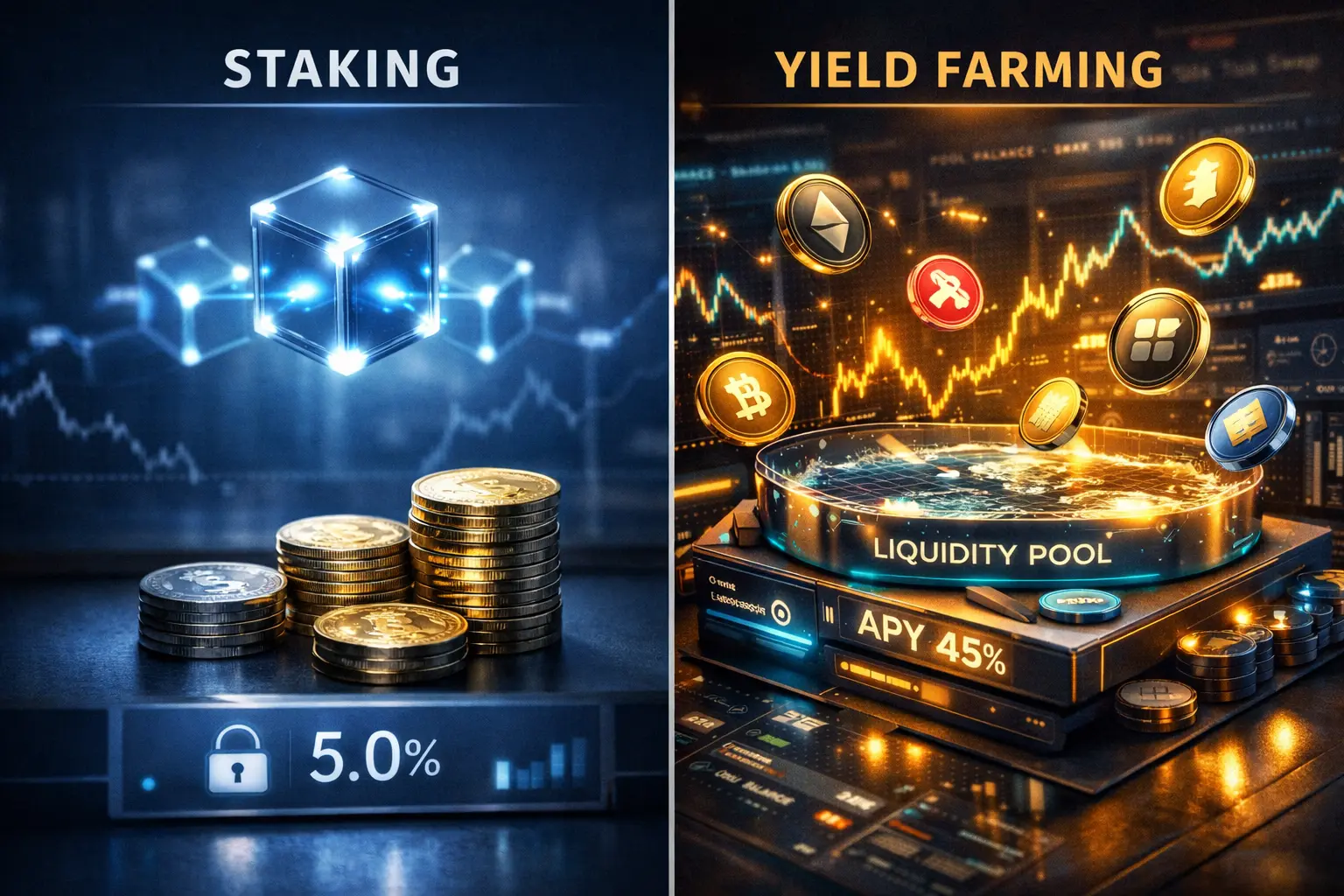
Crypto staking and yield farming are two of the most popular ways to earn passive income in crypto—but they carry very different levels of risk.
Staking offers more stable and predictable returns, while yield farming can generate higher rewards with greater volatility.
If you’re comparing crypto staking vs yield farming, the key question is simple: which one is actually safer, and why?
For a broader perspective on crypto wealth formation, see this crypto wealth breakdown guide, which explains why outcomes differ so significantly between investors.
Which is safer: staking or yield farming?
Staking is generally safer than yield farming because it involves lower complexity, fewer risk factors, and more predictable returns. Yield farming can offer higher returns but comes with greater exposure to volatility, token incentives, and smart contract risks.
These differences are part of a broader system of crypto passive income Risks that affect all yield-generating strategies in the market.
The Core Difference Most Investors Miss
Crypto staking and yield farming are both labeled as passive income—but their underlying risk models are fundamentally different.
Staking focuses on supporting blockchain networks in exchange for rewards. Yield farming relies on liquidity provision and incentive systems that can change rapidly.
Most investors compare returns. The more important comparison is structure—and how that structure affects risk.
What Is Crypto Staking?
Staking involves locking crypto assets into a blockchain network to help validate transactions and maintain security.
In return, users receive rewards, typically paid in the same token.
Key characteristics:
- Lower complexity
- Predictable reward structure
- Network-based yield
- Reduced exposure to external variables
Staking depends largely on how well the blockchain is built and maintained.
What Is Yield Farming?
Yield farming involves providing liquidity to decentralized finance (DeFi) protocols in exchange for rewards.
These rewards usually come from a combination of trading fees and token incentives.
Key characteristics:
- Higher complexity
- Variable and unstable returns
- Multiple layers of risk
- Incentive-driven rewards
For example, providing liquidity to an ETH/USDC pool can generate fees and rewards, but if ETH rises sharply, impermanent loss may offset those gains.
For a deeper breakdown, see this DeFi yield farming risk vs reward guide explaining how these systems actually generate returns.
Risk Comparison: Staking vs Yield Farming
Smart Contract Risk
Both strategies rely on smart contracts.
- Staking: simpler contract structure
- Yield farming: complex interactions across multiple protocols
More complexity increases the likelihood of vulnerabilities.
Impermanent Loss
- Applies only to yield farming
- It may diminish total returns despite ongoing reward generation.
Staking does not have this risk.
Volatility Risk
- Staking: moderate exposure (single asset)
- Yield farming: higher exposure (paired assets + incentives)
Token Emission Risk
- Staking: typically lower inflation pressure
- Yield farming: often dependent on token incentives
High returns often come from printing new tokens instead of earning real income.
Liquidity Risk
- Staking: predictable lock-up periods
- Yield farming: variable liquidity and exit conditions
| Feature | Staking | Yield Farming |
|---|---|---|
| Risk Level | Low–Medium | Medium–High |
| Complexity | Low | High |
| Return Stability | High | Low |
| Yield Source | Network rewards | Fees + token emissions |
| Best For | Long-term holders | Advanced users |
Which Strategy Is Safer?
Staking is generally safer due to its simpler structure and more predictable reward system.
Why staking is safer:
- Fewer moving parts
- Lower exposure to external risks
- No impermanent loss
- More stable reward model
Why is yield farming riskier?
- Multiple layers of risk
- Dependence on token incentives
- Market-sensitive returns
- Potential for rapid yield decline
The Structural Insight That Matters
Safety in crypto passive income depends on structural design rather than yield levels.
- Staking = protocol-based rewards
- Yield farming = incentive-driven liquidity systems.
Higher returns typically reflect higher structural risk.
When Yield Farming Makes Sense
Yield farming may be suitable if:
- You understand DeFi mechanisms
- You actively manage positions
- You can tolerate volatility
- You diversify across protocols.
When Staking Is the Better Choice
Staking is more suitable if:
- You prefer lower-risk exposure
- You want a predictable income
- You are a long-term holder
- You want minimal management.
Frequently Asked Questions (FAQs)
Is staking safer than yield farming?
Yes. Staking is generally safer due to lower complexity and fewer risk factors.
Can you lose money in staking?
Yes, mainly due to token price declines rather than structural risks.
Why does yield farming offer higher APY?
Many rewards come from token incentives instead of real income.
Which is better for beginners?
Staking is typically more suitable due to simplicity and lower risk.